Get Full Government Meeting Transcripts, Videos, & Alerts Forever!
Get email alerts on the Public Art Handbook topic
No spam. Unsubscribe anytime.
Commission reviews draft public-art handbook, requests edits and sets October meeting
Summary
Commissioners provided detailed edits to a draft public-art policy handbook on Sept. 29 — seeking clearer RFQ/RFP language, narrower mural review rules (public property vs private), and maintenance/attribution guidance — and agreed to meet Oct. 27 to review a revised draft.
Community Development Director Erica Ramirez presented a draft public-art policy handbook to the Public Art Commission on Sept. 29 and requested feedback; commissioners provided several substantive edits and asked staff to return with a revised final draft at a special meeting on Oct. 27.
Ramirez said the draft handbook synthesizes code requirements and ad hoc committee recommendations and that some redundancy and formatting issues remain to be resolved. She highlighted new handbook topics that are not currently in code: artist selection criteria and processes, accession and deaccession procedures, and guidance for murals.
Public comment included a three-minute statement from Rick Schneider of the South Pasadena Preservation Foundation urging speedy adoption and offering support for a public-art display at the Adobe Flores historic house.
Commission discussion covered multiple, specific points. Commissioner Seal asked that staff supply the commission with building valuation figures used to calculate development fees so the commission can see the public-art funding context for each qualifying project. Seal also recommended separating RFQ (qualifications) steps from RFP (project-specific proposals) language in the handbook and removing a requirement calling for broad community-engagement exercises for every artist selection or mural — several commissioners said broad public-engagement requirements could create delay and are unnecessary for privately funded murals that are not required by the public-art ordinance.
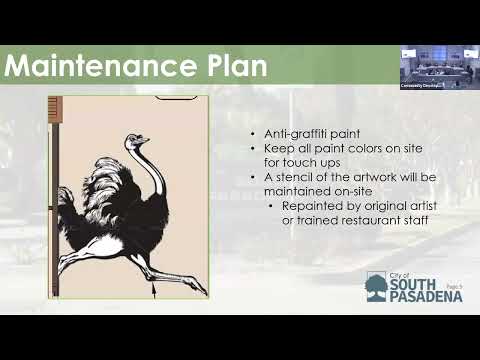
Commissioners also asked the handbook to clarify maintenance responsibilities and attribution: if a private developer creates required on-site art, the property owner remains responsible for maintenance; if the city purchases art with the public-art fund, the city is responsible for care; plaques or other attribution should be required to credit artists. Commissioners asked staff to clarify utility-box ownership and maintenance processes where boxes are not city property.
Commissioner discussion also noted seed funding recently provided to the public-art fund: commissioners reported $9,500 in discretionary contributions from councilmembers (donor names were identified at the meeting) to supplement the fund so the commission could begin small projects such as painted crosswalks, pending public-works review.
Ramirez proposed holding a special meeting in October to receive a revised handbook; commissioners agreed. The commission voted to schedule the Oct. 27 special meeting and asked staff to distribute draft edits two to three weeks ahead of that date so members could comment. Roll call recorded ayes from Commissioner Seal, Commissioner Burke, Commissioner Piazza and Vice Chair Velasco; motion carries.
Ending: Staff will incorporate the commission’s edits (RFQ/RFP clarity, mural scope definition, maintenance and attribution language) and circulate a revised handbook ahead of the Oct. 27 special meeting for final review.