
Commission recommends zoning text amendment to permit information-technology facilities in M‑1 industrial zones
Get AI-powered insights, summaries, and transcripts
Subscribe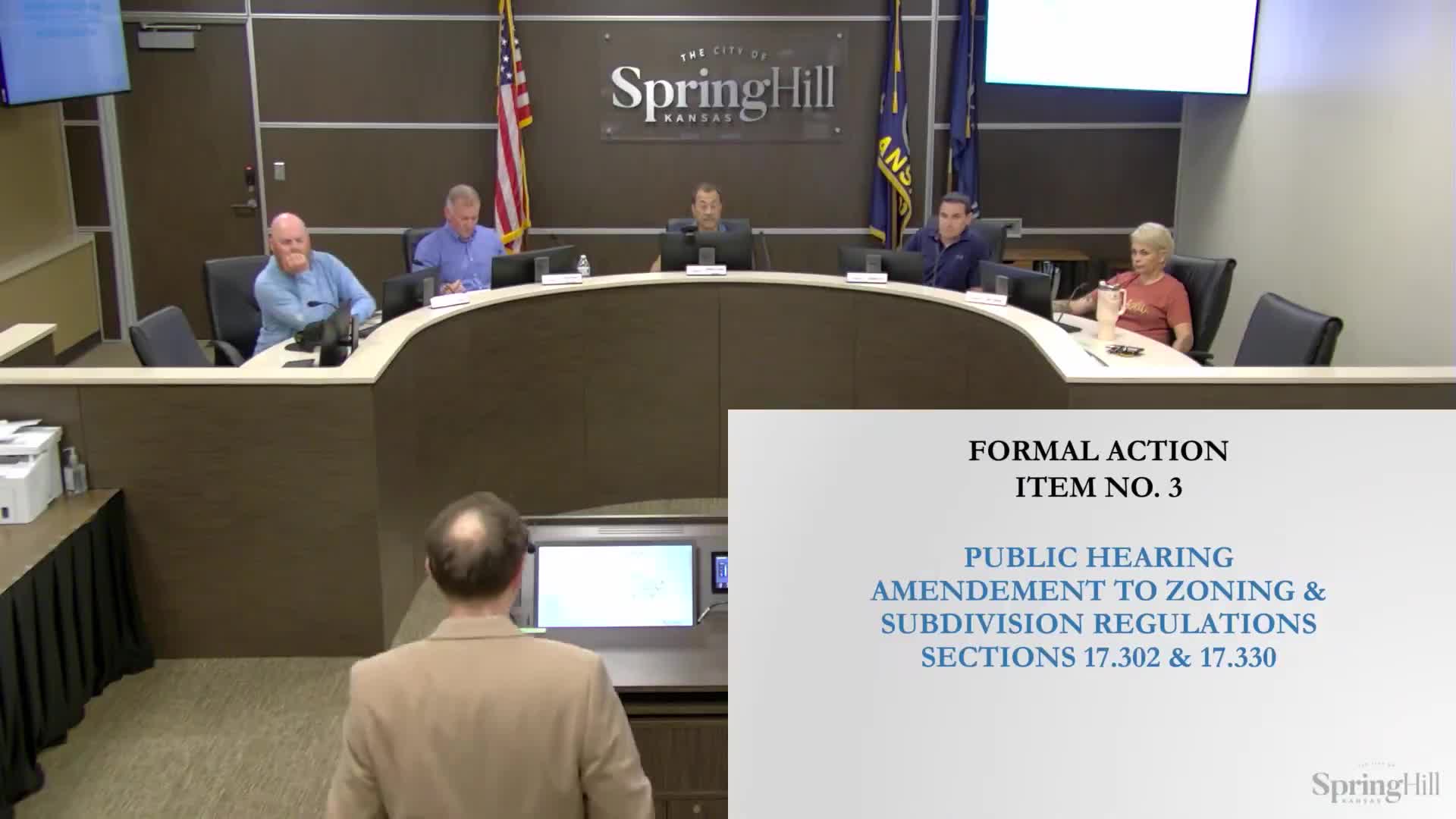
Summary
The commission voted 5-0 to recommend the governing body approve a text amendment adding a definition for "information technology facility" and listing it as a permitted use in M‑1 industrial zoning; members discussed infrastructure, noise and utility impacts.
The Spring Hill City Planning Commission unanimously recommended approval of a zoning text amendment to add a definition for "information technology facility" and to permit that use in M‑1 industrial districts.
Planning staff described the amendment as a proactive change to the Spring Hill Unified Zoning and Subdivision regulations that would allow information technology centers — occasionally described in the discussion as "data centers" — as a permitted use in M‑1 rather than requiring conditional use approval. "This change is adding in the capability of putting in data centers...in our M‑1 industrial zoning districts, just as a permitted use rather than a conditional use permit," a planning staff member said. Staff said the amendment includes a new definition (listed in the draft as Section 17.302.b.70) and intended to be broadly inclusive so future developers would not routinely seek variances for marginal cases.
Commission discussion raised infrastructure and neighborhood concerns. One commissioner who had researched the topic said that high-performance AI-focused data centers can require extremely large quantities of electricity and sometimes water for cooling, and that noise and continuous low-level vibration reported near some facilities have caused community complaints elsewhere. "The AI data center boom is a job creation bust," the commissioner said while reading titles from national reporting to illustrate tradeoffs; the speaker noted such facilities may bring construction jobs but relatively few permanent operations jobs. Commissioners also discussed that some modern centers can be sited remotely from population centers and that locating them near residential neighborhoods can raise concerns about noise and utility impacts. Planning staff agreed the amendment is not in response to any specific pending application but is intended to give the city a clear code framework should developers propose such projects.
A motion to recommend approval to the governing body — amending Sections 17.302 and 17.33 of the Spring Hill Unified Zoning and Subdivision regulations, third edition — passed 5-0. The recommendation will be forwarded to the city governing body for final action; the meeting record shows no final ordinance adoption occurred at the planning commission hearing.
The staff packet accompanying the amendment included the draft definition and the proposed code changes. Commissioners asked that staff provide the national reporting and articles referenced during the discussion to commissioners and councilmembers for background review. No specific mitigation measures, performance standards (e.g., noise or utility thresholds), or special permitting conditions were adopted by the commission at this stage; those would be considered if an applicant sought site-specific approvals.