Get Full Government Meeting Transcripts, Videos, & Alerts Forever!
Get email alerts on the Healthcare Facilities Lighting Retrofit topic
No spam. Unsubscribe anytime.
HCAI issues streamlined guidance for LED retrofits after California ban on fluorescent lamps
Summary
HCAI presenter Jamie Schneck outlined a streamlined process for hospitals and licensed health facilities to convert fluorescent fixtures to LED, centered on OSHPD Form 102 and FREER manual exemptions after Assembly Bill 2208 restricted sales of fluorescent lamps beginning Jan. 1, 2025.
Jamie Schneck, senior electrical engineer and electrical technical lead in the Department of Health Care Access and Information (HCAI) OSHPD building standards unit, told a statewide webinar that HCAI will evaluate many LED lighting retrofits as excluded work under its FREER manual if proponents submit an OSHPD Form 102 with the required technical documentation.
The guidance responds to Assembly Bill 2208, which Schneck said “essentially, prohibits the sale of all compact fluorescent lamps and linear fluorescent tubes, which started 01/01/2025.” HCAI staff told attendees the agency oversees more than 1,500 facilities and expects a large volume of retrofits as hospitals shift away from fluorescent lamps.
Why it matters: the law removes a widely used source for replacement fluorescent lamps and creates a practical deadline for health-care facilities to convert aging lighting systems. Schneck said HCAI wants to “simplify this process for everyone” and that the agency has updated its FREER manual and created line items to allow many LED retrofits to be handled as excluded work rather than full projects.
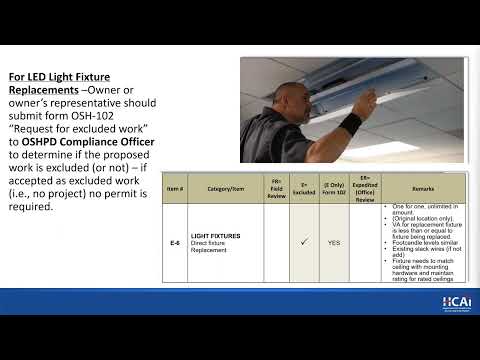
Under the process Schneck described, owners or contractors who seek excluded-work treatment must submit OSHPD Form 102 to the facility’s regional compliance officer along with a technical package. Required materials include a key plan showing where fixtures will be changed; a fixture matrix listing each fixture, quantity, existing watts and lumens, proposed LED watts and delivered lumens, and watts saved; manufacturer spec sheets and installation instructions for each retrofit kit or new fixture; and a proposed schedule of work. Schneck said the FREER manual was “just reissued again, last month,” and advised users to confirm they have the latest version.
Schneck summarized objective criteria that typically qualify a replacement as excluded work for direct fixture replacements (FREER line items e6, e8, e9, e10): a 1-for-1 replacement in the same location; new fixture weight equal to or less than the removed fixture; equal or greater maintained footcandle levels; equal or reduced power consumption; and equal or lower BUG (backlight, uplight, glare) ratings for exterior fixtures. He noted that relocated fixtures or changes that affect ceiling ratings or support will trigger a submitted project and field or office review.
For interior retrofits that reuse existing housings, Schneck outlined three UL retrofit kit types attendees should identify in the submission: Type A (lamp-within-ballast approach that leaves the ballast in place), Type B (ballast removal with alternate drivers), and Type C (new driver or ballast bypass). He emphasized that retrofit kits should be UL listed and that manufacturers’ listing and installation instructions should be included with Form 102.
On ceiling and support requirements, Schneck said contractors should confirm ceiling ratings and fixture support prior to installation. He gave an installation guidance example from HCAI: downlights under 10 pounds may be supported with one slack wire secured to a ceiling grid; fixtures up to 56 pounds typically require two slack wires and grid-secured support. If field staff or contractors observe that a replacement or retrofit does not maintain the existing ceiling rating, the condition should be reported and treated as discovered noncompliant under the remodel guidance (Advisory Guide 14).
Schneck also addressed common questions raised by attendees: footcandle measurements before and after installation are not required if the submitted fixture matrix demonstrates equivalent or greater delivered lumens fixture-by-fixture; the agency will expect UL-listing documentation; excluded-work submissions do not require a licensed design professional or stamped drawings; owners must notify the compliance officer when excluded-work construction begins and when it finishes; and certain control upgrades or “exotic” lighting-control installations may trigger a full project submittal rather than excluded work.
He said the agency does not plan to apply Title 24 energy-code calculations to excluded retrofits, aside from ensuring exterior BUG ratings are maintained. On costs and other permit streams, Schneck said that the separate SB-related permit threshold referenced by attendees does not change excluded-work evaluation and that many LED retrofit packages may exceed $50,000 while still qualifying as excluded work; he advised submitters to follow the Form 102 documentation requirements rather than rely on cost thresholds.
HCAI signaled it will continue to treat preexisting in-progress or permitted LED conversions as projects when they were filed before this guidance took effect, but expects most new retrofits to be handled as excluded work if they meet the listed criteria. Schneck said the agency has briefed senior, office and field staff and that regional compliance officers will perform initial reviews and communicate what is acceptable to the submitter.
The webinar included a question-and-answer session. Schneck told participants to confirm generator compatibility for LED products that may be installed on essential or emergency circuits and to call or email HCAI’s regs unit (regsunit@hcai.ca.gov) for rulings on ambiguous cases. The recording, the FREER guidance and answers compiled from the webinar will be posted on HCAI’s website, Schneck said.
The presentation concluded with HCAI staff advising facilities to prepare an OSHPD Form 102 package that includes a key plan, fixture matrix, spec sheets, manufacturer instructions, and schedule; submit those materials to the regional compliance officer; notify HCAI when the work begins and ends; and expect field staff to flag discovered nonconforming conditions for remediation.
Availability and next steps: Schneck said HCAI will publish a written question-and-answer matrix derived from the webinar and that the slide handout and recording will be posted on the HCAI website in the coming weeks. Questions or requests for rulings can be sent to regsunit@hcai.ca.gov.