
Commission committee advances first readings on building-code changes for school storm shelters and ‘middle‑scale’ housing
Get AI-powered insights, summaries, and transcripts
Subscribe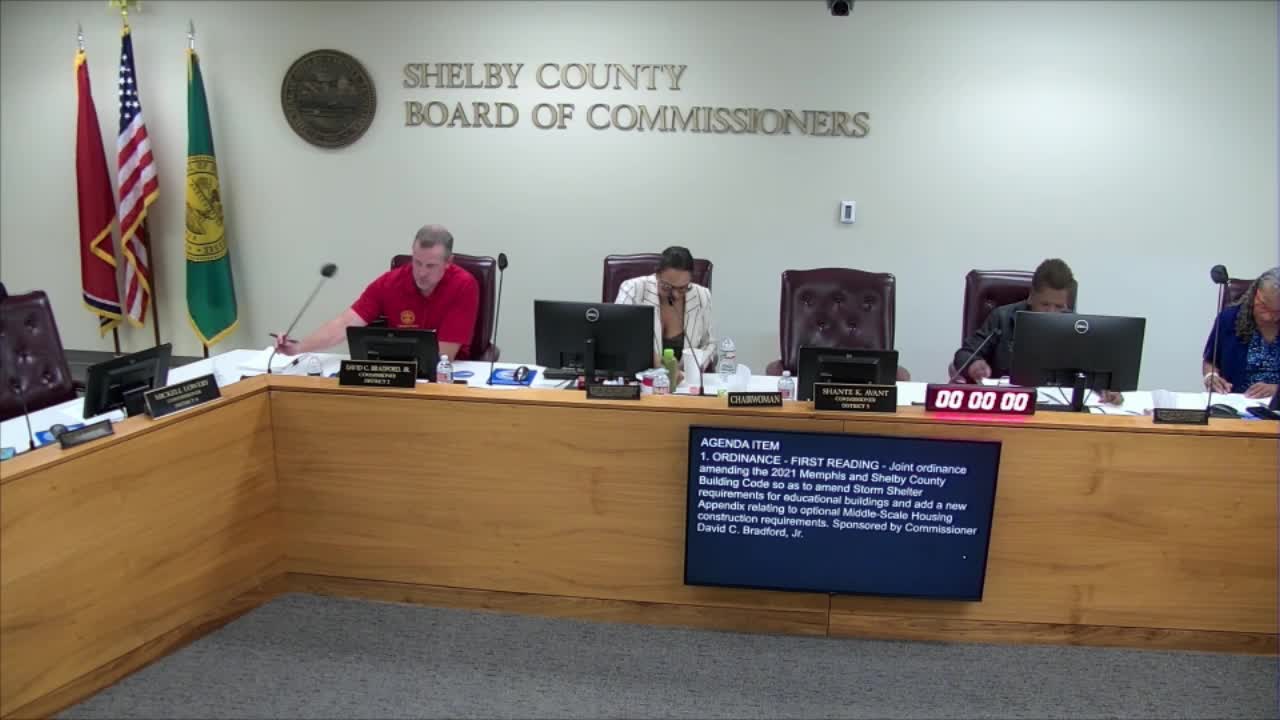
Summary
Shelby County staff presented two joint ordinances to align local codes with the state and offer an optional alternative compliance path for low-rise multifamily housing; both measures cleared first reading and will return for later votes.
Shelby County’s Land Use, Planning, Transportation and Codes committee on Oct. 1 advanced first readings of three related ordinances to align local building codes with recent state changes and to add an optional alternative compliance path for “middle‑scale” housing.
Rita Anderson, building official for Shelby County’s Division of Planning and Development, told the committee the package contains two related proposals: optional storm-shelter language for educational buildings and a new Appendix M that would create an alternative compliance path for “middle‑scale” low‑rise multifamily construction.
On storm shelters, Anderson said the change mirrors the state’s recent action. "The state recently adopted the 2021 International Building Code, and they amended out of that [storm-shelter] requirement," Anderson said, noting the local text uses permissive language ("may") so that installation of an ICC 500‑style shelter would be optional for new educational buildings.
On middle‑scale housing, Anderson and John Zena, the City of Memphis Chief of Development and Infrastructure, described Appendix M as an optional path for small, low‑rise multifamily buildings—units roughly in the 3‑to‑24 dwelling range—that can reduce construction costs while retaining life‑safety standards. "If one were to maximize this alternative compliance path for a structure of anywhere between 3 units and 8 units, I would expect that one could save around 8 to 10% in construction costs on a structure like that," Zena said.
Anderson said the appendix was developed collaboratively with city and county fire departments, the Tennessee State Fire Marshal’s office, zoning and code-enforcement staff and the Shelby County advisory board. She described the package as a joint city‑county ordinance that already passed a first reading at City Council on Sept. 23.
Committee members asked about the prior moratorium the City of Memphis had placed on storm-shelter requirements; Anderson said the moratorium gave the local advisory board time to study costs after the city moved to the 2021 IBC, and that the state later removed the mandatory shelter language. Commissioners repeatedly emphasized affordability concerns and asked staff for additional cost detail; Zena said savings are greatest on smaller buildings (3–8 units) and decline for larger structures.
The committee recorded mixed votes during the first readings; each measure will return for further readings under the county’s three‑reading process. Anderson said alignment across the International Building Code, the existing building code and the National Fire Code is the intent.
No formal policy changes were required of existing schools; the committee advanced the draft language so it can be reviewed in subsequent readings and public comment opportunities.