
Center for Immigrant Progress explains detainee rights, locating tools and voluntary-return options
Get AI-powered insights, summaries, and transcripts
Subscribe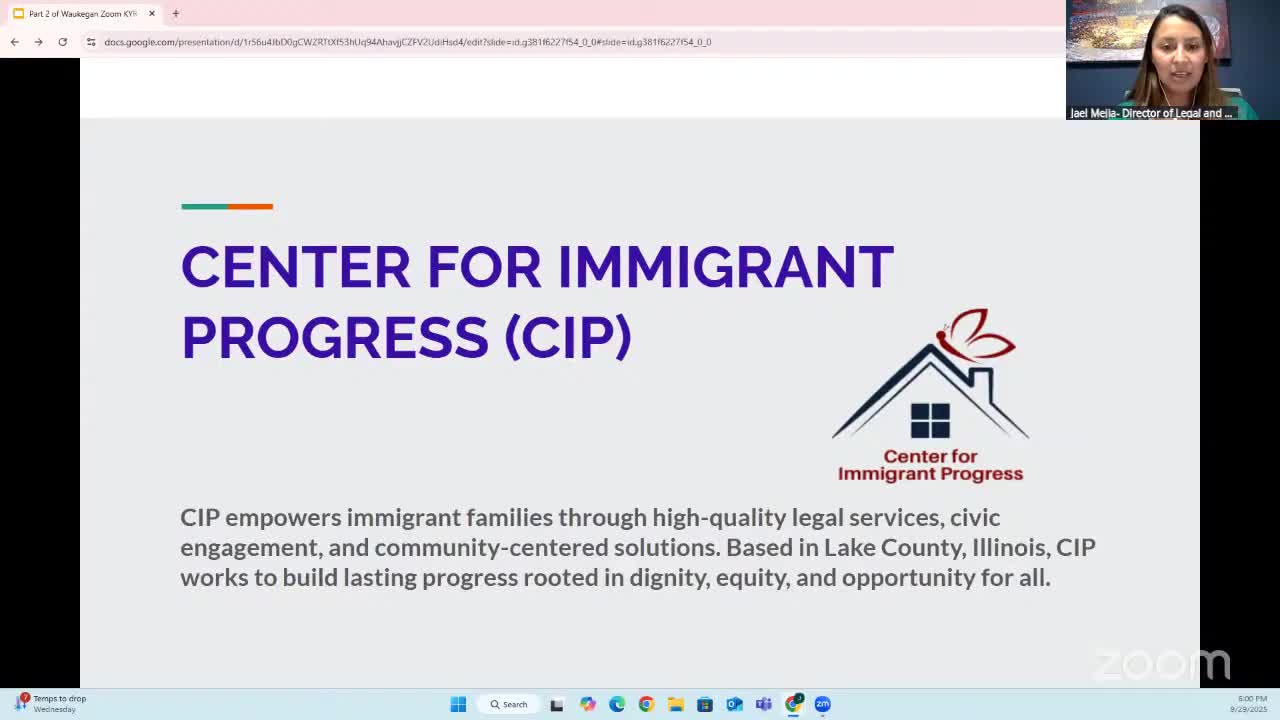
Summary
Jael Mejia of the Center for Immigrant Progress outlined rights for people in immigration custody, tools families can use to locate detainees and cautions about a voluntary-return app during a presentation to Waukegan CUSD 60.
Jael Mejia, with the Center for Immigrant Progress, told attendees during a presentation to Waukegan CUSD 60 that people who are detained by immigration officials should exercise their rights, contact an attorney, and avoid signing documents without counsel.
Mejia said the guidance matters because detained people often face pressure to give information or accept documents that could lead to removal. She urged detainees to remember they have a right to remain silent, a right to an attorney, and a right to a local phone call to notify family or counsel.
Mejia opened by stressing the priority: "You have to try and, make sure that you don't provide self incriminating information." She added that allowing someone into a home can give officers legal grounds to investigate: "if you open the door and you allow them to enter even if they didn't have a judicial warrant, now they have the right to investigate you and detain you," Mejia said.
The presenter gave practical steps for families trying to find a detained relative, including using the federal detainee locator at locator.ice.gov. Mejia explained the locator can use an individual's A-number (a nine-digit immigration identification number) or biographical information (full legal name, country of birth and date of birth) if the A-number is not known. She also provided the address for the Broadview Processing Center in Chicago (1930 Beach Street, Broadview) and noted that people processed there are often transferred to detention facilities in other states, which can complicate family contact and release efforts.
Mejia recommended immediate contact with an immigration attorney when possible and named an ISER family support hotline that, she said, currently operates roughly 6 a.m. to 9 p.m. and provides live assistance with locating detainees, connecting callers to legal resources, arranging volunteer monitoring of ICE activity and offering counseling or other family supports. She noted the hotline previously was 24/7 but is no longer around the clock.
The presentation also covered consular and international supports for people who plan to return to their countries of origin. Mejia said some consulates and nonprofits offer repatriation and reintegration services, including help obtaining passports or birth certificates, assistance transporting household goods, skill certification and limited financial support. She cited programs the Mexican consulate promotes, including a Mexican Interior Repatriation Program (MERP) and reintegration services, and referenced Alianza Americas as an international network that links returnees to in-country nonprofits. Mejia warned that availability and scope of services vary and advised families to confirm services before departing the U.S.
Mejia discussed an application she called the "CDP home app," described in the presentation as a DHS-linked voluntary-return tool that promises travel assistance and a stipend after departure. She said the app, as presented, offers up to $1,000 after a participant confirms departure, claims to deprioritize participants for enforcement while they prepare to leave, and promises that participating could preserve future immigration benefits. Mejia cautioned about limitations: eligibility is described as for people without significant criminal history, but public materials do not clearly define that standard; promised stipends and benefits are paid only after departure and, according to Mejia and partner organizations, are not consistently delivered; and providing personal information through the app could expose participants to enforcement risk. "The only difficult part is that the term noncriminal is not fully defined in the public documents," Mejia said. She added that experts warn future reentry or legal bars can still apply after a return and that no statutory guarantee compels DHS to honor all promises described in the app materials.
Throughout the presentation Mejia repeatedly cautioned against signing documents in detention without attorney review. "It's very important that you do not sign any documents while being detained," she said, explaining that detainees are sometimes told that signing will secure release even when the paperwork actually effects voluntary removal.
The presentation concluded with an offer of free legal screenings through the Center for Immigrant Progress and a notice of a power-of-attorney and guardianship workshop scheduled for Oct. 11. Mejia invited attendees to contact the organization for assistance and to report instances where consulates or other services failed to provide promised help.
Mejia's talk, delivered primarily by one presenter with a short moderator exchange, focused on practical information and warnings rather than on lobbying or local policy changes. No formal votes or district actions were taken during this item.