
Mass. officials, economists say OB3, tariffs and immigration policy raise fiscal risks for FY26 budget
Get AI-powered insights, summaries, and transcripts
Subscribe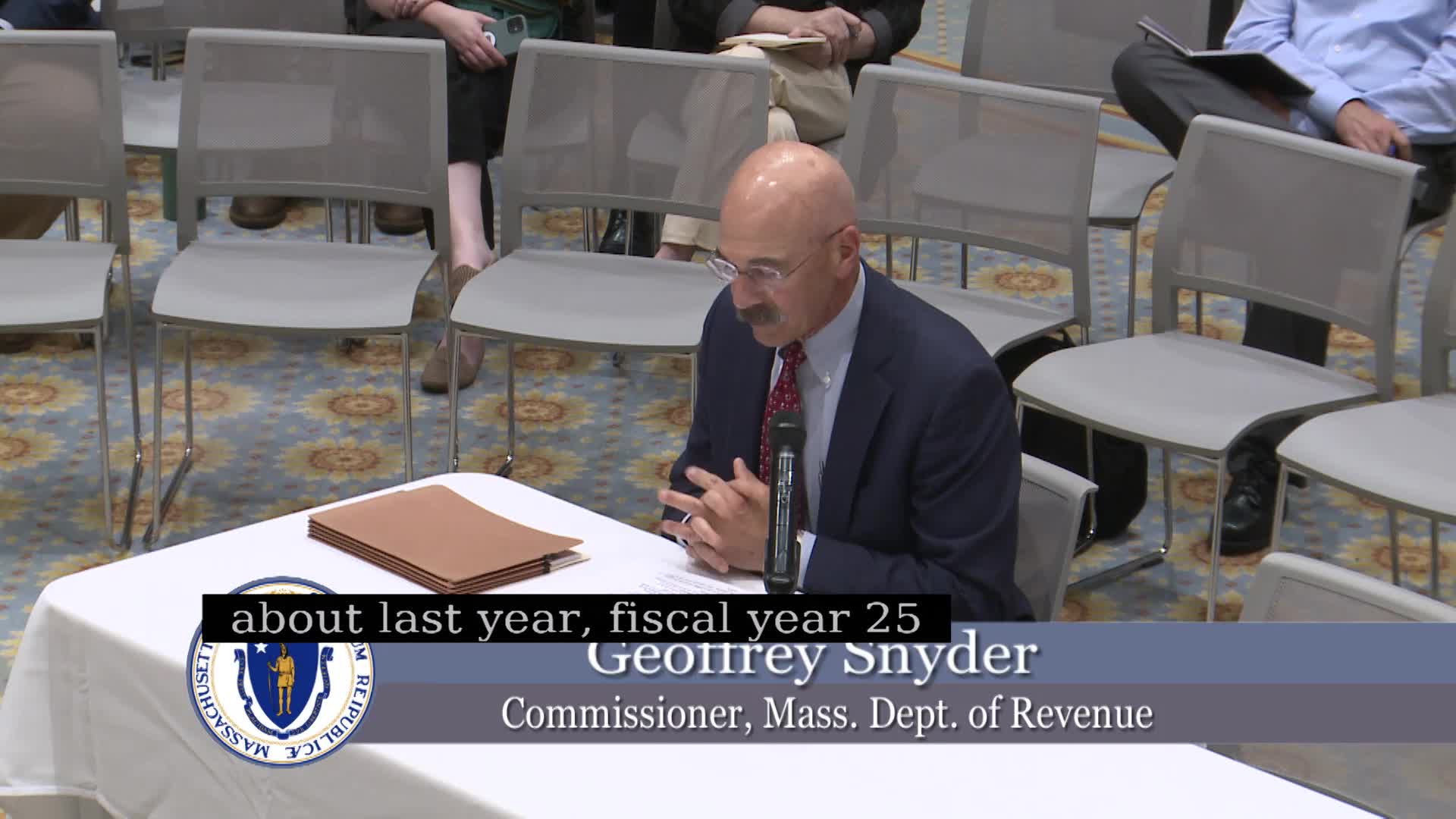
Summary
At a legislative economic roundtable, the Department of Revenue and outside economists warned that federal tax changes known as OB3, elevated tariffs and restrictive immigration policy are likely to shave hundreds of millions from Massachusetts tax receipts and increase pressure on health-care and research funding that support the state—s economy.
Secretary Matthew Gorkward, secretary for administration and finance, joined legislative chairs and outside economists at a midyear economic roundtable to lay out the risks facing Massachusetts— budget for fiscal year 2026 and beyond. Officials and panelists cited a combination of a newly enacted federal tax law (referred to at the hearing as OB3), elevated tariff policy, and a slowdown in immigration as the principal drivers of downside revenue risk and growing stress on health-care and research institutions the state relies on.
Commissioner Snyder of the Department of Revenue told the panel that "revenue collections for FY25 totaled approximately $43,700,000,000," and said FY25 collections were 5% above the benchmark overall but noted corporate and sales tax categories came in below benchmark. The commissioner said the administration projects that "OB3 will reduce state tax collections by more than $650,000,000 in FY '26," and that most of the impact is concentrated in a handful of provisions that the Commonwealth currently conforms to.
The warning from DOR came alongside forecasts from Moody—s and S&P Global that trade policy and restrictive immigration enforcement are likely to slow growth, lift inflation pass-through to consumer prices, and reduce labor supply. Emily Mandel of Moody—s said tariff policy has injected "a huge amount of uncertainty" into the economy and that firms are beginning to pass higher import costs into consumer prices, with Moody—s projecting core inflation to rise and weigh on demand.
Panelists said the combination of slower corporate estimated payments (a leading indicator for corporate tax receipts), weak sales tax months, and volatility in nonwithheld income creates real near-term uncertainty for state revenues. Commissioner Snyder explained that withholding and sales receipts are viewed as more current indicators, while nonwithheld income is "much more backward looking" and therefore more volatile.
Economists at the roundtable also emphasized non-tax channels that will press the state—s fiscal position. Michael Goodman of UMass Dartmouth and Michael Lynch of S&P cited reductions in competitive federal research grants (NIH and NSF) and potential MassHealth changes as threats to both jobs and hospital finances. Goodman noted Massachusetts— heavy reliance on international students and high-skilled immigration "for its innovation ecosystem," and warned that recent federal immigration policy trends and F-1 visa restrictions are reducing the labor pipeline for higher education and technology sectors.
Doug Haugate of the Massachusetts Taxpayers Foundation urged state leaders to act on the items they can control now, including prompt closeout of FY25 accounts, careful review of outstanding vetoes and one-time spending, and consideration of midyear spending controls (9C reviews) to preserve resources for FY26 and FY27. Haugate and other witnesses recommended using the upcoming September and October revenue reports as key data points before making larger revenue adjustments.
Officials repeatedly signaled there is no single fix: the DOR commissioner and panelists discussed policy options including decoupling from specific federal tax provisions, smoothing front-loaded effects of federal changes, and administrative adjustments to passthrough entity treatments, but emphasized that each choice has trade-offs and legal/timing constraints. Secretary Gorkward said the roundtable was convened "so that we have a full picture of what to expect" and to inform decisions as the budget process for FY27 begins in the months ahead.
The panel identified several near-term milestones for state fiscal planning: September tax collections (the first significant month for FY26), the administration—s October 15 9C revenue and spending review, the closeout supplemental for FY25, and deliberations over FY27 budget proposals. Officials said these data and actions will drive whether the Commonwealth needs midyear cuts, revenue changes, or use of one-time reserves.
Ending: The chairs and the administration said they will continue reviewing incoming revenue data and follow up with the Department of Revenue analysis and the fiscal offices to refine options. Panelists warned that even if a broad recession does not materialize, a period of slow growth, higher costs and reduced federal support could force difficult budget choices in FY26 and beyond.