
Portland schools largely identified for targeted state supports; district lays out school improvement steps
Get AI-powered insights, summaries, and transcripts
Subscribe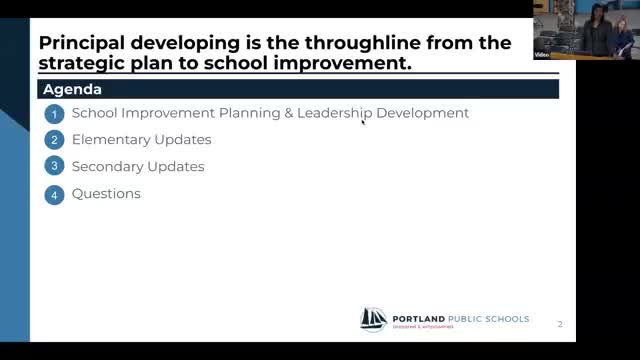
Summary
District officials told the school board that most Portland schools were classified by the Maine Department of Education as needing additional targeted support (ATSI) or targeted support (TSI). District leaders described school improvement plans, leadership development, walk‑throughs and progress monitoring intended to address chronic absenteeism,
Portland — Portland Public Schools officials told the board on Sept. 30 that state accountability data placed most district schools in categories that require targeted support, and the district outlined planned steps to align school improvement plans to the district strategic plan.
The district presented state accountability definitions and said the Maine Department of Education uses five indicators — chronic absenteeism, progress in English proficiency, academic growth, academic achievement and graduation rate — to identify schools. Those identifications are labeled as additional targeted support and improvement (ATSI), targeted support and improvement (TSI) and, in more severe cases, comprehensive support and improvement (CSI).
Officials said that for the most recent review, all but one Portland school were identified as ATSI or TSI. Assistant Superintendent for Elementary Schools noted subgroup flags: students with disabilities were an at‑risk subgroup at seven elementary schools, economically disadvantaged students at five schools, white students at five schools, Hispanic/Latino students at three schools, two‑or‑more‑race students at two schools and multilingual learners at one school.
"The school improvement plan serves as a guide," one district official said, describing school improvement plans (SIPs) as structured approaches that set goals, monitor implementation and measure progress. The district said each school's SIP is being aligned with the district strategic plan and its five focus areas: equity, achievement, whole student, connected community, people and systems.
District leaders described a package of supports for schools that includes instructional leadership team facilitation, quarterly "step back" meetings where district network teams review progress with principals, district classroom walk‑throughs, monthly grade‑level leadership sessions and individualized coaching. For secondary schools, the district said it is partnering with an external organization (Attuned) to provide leadership learning focused on student outcomes, classroom practices and leadership effectiveness.
Officials emphasized results‑based leadership development and shared accountability across district, school and classroom levels. Assistant Superintendent for Secondary Schools said goals include 100% of schools meeting or exceeding targets in their improvement plans and strengthening instructional observation and feedback cycles.
Board members asked for additional data access and briefings. Several asked for clearer public placement of school SIPs and for training to help board members interpret the state dashboard and exit criteria. District staff said they would distribute links to the state's public dashboard and provide guidance and follow‑up reports, including exit criteria timelines and how schools can move off the targeted lists if sustained improvement is documented.
No formal board action was taken at the meeting; the presentations were informational and intended to orient the board before ongoing engagement and implementation steps.
District officials said they will continue to hold step‑back meetings with schools, conduct walk‑throughs to calibrate instructional practice, and roll out results‑based leadership coaching to principals and assistant principals. Staff said they will also present adjusted school maps and community engagement dates related to the district's boundary review in October.