
Planning committee deadlocks on 605 Davis; neutral recommendation sent to City Council
Get AI-powered insights, summaries, and transcripts
Subscribe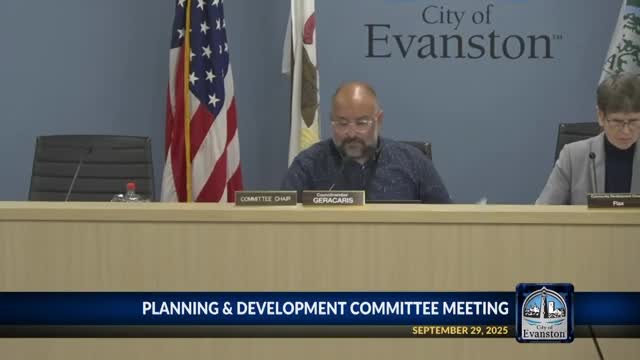
Summary
The Evanston Planning and Development Committee deadlocked 3-3 Monday on a planned development for 605 Davis, sending a neutral recommendation to the City Council on a proposal that would add about 430 units — including 86 inclusionary units — to a long‑vacant downtown parcel.
The Evanston Planning and Development Committee deadlocked 3-3 Monday on a planned development for 605 Davis, sending a neutral recommendation to the City Council on a proposal that would add about 430 units — including 86 inclusionary units — to a long‑vacant downtown parcel.
The proposal, presented by developer Vermilion and its design team, would combine the site with adjacent development rights and build a high‑rise designed to bring housing, retail and pedestrian upgrades to downtown. Devin Patterson, a project representative, told the committee, "this project delivers on them day 1," citing an all‑electric design, LEED Gold goals, and 86 on‑site affordable units.
Why it matters: supporters said the project will convert a vacant lot into housing and tax revenue, and produce the largest single‑site addition of affordable units downtown. Opponents said the proposal’s scale, use of state tax assessment programs and front‑loaded tax benefits would shift costs to homeowners and school districts and create traffic, wind and pedestrian‑safety problems.
What the committee decided: after public comment and a developer presentation, a roll‑call vote produced a 3-3 tie (Rogers: No; Harry Carras: Aye; Kelly: No; Ailes: Aye; Burns: Aye; Davis: No). The chair said the tie results in a neutral recommendation and the item will move to the full City Council for a final decision.
Project details and fiscal estimates: The developer reported the project would create about 430 apartments and more than 600 new downtown residents, plus 86 affordable units under the state program the team described as the “Affordable Illinois” / Affordable Housing Special Assessment Program. Jonathan Perman of the Perman Group presented fiscal modeling that estimated the site currently generates roughly $21,000 a year in property taxes and projected annual property tax receipts rising to roughly $580,000 by 2031, about $1.25 million by 2034 and nearly $2.7 million by 2040. Opponents, including resident Kira Kelly, said the program front‑loads a tax reduction that would divert what she said is about "$40,000,000 in property taxes away from our city and schools." (Kira Kelly, resident, public comment.)
Public comment reflected deep divisions: Supporters argued the development is necessary to address Evanston’s housing shortage and downtown vacancy. Resident Brian Hanson said the site’s current $21,000 tax yield would be replaced by tens of millions of dollars over time and called the project a citywide fiscal opportunity. Several speakers noted the project’s 86 affordable units are near transit and would house people who otherwise could not live downtown.
Opponents raised scale, shadowing, wind and traffic concerns, and questioned the developer’s use of transferred floor‑area ratio and the state tax assessment tier selected. Steven Miskiewicz, president of Sherman Plaza Condo Board and the Committee of Downtown Evanston Condominium Association Presidents, said the proposal’s FAR request (the developer’s materials cite an effective FAR above the base and bonus limits) was “unprecedented” for Evanston and warned of construction and curb‑cut impacts. Gul Aga, representing the Downtown Evanston Residents Association and the Environment Board, criticized the environmental and wind analyses and said the project’s reporting did not use commonly applied safety standards.
Schools and taxes: Several speakers tied the fiscal debate to current school budget pressures. Developer materials estimated modest student enrollment increases (about 18 students for District 65 and about 8 students for District 202) and said net revenue to districts would become positive after the tax break phases. Opponents countered that the program’s front‑loaded tax break could increase fiscal strain on the districts in early years.
Planning and technical claims: The developer’s presentation included traffic and parking studies and identified a plan for on‑site parking plus use of under‑utilized municipal garages; a consultant team listed wind, traffic and parking specialists on the project team. Critics disputed some of the assumptions and asked for independent third‑party studies of wind, traffic, loading and alley impacts, and for a clearer controlling party for the site’s multiple stakeholders.
Next steps: Because the committee vote produced a tie, the matter will go forward to the City Council with a neutral recommendation. City Council will consider the planned development ordinance and the related request to use the state assessment reduction that enables the proposed inclusionary unit count.