Cedar Park partners with UT Austin landscape architecture program to study 'tiny forest' pilot
Loading...
Summary
Cedar Park approved a six-month partnership with UT Austin’s landscape architecture faculty and graduate students to study feasibility, site selection and potential funding for a dense native-plant 'tiny forest' pilot.
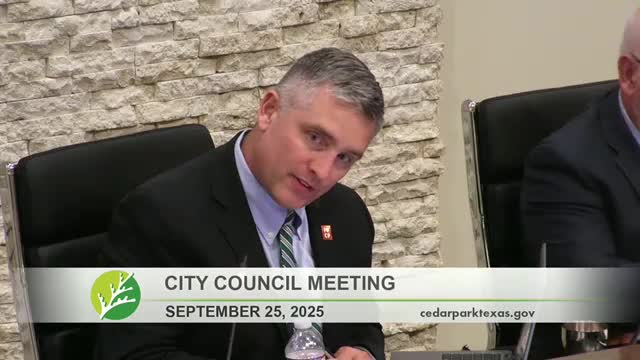
The Cedar Park City Council heard a city manager report and presentations from faculty at the UT Austin School of Architecture to launch a six-month partnership to evaluate a ‘tiny forest’ pilot — a small, dense, native-plant assemblage intended to increase urban greening, biodiversity and public engagement.
Ashley Smith, city management intern, said the concept arose from council strategic goals to evaluate community greening and that the partnership will provide graduate-student research support to refine project scope, evaluate site feasibility and identify funding. Hope Hasbrook, associate professor, and Michael Averett, assistant professor of practice at UT Austin, outlined the two-phase work plan: a narrative literature review examining community engagement and health benefits and a systematic literature review comparing reforestation methods and measures appropriate to Cedar Park’s soils and climate.
UT faculty explained the Miyawaki method — a high-density native planting approach that has been used internationally and in some U.S. projects — and noted tiny forests commonly use native species and dense planting to accelerate canopy formation. They described site-selection criteria that include soil type, available planting depth and desired ecological community (they cited oak savanna and oak/juniper woodlands as potential target communities near Cedar Park). Professors said some soil amendment and early maintenance investment is required, but that mature maintenance needs decline after establishment.
Council members discussed aesthetics (whether a site would resemble a tiny forest or a savanna), volunteer and partner recruitment, and how the project could engage residents and university researchers. Staff noted existing volunteer relationships with the native plant society and said the city will pursue mapping potential sites and defining measures of success as part of the initial work.
No construction or budget appropriation was approved at the meeting; the item was presented as a city–university research partnership to inform future decisions.