
Wilsonville planning commission reviews Northwest Industrial Zone draft; property owner warns urban design rules could limit industrial uses
Get AI-powered insights, summaries, and transcripts
Subscribe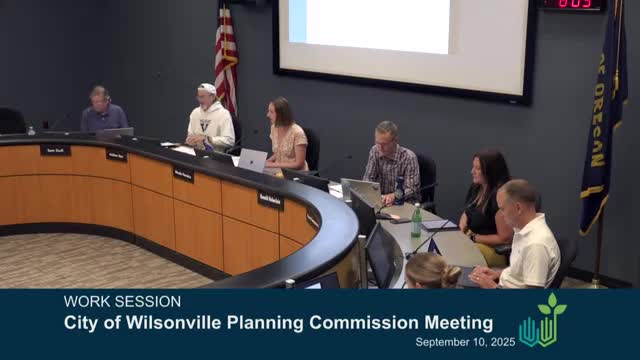
Summary
City staff presented draft code for a new Northwest Industrial (NWI) zone and revisions to a Craft Industrial (CI) zone for the Basalt Creek planning area. Commissioners asked for clarifications; a nearby property owner urged loosening certain standards that could constrain large industrial buildings.
Wilsonville Planning Commission members reviewed draft development code revisions for the Basalt Creek planning area on Sept. 10, focusing on a new Northwest Industrial (NWI) zone and updates to a Craft Industrial (CI) zone.
The presentation by Cindy Locsoy, an associate planner for the city, summarized how the NWI zone would merge the Coffee Creek Industrial Design Overlay District with elements of existing plan development industrial (PDI/RSIA) regulations and add several uses not clearly listed in the current code. Staff said the draft uses table would vary by subdistrict — Coffee Creek, high‑tech employment, light industrial and West Railroad — and that certain uses would include specific size or locational limits to protect scarce industrial land.
The commission was asked to provide early guidance; the meeting was a work session, not a public hearing, so no zoning changes were voted on.
Why it matters: The Basalt Creek area is a major opportunity for traded‑sector jobs in Wilsonville. The NWI code will shape what types of employers can locate there, how sites are laid out and how industrial parcels are connected to roads and transit.
Key points from staff and the draft
Cindy Locsoy said the draft code limits retail and residential uses in the CI zone to accessory uses that support primarily industrial activity, and applies the new NWI design and development standards across the CI zone. The NWI use table draws from existing PDI/RSIA allowances and adds new use categories including hospitals (as defined in the draft), specialized automotive services, small‑to‑medium e‑commerce fulfillment, data centers, commercial recreation, and contractor establishments.
Notable numeric limits and standards in the draft (as explained in the packet and by staff): - Data centers: recommended maximum of 25,000 square feet per site in Coffee Creek and high‑tech employment subdistricts to avoid large energy‑intensive facilities displacing other industrial uses. - E‑commerce/fulfillment: on‑site customer trips limited to 5% of site trips; on‑site delivery vehicle storage to be screened. - Minimum building facade height along addressing streets: 30 feet (allowance for a 10% reduction in some cases). - Driveway width maximum noted in the draft: 24 feet (raised as a concern by commenters). - Enhanced transit plazas and some transit‑oriented wayside standards are conditioned on coordination with SMART; staff said an enhanced transit plaza would require SMART involvement and could not simply be added by an applicant where SMART does not plan service.
Commissioner questions and requests
Commissioners probed a range of design and clarity issues. Among the topics raised: - Connectivity and figures: Commissioners asked for clearer legends and explanations for figures showing addressing streets, supporting streets and through connections, and requested clearer language on spacing standards (for example, 600 feet centerline spacing that includes multiple exceptions in the draft table). - Pedestrian/bicycle facilities: Commissioners sought confirmation that some supporting streets are intended as shared streets without dedicated bike lanes and asked staff to confirm where bike lanes are expected versus shared facilities. - Exterior modifications and signs: Commissioners questioned whether language that brings minor exterior modifications or sign changes into the new standards is overly broad or redundant with nonconforming‑use rules. - Primary building entrance and parking: Commissioners asked how limited on‑street parking and primary entry placement would affect large industrial uses and whether the "safe, direct and convenient" accessibility language is too subjective. - Minimum facade height: Commissioners asked why a 30‑foot minimum facade was proposed; staff said the requirement is a form‑based urban design standard intended to frame public streets and create an employment‑district character, even where single‑story buildings are proposed. - Transit coordination: Commissioners requested clearer code language explaining that enhanced transit plazas would be implemented only in coordination with SMART (the regional transit agency) and would not be permissible where SMART has no service plans.
Public comment and developer concerns
Ryan Sherra, who identified himself as a property owner with Schinister Properties and gave his Portland address, spoke in person during the public comment period. He said he supports a consolidated Northwest Industrial zone in principle but warned the draft development and design standards appear tailored toward more urban or office development and could make conventional industrial development infeasible on larger sites.
"When you take into account what we need to dedicate for future Basalt Creek Parkway... and the maximum spacing shown, which is 600 feet, it looks almost like a town center," Sherra told the commission. He said applying the street spacing and pedestrian‑oriented standards across a 44‑acre industrial site could consume significant developable area, leaving less land for large industrial footprints.
Sherra urged staff and the commission to revisit standards that most affect industrial functionality, specifically naming connectivity spacing, driveway widths, building heights for industrial uses, retaining wall limits on sloped sites and maximums for parking between buildings and addressing streets. He asked for follow‑up meetings with staff to work through standards that could be tailored for light industrial users.
Staff response and next steps
Cindy Locsoy and Dan Polley said much of the draft language carries forward standards from the Coffee Creek overlay and the form‑based code that preceded this work. Staff acknowledged places where the draft was a "cut‑and‑paste" carryover and agreed to seek clarifications with engineering and transit partners. Staff also said they would review whether certain requirements are redundant with general nonconforming or zoning standards and would consider carve‑outs or adjusted dimensional standards for light industrial uses where appropriate.
Commissioner reaction and outstanding issues
Several commissioners said they were generally supportive of the proposed zone and the use of a consolidated table, but asked staff to return with clearer figures, refined definitions for uses such as "hospital" (some commissioners suggested alternative phrasing such as "inpatient specialty medical facility" or "medical research/medical specialty facility" to avoid implying a full‑service hospital) and tighter, less ambiguous language on transit coordination and addressing/street standards.
No formal action was taken; the session concluded with staff requesting additional input and an upcoming joint work session with city council to further discuss permitted uses for the area.
Ending
The commission closed the Sept. 10 work session after taking one in‑person public comment and asking staff to return with clarifications and potential adjustments to the draft NWI and CI code language. The commission will discuss the zone further at a future joint work session with the city council.