
Clearwater advisory committee launches annual review of local housing incentives, flags parking and senior-housing gaps
Get AI-powered insights, summaries, and transcripts
Subscribe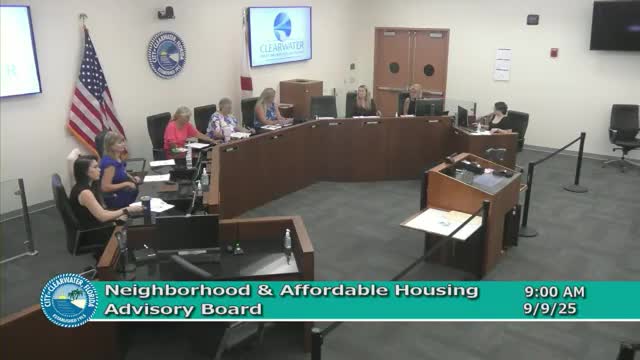
Summary
The City of Clearwater’s Affordable Housing Advisory Committee (AHAC) began its 2025 cycle Sept. 9, reviewing the Local Housing Incentive Strategy required by the State Housing Initiatives Partnership (SHIP) program and identifying barriers and potential incentives including parking rules, accessory dwelling units and senior housing needs.
The Affordable Housing Advisory Committee for the City of Clearwater began its 2025 work Sept. 9 with a kickoff meeting to update the city’s Local Housing Incentive Strategy (LHIS) and prepare recommendations that the City Council will consider this winter.
The committee — appointed by City Council in August — is required by the State Housing Initiatives Partnership Program (SHIP). Amanda Warner, planner and consultant with Wade Trim, told the committee, “So we are kicking off the first meeting of the affordable housing advisory committee for year 2025,” and reviewed the timeline for producing the LHIS and related documents to support the city’s SHIP grant application.
Why it matters: The LHIS informs policy options that affect where and how affordable housing can be developed in Clearwater, including incentives a project might use under Florida’s Live Local Act, which allows certain housing projects to claim statutory exemptions or streamlined approvals. Committee recommendations feed into a report the City Council will adopt and submit to the state; that report affects local eligibility and design of SHIP-funded programs.
Committee members and staff spent most of the meeting discussing barriers that reduce production and access to affordable housing in Clearwater. Speakers repeatedly cited construction and site-preparation costs, infrastructure and permitting requirements, and limits on available land as major constraints. Robin Field, the committee chair who represents residential lending, opened the meeting and framed the committee’s charge to advise the council on incentives and regulations the city can change.
Parking requirements under the Live Local Act emerged as a recurring concern. A committee member worried aloud about what the statute means by “available parking elsewhere” and whether that includes private shopping or office lots. That member said reduced on‑site parking can create practical problems in neighborhoods where “people are attached to their automobiles,” and described visible impacts such as parking on yards and multiple vehicles per rental unit.
Developers and real-estate professionals on the committee described instances where a site’s infrastructure needs — for example, stormwater vaults or utility relocation — make otherwise suitable infill parcels financially infeasible. One developer said a parcel “is a great place to build affordable housing… but it just can’t pencil,” citing the cost of bringing the site to build-ready condition.
Senior housing was singled out as an increasing and urgent need. Committee members described a rising number of older residents who cannot afford to remain in place and limited options for lower-cost senior housing. Terry Malcolm Smith, identified as the city’s housing SHIP administrator (housing coordinator), offered to share a list of locally supported senior housing properties, including Pineberry Seniors and Lexington Club, and said he would circulate that list to committee members.
Accessory dwelling units (ADUs) were discussed as a concrete incentive the city already allows. Lauren Matzke, Director of Planning and Development, said the city amended the land-development code to permit ADUs in all zoning districts and that the department has so far seen a small number of applications. Matzke also described pending zoning work for the North Greenwood CRA area, including a potential density bonus and standards to encourage mixed uses along Martin Luther King Avenue.
Warner reviewed key statutory and program definitions the committee must use, including the SHIP program’s income limits and HUD area median family income (AMI) benchmarks. For Clearwater/Pinellas County in 2025 she cited an AMI of $98,400 and noted that 120% of AMI is $118,080; she also listed the 30%-of-income rule and provided example rent and purchase thresholds included in the report.
Next steps: The committee set a schedule for further work: meetings on Oct. 14 and Oct. 28, a public hearing on Nov. 18, and City Council consideration in December. Warner asked members to read the 2024 LHIS report ahead of the Oct. 14 meeting and noted Appendix E of that report summarizes prior AHAC recommendations. Dania Perez, filling in for city staffer Dylan May, confirmed the Oct. 14 date. The meeting was adjourned without formal votes.
The AHAC’s role is advisory: it will review 16 incentive areas (the 11 statutorily required categories plus locally added items) and recommend which incentives to continue, modify or remove. Several committee members urged the group to focus on zoning and code provisions the city can control, while acknowledging many barriers (taxation, some fees, and market forces) are controlled by county or state agencies.
The committee also discussed topics it will revisit in future meetings, including tax approaches landlords suggested to offset rising property taxes on rental properties, exceptions or flexibility for accessibility retrofits, and how to publicize ADU permitting options to potential homeowners and developers.
The meeting concluded with staff confirming the next AHAC meeting date and an invitation for public comment; no members of the public spoke on the record that morning. The committee will reconvene Oct. 14 to begin going through the prior year’s recommendations and to develop a recommended LHIS update for public hearing in November.