
Planning board recommends approval of 470‑unit PD that would rehabilitate historic Bridal House amid resident concerns
Get AI-powered insights, summaries, and transcripts
Subscribe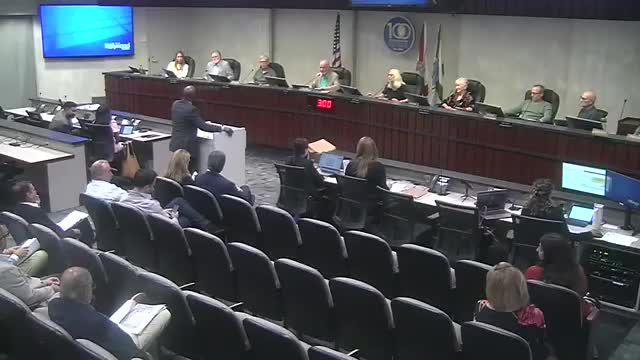
Summary
The City of Hollywood Planning and Historic Preservation Board voted to recommend that the City Commission approve a planned development (PD) at 4220 and 4231 North 50 Eighth Avenue that would allow an eight‑story, 470‑unit multifamily project with a 3,500‑square‑foot place of worship and rehabilitation of the locally designated Bridal House.
The City of Hollywood Planning and Historic Preservation Board voted to recommend that the City Commission approve a planned development (PD) at 4220 and 4231 North 50 Eighth Avenue that would allow an eight‑story, 470‑unit multifamily project with a 3,500‑square‑foot place of worship, 14 live‑work units and restoration of the locally designated Bridal House.
Staff planner Reggie White opened the presentation by identifying the file as “24zjdp67” and describing the proposal, saying the applicants seek “a waiver of the 10‑acre minimum required planned development” outside the downtown CRA and to rezone the parcels from North Mixed Use (NMU) to Planned Development (PD). White told the boards staff recommended forwarding approval to the City Commission on the waiver, rezoning, master plan, certificates of appropriateness for demolition and design, and site plan with conditions.
Why it matters: The project combines a high‑density housing proposal with an explicit historic‑preservation element. The applicants propose to partially demolish a later western addition to the two‑story, early‑20th‑century Bridal House and rehabilitate the remaining structure for use as a small library or multipurpose room serving the development and, potentially, visitors. Staff and the applicant said the rehabilitation prevents further deterioration of a designated historic structure and yields community benefits that supported a waiver of the PD acreage requirement.
What the boards recommended and key conditions - Waiver of the 10‑acre minimum for a planned development (recommendation to City Commission). Staff and the applicant cited community benefits — notably the Bridal House rehabilitation and a proposed place of worship — as justification. - Rezoning from NMU to Planned Development and approval of a master plan that becomes the project’s zoning regulations; a unity of title is required and other legal documents must be recorded before issuance of a certificate of occupancy. - Certificate of appropriateness for partial demolition of a non‑original western addition; staff required a structural engineer’s report showing partial demolition would not compromise the Bridal House’s structural or historic integrity. - Approval of the certificate of appropriateness for design and site plan approval with conditions including: dedication of right‑of‑way corner for future traffic signal equipment, plat approval, a traffic‑signal warrant study to be performed at 50% occupancy with a bond for signal construction if required, and other engineering and permitting conditions.
Project details presented in the hearing The applicants described the site as two parcels totaling 5.74 acres, mostly under‑developed. The PD would include an eight‑story building with a maximum height presented to the boards as 45 feet; the plan shows 470 residential units, 14 live‑work units, a private clubhouse, a parking garage and 809 parking spaces plus 52 bike racks. The applicant asked for modifications to parking standards (reducing typical residential parking from 2 spaces per unit to 1.5 per unit and setting workforce units at 1 space each) and to internal/external setbacks (reducing a 25‑foot standard to 15 feet in places). The site coverage was presented as 111,025 square feet (about 44% of the PD).
On the Bridal House, architect Joseph Koehler described its condition and the rehabilitation approach: keep the two‑story exterior volume, replace rotten elements with like materials where feasible, install code‑compliant systems and provide accessible entry and restrooms so the building can be used by residents. Koehler said the portion proposed for removal was a later addition built decades after the original and that the design would retain and rehabilitate the core historic fabric.
Traffic, trees and neighborhood concerns Traffic and safety were recurring themes. The boards heard that Oak Street is narrow and currently about 18 feet wide; the applicant’s traffic consultant, Joaquin Vargas (Traptech Engineering), said plans call for widening certain road segments to 20–22 feet and that the project team agreed to a future signal study at Sterling Road and North 50 Eighth Avenue at 50% occupancy, with required mitigation and access management if a signal is warranted. Vargas said traffic counts included existing commercial traffic and that the project’s likely preferred access would be Sterling Road rather than the constrained Oak Street connection.
Nearby residents spoke in opposition. Pilar Jankula, who identified herself as an Oak Street homeowner, told the boards: “I live on Oak Street. That house has been in my family since the forties, so I oppose this. There shouldn't be such a ginormous development 2 houses away from my house.” Another resident, Dan Pategasic, said removal of large trees and the height and proximity of the parking structure would harm sunlight, trees and privacy. The applicant and representatives responded that they had met with neighbors, removed invasive vegetation at neighbors’ request, increased setbacks in some locations during design review, reduced the parking garage height to seven stories during review, and offered to work with the Hollywood Historical Society to enable periodic public access and tours of the Bridal House.
Applicant comment and community outreach Applicant representative Keith Poliakov said the proposal reflected about three years of community meetings and negotiations. “This was 3 years in the making and there was a lot of work and thought that went into it,” he told the boards, and he said the ownership team agreed to a deed commitment for 10% workforce housing and other community benefits negotiated with city staff.
Board actions and next steps The boards’ votes were recommendations to the City Commission; they do not enact the rezoning or PD themselves. The boards moved the packet to the City Commission with staff conditions and additional requirements to document the unity of title, submit structural reports prior to demolition permits, perform a traffic‑signal warrant study at 50% occupancy, and record required legal instruments before certificates of occupancy. Board members asked staff to ensure the applicant provides a written agreement with the Hollywood Historical Society to enable regular (the boards discussed a monthly minimum) access or programming at the rehabilitated Bridal House; the boards also requested a historic plaque describing the house and its original construction date be included on the site plan.
What was not decided or remains to be resolved The City Commission will make final decisions. The traffic signal warrant, any resulting construction obligations, final tree preservation/mitigation calculations and the phrasing and enforceability of any written access agreement with the historical society remain outstanding and are conditions of approval recommended to the commission.
Quote highlights “Staff recommends that the Planning and Development Board, together with the Historic Preservation Board, forward a recommendation of approval to the City Commission,” said Reggie White, planner for the City of Hollywood.
“This was 3 years in the making and there was a lot of work and thought that went into it,” said applicant representative Keith Poliakov.
“I live on Oak Street. That house has been in my family since the forties, so I oppose this,” said Oak Street resident Pilar Jankula, a caller during public comment who said nearby trees and sunlight would be harmed.
“Our traffic counts accounted for all the traffic using these roadways,” said traffic consultant Joaquin Vargas, who said the project team agreed to a signal study and roadway widening on certain links.
Ending note The joint board forwarded the PD, demolition and design certificates, master plan and site plan to the City Commission with its recommended conditions. The commission will consider the ordinance, legal instruments and final approvals; if adopted, the developer must satisfy the listed conditions — including structural reports and recorded legal documents — before final occupancy certificates are issued.