Get Full Government Meeting Transcripts, Videos, & Alerts Forever!
Get email alerts on the Pavement Art Pride Crosswalk topic
No spam. Unsubscribe anytime.
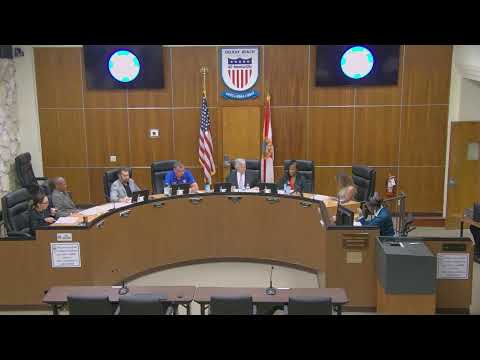
Delray Beach commissioners rescind plan to pursue FDOT litigation over Pride crosswalk, vote to stop further filings
Summary
After heated debate about home rule, legal risk and costs, the Delray Beach City Commission voted to reconsider an earlier directive to file an Administrative Procedure Act challenge to an FDOT memorandum and then approved a motion to cease further petition filings; commissioners said they will pursue local alternatives to recognize Pride art.
Delray Beach — The Delray Beach City Commission voted Thursday to withdraw the city from further court filings tied to a dispute with the Florida Department of Transportation over a rainbow "Pride" pavement mural, saying the political and legal landscape changed after FDOT removed the artwork.
The commission first voted to reconsider a 3-1 directive adopted at its previous meeting. It then passed a motion to "cease any further petition filings in court concerning the FDOT noncompliance matter with their Bridal Crosswalk," effectively ending plans to proceed on its own with an Administrative Procedure Act challenge while leaving open coordination with other cities that have already filed petitions.
The moves followed more than three hours of heated discussion and public comment about home rule, the scope and likelihood of legal success, and potential financial exposure if the city pursued litigation. Mayor Kearney said the way FDOT removed the pavement art was "an overreach" but urged caution about committing municipal funds to a long legal fight.
City Attorney Lynn (last name on file with the City Attorney's office) told the commission that the city is now in compliance at the site because the pavement markings have been removed and that the statute FDOT cited (Florida Statute 316.0745) authorizes withholding state transportation dollars only for additional violations. Lynn also warned that litigation can be expensive: "Litigation is expensive. I mean, I would probably imagine, at least $2,530,000. Ah, minimum. Minimum," she said while noting other estimates given in the meeting that ranged as low as roughly $100,000 depending on length and complexity of proceedings.
Several commissioners said the urgency behind the earlier vote — taken to try to obtain a stay to preserve the mural while legal review continued — had evaporated after FDOT sandblasted and painted over the intersection. Deputy Vice Mayor Angela Burns told colleagues the petition no longer served the original purpose and cautioned against spending taxpayer money on a case the city could not realistically win. "We have a duty to ensure our taxpayers that we use the money wisely," Burns said.
Vice Mayor George Long and others argued for defending home rule and securing a day in court. Long said the commission sought a chance for due process and noted that other cities, including Fort Lauderdale and Miami Beach, have filed petitions challenging FDOT guidance. Resident speakers at public comment framed the conflict both as an issue of local control and as one that affects the LGBTQ+ community; Ronnie Denaire asked commissioners to pursue alternatives that would "hold on to the value" of the city’s gay residents while protecting taxpayers.
Following roll-call votes, the motion to reconsider passed with the same five-member panel — Commissioner Markert, Commissioner Cassell, Deputy Vice Mayor Burns, Mayor Kearney and one other commissioner present — supporting reconsideration and Vice Mayor Long recorded as opposed. On the subsequent motion to cease further petition filings the tally was the same: Long opposed; the motion passed and was recorded as carried by the majority.
Commissioners directed staff to focus on a "Plan B" to recognize the community and to place an item on the agenda of the upcoming Monday workshop (item 7A) to discuss alternative ways to commemorate Pride that avoid further confrontation with FDOT. Several commissioners urged faster local work to design and site an alternative symbol or installation — including options discussed in public comment such as a monument, projection, or tree-wrapping — so the city can visibly acknowledge inclusion without additional legal risk.
The meeting also contained procedural objections about notice: multiple commissioners and members of the public said the special meeting had been noticed only hours before it convened. A point of order referencing the city charter and Florida Sunshine Law was raised; the city attorney and staff responded that, in their view, the meeting was legally noticed and a quorum in attendance preserved the meeting’s legality, even as some commissioners complained the shortened notice reduced public participation.
The city did not identify an exact dollar figure it will save by halting pursuit of the petition. Commissioners reiterated that they may still coordinate with other municipalities that have active lawsuits but will not lead or directly fund further petition filings at this time. They scheduled discussion of alternative recognition and next steps at the Monday workshop.