
Spokane County planning commission reviews EIS alternatives, hears West Plains contamination concerns and UGA request
Get AI-powered insights, summaries, and transcripts
Subscribe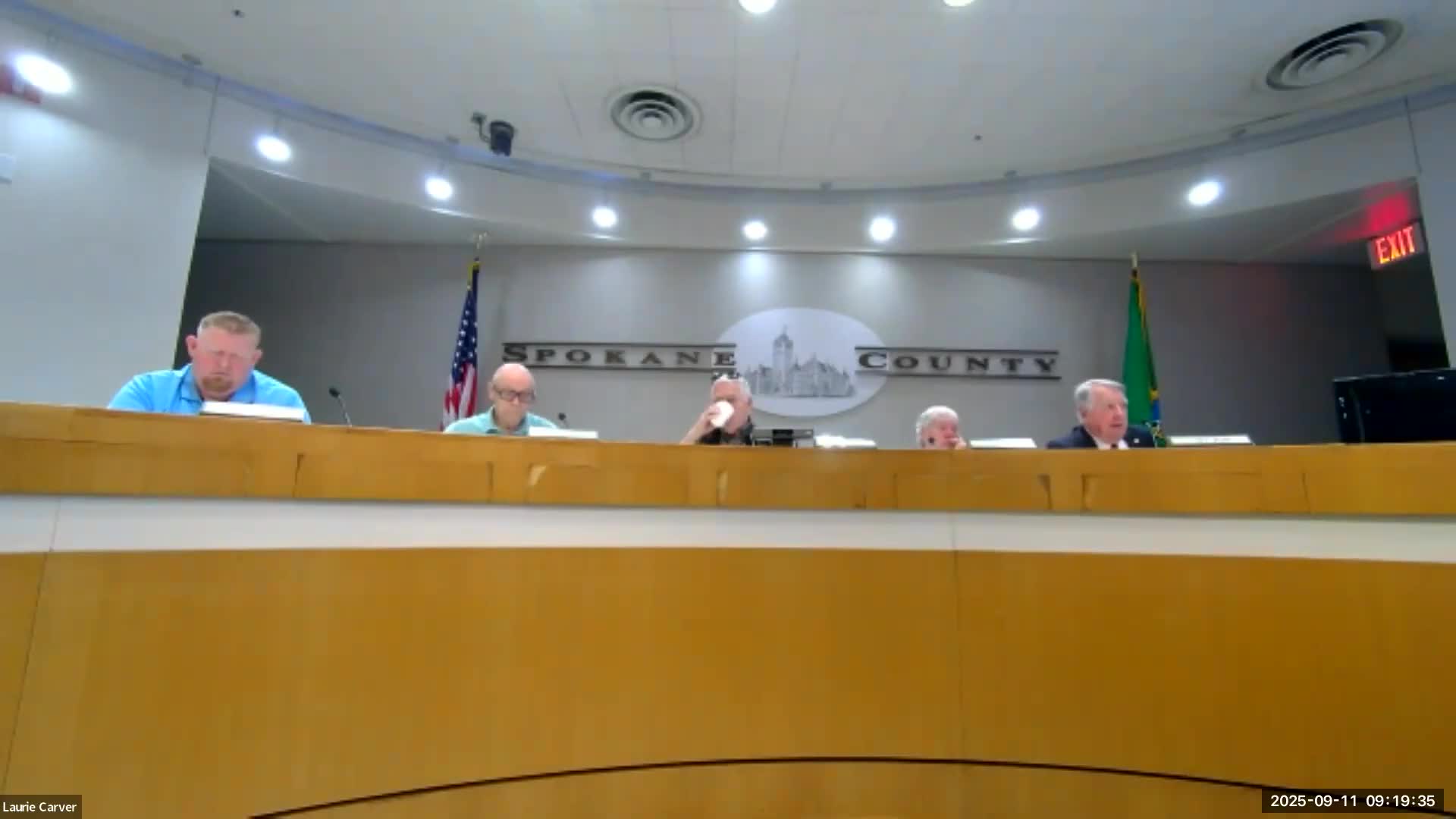
Summary
At a Sept. 11 Spokane County Planning Commission workshop, staff outlined an "infill" alternative for the comprehensive-plan EIS and officials and residents debated whether the county can meet housing targets without expanding urban growth areas amid West Plains aquifer and infrastructure questions.
Spokane County planning staff on Sept. 11 presented the first of two Environment Impact Statement (EIS) alternatives for the countywide comprehensive-plan update, describing an "infill" approach that assumes higher densities within existing urban growth areas and asks whether the county can accommodate roughly 24,000–25,000 dwelling units without changing UGA boundaries.
The presentation, delivered by Scott Chesney of Spokane County planning staff, framed Alternative 1 as an infill-based option and said the EIS process would compare that against a second alternative that could include potential UGA boundary adjustments. "Alternative 1 is looking at how we generally fit within our existing world," Chesney said, adding the EIS will use the county's critical areas ordinance and Shoreline Master Program in the environmental analysis.
Why it matters: The commission must choose the level of study for the DEIS and ultimately recommend a preferred approach to the Board of County Commissioners. That choice affects analysis scope — transportation, sewer and stormwater capacity, school impacts, and aquifer vulnerability — and influences whether higher densities alone can meet state-guided housing targets.
Chesney and staff outlined density and product assumptions that would be tested in Alternative 1: low-density residential (LDR) counted at roughly 6 net units per acre for planning purposes (the county recently raised LDR maximums from earlier levels and noted built-out single-family densities have averaged about 4.5 units per acre); medium-density categories spanning about 6–15 units per acre; and high-density categories that currently include 15-unit and 30-unit thresholds in code. For analysis the county used working assumptions such as ~16 units/acre for neighborhood-commercial mixed-use areas and a roughly 50/50 residential/nonresidential split in some neighborhood commercial scenarios. Chesney emphasized these are analytical assumptions, not recommendations: "These are the numbers we're intending to study, and we want feedback from you today," he said.
Public commenters pressed staff on environmental and infrastructure questions. Julia McHugh, who lives on the West Plains, said planning has emphasized housing without sufficiently analyzing existing environmental conditions there. "You absolutely have the cart before the horse," McHugh told the commission, citing PFAS contamination, the distinct West Plains aquifer, stormwater and road capacity, and the need for an updated aquifer susceptibility map. Planning staff and commissioners said those topics are being studied: Chesney and other staff said the county is updating its critical areas ordinance and climate/resiliency element and intends to incorporate mapping and analysis from Eastern Washington University professor Chad Pritchard, who is doing aquifer/groundwater work for the West Plains.
Developer and landowner Eric Stranahan Lowe spoke during the UGA portion of the workshop to describe a separate proposal for about 166 acres in the Latah Valley that his family has asked the county to include in the UGA. Lowe said the project's design team is preparing a neighborhood-focused, "walkable first, bikable first" concept and that he intends to return with detailed materials at the October meeting.
Commissioners and staff debated tradeoffs. Several commissioners said the county must show whether the market will produce the housing types assumed in the infill alternative and whether infrastructure (roads, transit, sewer, schools) can support higher densities if the plan directs them. Commissioner Logan Camporelli and others urged clearer public timelines and called for staff to post a calendar showing when elements such as climate, critical areas and UGA alternatives will be discussed; Chesney said staff will publish a schedule and that an October 2 meeting will present Alternative 2 (UGA changes) and additional materials. The presentation also noted an Oct. 30 alternatives meeting at the sheriff's training center and several other outreach events.
Other topics raised during the workshop included parking standards (several commissioners discussed replacing minimum parking requirements with maximums or market-based approaches), condominium law and insurance/liability concerns raised by local builders as a barrier to ownership-oriented infill types, and permitting timelines. Staff said they are working on permitting system improvements, pre-application coordination among departments, and a public dashboard for permit processing times.
The commission heard technical notes and local project updates from staff: MultiCare purchased about 40 acres in the North Division area for future medical use and sold roughly 10 adjacent acres to Shriners; the county is building a regional park funded by ARP dollars; Greenstone's MeadWorks and other projects are already moving forward under recent plan amendments; and STA (Spokane Transit Authority) will present transit proposals at the October 2 meeting focusing on division corridor service near future development areas.
Votes at a glance - Adoption of Aug. 14, 2025 minutes: motion to adopt (mover not specified), second by Commissioner Logan Camporelli; adopted by voice vote. (Transcript records the motion, second and voice vote but does not record a roll-call tally.)
Ending: The commission kept the EIS/UGA workshop in active study status and scheduled a follow-up meeting for Oct. 2 to present the second alternative and additional technical materials. Staff said they will post the outreach calendar and meeting materials online and incorporate preliminary aquifer mapping and other critical-area analyses into the October packet.