
Scottsdale council authorizes notice of claim to preserve challenge to SB 1543
Get AI-powered insights, summaries, and transcripts
Subscribe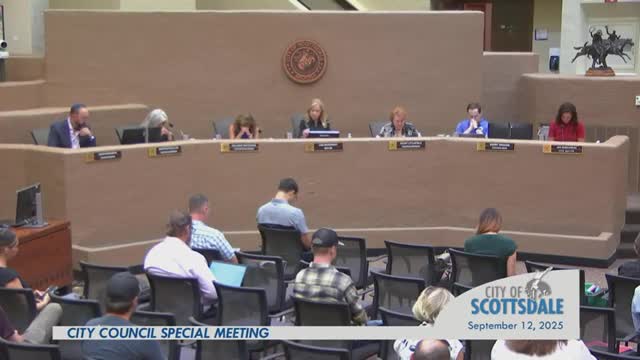
Summary
Scottsdale City Council voted to direct the interim city attorney to file a notice of claim preserving the city's ability to challenge the constitutionality of state law SB 1543 after an executive-session discussion on Sept. 9. The vote stops short of immediate litigation; an alternate motion to file a complaint for declaratory judgment failed.
Scottsdale Mayor Lisa Boroski and the City Council on Sept. 12 voted to authorize the interim city attorney and his designees to file a notice of claim consistent with direction given in an executive session on Sept. 9, preserving the city’s ability to challenge the constitutionality of state law SB 1543.
The vote authorizes a notice of constitutional challenge, sometimes called a notice of claim in the meeting, but does not itself open a lawsuit. Council debate centered on whether to move immediately to file a complaint for declaratory judgment or to preserve rights while negotiations with the project proponent continued; an alternate motion to authorize filing a formal complaint failed.
The action follows weeks of public comment and a citizen petition. Public speakers told the council they wanted a clear, immediate response: “The only meaningful step is to vote tonight to instruct the city attorney to fight a lawful to file a lawful suit against the state of Arizona and to seek an injunction,” said Andrew Wallman during public comment. Yvonne Cahill argued SB 1543 is “nothing more than a corporate handout” and cited Article 4, Part 2, Section 19 of the Arizona Constitution in support of a constitutional challenge.
Councilmembers who supported authorizing the notice of claim framed it as a procedural step to preserve legal options. Councilwoman Solange Whitehead moved to authorize the interim city attorney to file the notice of claim “consistent with the direction provided on September 9, 2025,” and a second was recorded. Vice Mayor Jan De Boskus said, “Now is not a time for excuses... I sit here ready today to fight for the residents of Scottsdale and to file litigation.”
Other councilmembers pressed caution. Councilman Barry Graham offered an alternate motion to authorize both a notice of claim and a complaint for declaratory judgment, saying the cost of litigation was justified to protect referendum rights. Councilman Adam Quasman and others said they wanted additional written advice from outside counsel before committing to a complaint; estimates discussed during the meeting ranged from about $600,000 to over $1 million in legal fees. Ethan Knowlton, a public speaker, warned the city would be litigating the state, not a private developer.
Mayor Boroski opened the meeting by saying the Sept. 9 executive session had provided legal advice and nonbinding direction and that the purpose of the special meeting was to formalize that direction publicly without disclosing privileged strategy. The council approved the motion to authorize filing a notice of claim; the transcript does not record a roll-call tally for the final vote.
Council members and public speakers repeatedly referenced the citizen petition effort that produced roughly 27,000 signatures seeking a referendum on the underlying rezoning; speakers said the petition reflected strong public interest in retaining local review. Several councilmembers also discussed negotiations with the project proponent and whether legal action could impede bargaining or drive the employer elsewhere. The meeting recessed into and returned from executive session during the discussion as allowed under state law.
The council’s authorization directs the interim city attorney and his designees to file a notice of claim as described in the Sept. 9 executive session. Council members said further decisions about filing a complaint or pursuing litigation would depend on the legal advice and on negotiation outcomes. The council adjourned after the vote.