
McHenry County Zoning Board continues Pebble Solar Farm hearing, requests wetland and tree studies
Get AI-powered insights, summaries, and transcripts
Subscribe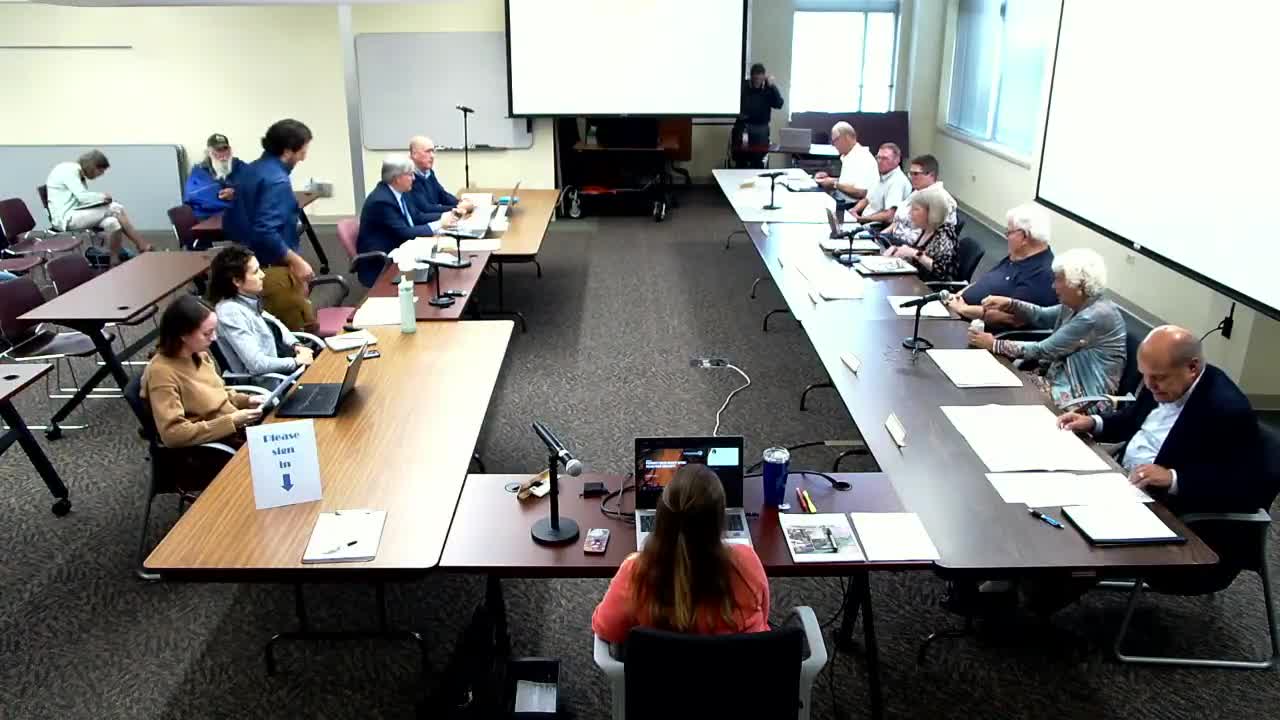
Summary
The Zoning Board of Appeals continued a conditional-use hearing on the Pebble Solar Farm after residents raised concerns about wetlands, remnant oak woodlands, setbacks and property values; the board set an Oct. 22 continuation and asked petitioners for additional ecological studies.
The McHenry County Zoning Board of Appeals continued its hearing on the Pebble Solar Farm conditional-use application and set a date-certain continuation for Oct. 22 at 1:30 p.m., requesting a wetland delineation and a tree health/inventory study before further action.
The board paused its review after extensive public comment and petitioner testimony that included a property-value expert’s summary of academic and paired-sales research and developer statements about design, setbacks and compliance requirements. The hearing record showed residents’ repeated concerns about impacts to remnant oak woodlands, Boone Creek watershed wetlands and nearby homes.
Why it matters: Board members said the county’s Unified Development Ordinance requires facilities to be “situated so as to minimize impacts to woodlands, savannahs, wetlands, drainage tiles and encroachment into floodplains.” Several members and nearby residents told the board they lacked enough site-specific ecological evidence to judge whether the current site plan minimizes those impacts.
Erin Bowen, a real‑estate appraiser and property‑value expert with Kone Reznik, told the board that her firm’s review of published academic studies and 40 paired‑sales analyses across the Midwest and U.S. did not find systematic adverse effects of solar facilities on adjacent residential sale prices. “Based off of our research and analysis of existing solar, we have found that there is no evidence to suggest that solar facilities decrease property values,” Bowen said. She noted a Loyola University Chicago study (Sept. 2024) that found a small positive effect in some Midwest cases and a Virginia Tech–edited study with mixed results, and said her firm relied on appraiser‑style paired sales rather than large‑scale statistical regressions.
Residents and conservation groups pressed for more local data. The Boone Dutch Creek Watershed Alliance and other commenters asked the board not to close the record until a formal wetland delineation and a tree inventory are completed. “The both wet and wooded area at the southeast end of the site should be wholly avoided,” said Cindy Skirkrood of the Alliance, asking petitioners to scale back arrays and to mitigate required tree removals within the Boone Creek watershed.
Petitioners and their consultants said additional technical work is customary after zoning approval and that final engineering, wetland delineations, tree surveys and stormwater designs are completed during permitting. Dylan Haber, lead developer for Cultivate Power, said project engineering and supplier choices were not finalized and offered to provide follow‑up documentation on panel securement and noise. Sarah Skronsky of Kimley‑Horn said wetlands shown in county GIS are desktop identifications and that formal field wetland delineations would be performed as part of permitting and stormwater review.
Board members debated whether the requested studies were part of the zoning application package or would be provided later during permitting. Several members said the county ordinance’s wording—requiring that the facility be “situated so as to minimize impacts” to natural features—means the board should see evidence the petitioner has considered and minimized those impacts before approving the site plan as currently drawn. Commissioner comments flagged a portion of the site’s southeast corner that the McHenry County Conservation District described as remnant oak woodland and asked for more specific, field‑verified information about tree quality and locations.
On procedural matters, the board accepted an amended motion to continue the hearing to Oct. 22 at 1:30 p.m. in the same room and recorded a roll call in favor of the continuance. The board also agreed to continue a related petition noted in the packet (petition #64) to the same date.
What’s next: The board’s continuation requests focus the record on on‑site ecological studies: a formal wetland delineation, a certified arborist/tree inventory and stormwater engineering that will be considered during permitting. Petitioners said they will pursue the delineation and tree survey and work with staff on compliance with the county’s tree/landscape and stormwater ordinances. The Oct. 22 session will reopen the conditional‑use hearing and take further testimony and staff analysis.
Votes at a glance: - Motion to continue Pebble Solar Farm hearing to Oct. 22 at 1:30 p.m., pending receipt of a wetland delineation and a tree study: approved (roll call recorded in favor).