Seattle’s 2026 proposed budget balances record housing spending with new public-safety revenue plan
Loading...
Summary
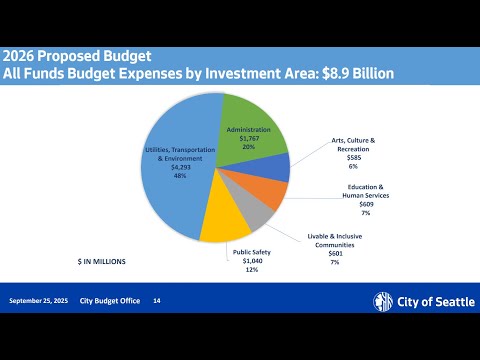
City Budget Office presented a balanced 2026 proposed budget on Sept. 25 that directs roughly $350 million to affordable housing, assumes a 0.1% public-safety sales tax that would raise about $39 million, expands shelter and care programs and includes $28–30 million set aside to respond to federal cuts.
The City Budget Office presented the mayor’s 2026 proposed budget to the Seattle City Council Select Budget Committee on Sept. 25, a spending plan the office described as balanced while relying on a mix of spending reductions, revised forecasts and new revenues.
The proposal includes a record level of affordable-housing investment — about $349.5 million for 2026 — assumes passage of a 0.1% public-safety sales tax that would raise roughly $39 million, and sets aside up to $28–30 million of anticipated new B&O (business-and-occupation) tax proceeds to respond to federal funding cuts affecting food assistance, immigrant and refugee services and emergency rental aid.
Why it matters: Budget director Dan Eder and central staff told the committee that the city arrived at a balanced proposal amid large swings in revenue forecasts this year, a continuing multiyear gap between rising costs and revenues, and specific, time-sensitive federal policy changes that the mayor and staff said could leave Seattle with sudden funding shortfalls.
Eder said, “The mayor’s proposed budget is fully balanced.” He and central staff described three broad categories used to reach balance: spending reductions and underspend realized in 2024–25, new revenue measures, and an improved August revenue forecast that partially offset a large spring forecast shortfall.
How the budget was balanced and where the money goes - Spending adjustments: The executive identified roughly $65 million of general-fund savings from 2024, expects about $30 million of underspend in 2025, and gathered department ideas that produced about $37 million of potential reductions targeted to minimize impacts on direct public services. - New revenues: The proposal counts on voter approval of the Seattle Shield changes to the B&O tax (the executive projects up to $81 million in additional B&O revenues if voters approve, with $51 million going to general-fund backfill) and assumes council approval of a 0.1% public-safety sales tax that would yield about $39 million; the budget treats the sales-tax proceeds as restricted to public-safety uses. - Forecast changes: The independent revenue forecast in April showed a $217 million shortfall for the general fund and payroll-expense tax (PET); an August update improved that position by about $95 million, leaving the city roughly $122 million below endorsed 2026 revenue assumptions.
Major investments called out in the proposal - Housing and anti-displacement: About $349.5 million for affordable housing in 2026 across multifamily capital, affordable homeownership, operations and services. The budget includes $5 million in 2026 toward the Northgate Commons project and a planned $20 million (of $80 million over four years) for an anti-displacement and reparations housing fund. - Homelessness and shelter: The proposal totals roughly $225 million for homelessness work in 2026. The executive would add $7.8 million to create and operate three new noncongregate shelters in 2026 (about 155 new units) and maintain operations for roughly 2,900 existing shelter units. The budget also includes about $125 million for the King County Regional Homelessness Authority (regional contribution). - Public safety and care: The budget assumes $39 million from a 0.1% public-safety sales tax and proposes to use roughly $15 million of that for ongoing operations supporting the city’s Care operations (crisis-response expansion). The proposal includes roughly $7 million to double the size of the crisis-responder team and extend responder hours, about $2.6 million to expand 911 call‑taking capacity, $6 million in new treatment investments (including roughly $1.8 million for Thunderbird treatment), $5 million to backfill lost state funding to Lehi, $2.1 million to add firefighter recruits (to 100 recruits in 2026), and $1.5 million for post-overdose treatment services. - Police staffing and costs: The city expects far more net new sworn officers than earlier anticipated. Eder told the committee that stronger recruitment and fewer separations produced 91 net new officers in 2025 (76 more than assumed in the adopted 2025 budget) and an expectation of 71 net new officers in 2026, generating additional costs that the executive estimates at roughly $13 million in 2025 and $26 million in 2026. - Human services and food: The mayor’s proposal includes $11.7 million to fund a 4.6% increase for human-services contractors (a 2.6% baseline adjustment required by city law plus a 2% market increase). The executive also proposed about $10.3 million in new food investments, with roughly $3 million of that directed to food banks (bringing total food-bank funding to about $6.5 million in the proposed budget). - Federal-response reserve: The budget allocates up to about $28–30 million of expected B&O proceeds to address federal policy and funding changes — immigration and refugee services (the executive proposes a $4 million increase to the Office of Immigrant and Refugee Affairs), food assistance, emergency rental assistance (a $4 million increase that would raise total rental-assistance funding to $11.5 million), and potential backfill for threatened national Continuum of Care reductions (the proposal adds about $9.5 million to allow partial backfill if needed).
Questions and next steps Committee members pressed the CBO and central staff for detail on the department-level cuts that were considered, the size and distribution of the 2025 underspend, the assumptions behind police hiring projections, how shelter investments relate to housing levy funds, and the operational evidence supporting Care expansions. Director Eder said central staff and executive teams will track unanswered questions and provide follow-up detail to the committee in the coming days.
The budget is the opening of an iterative process: central staff and departments will return with topical briefings and department overviews, the council will hold public hearings and amendment weeks, and the council aims to adopt the final 2026 budget later in the fall. Chair Dan Strauss said the committee will hold 19 meetings, six public-comment periods and two marathon public hearings over the next eight weeks.
Eder concluded his presentation to questions from the committee. The Select Budget Committee is scheduled to resume its sessions this afternoon and continue deliberations in public meetings through the council’s budget calendar.