Get Full Government Meeting Transcripts, Videos, & Alerts Forever!
Commission hears extensive public comment on proposed Technology Overlay District; staff outlines standards, commission continues hearing
Summary
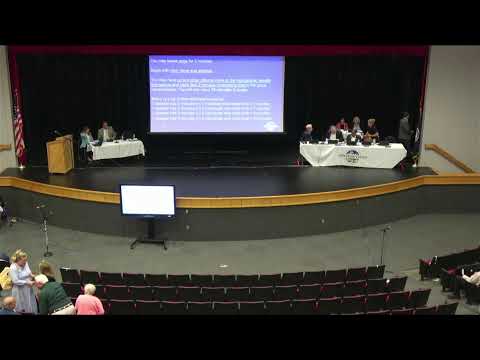
County staff presented a proposed Technology Overlay District and companion Technology Zone on Sept. 18; the Planning Commission continued the public hearing after hearing extensive public comment on noise, height, emergency power, and the inclusion of small modular reactors.
County staff presented a detailed proposal Sept. 18 to create a Technology Overlay District (TOD), a complementary Technology Zone for financial incentives, and an amendment to the 2035 Comprehensive Plan. The presentation by Sarah Worley, deputy county administrator for economic and community development, described where the TOD would apply, the uses it would allow, development standards intended to protect adjacent residential areas, and how the technology zone would provide incentive flexibility to attract high-revenue projects.
Worley said the TOD boundary was selected after county analysis of water, sewer, road, electrical and natural gas infrastructure and that the proposed overlay would cover roughly 2% of the county and about 21% of the county’s East End designated growth area. She said most land in the proposed overlay is already designated “prime economic development” in the comprehensive plan and much of it is already zoned industrial (M-1), including West Creek Business Park.
Worley outlined three elements of the initiative: the technology zone (a non-zoning ordinance that would permit financial incentives handled by performance agreements), the zoning ordinance amendments to establish the TOD, and a proposed comprehensive plan amendment to add “Technology Overlay District” as a land planning category. The technology zone would allow, for example, reduced utility connection fees when a return-on-investment calculation indicated a public benefit; Worley gave a hypothetical utility connection fee reduction from $2,000,000 to $1,000,000 as an example of the kind of flexibility that could be considered.
Worley said the TOD would permit technology businesses that are for‑profit enterprises deriving gross receipts from design, development, manufacture or sale of technology-based products or services, listing examples such as data centers and advanced manufacturing. The draft ordinance would also add definitions including “small modular nuclear…
Already have an account? Log in
Subscribe to keep reading
Unlock the rest of this article — and every article on Citizen Portal.
- Unlimited articles
- AI-powered breakdowns of topics, speakers, decisions, and budgets
- Instant alerts when your location has a new meeting
- Follow topics and more locations
- 1,000 AI Insights / month, plus AI Chat