
Hillsborough charter review hears split on expanding county commission; minority representation and maps dominate debate
Get AI-powered insights, summaries, and transcripts
Subscribe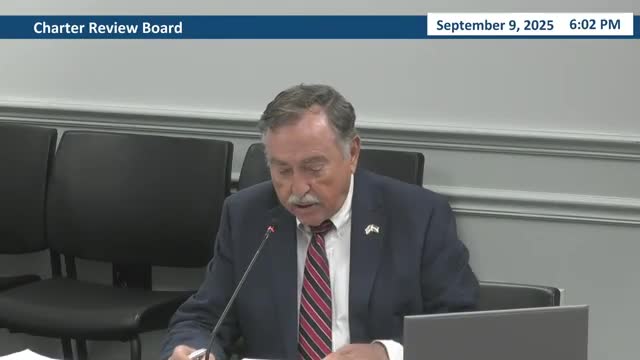
Summary
Hillsborough County’s Charter Review Board heard hours of testimony Sept. 9 on whether to change the makeup of the Board of County Commissioners, with current commissioners, a former commissioner and residents debating options that include keeping the current mix of countywide and single-member seats, converting to all single-member districts or expanding the board from seven to nine members.
Hillsborough County’s Charter Review Board heard hours of testimony Sept. 9 on whether to change the makeup of the Board of County Commissioners, with current commissioners, a former commissioner and residents debating options that include keeping the current mix of countywide and single-member seats, converting to all single-member districts or expanding the board from seven to nine members.
The debate focused on two questions: whether smaller, single-member districts would make commissioners more accessible to residents, and whether any change could preserve an existing majority‑Black seat required under federal voting‑rights law. The board voted to approve meeting minutes and deferred further votes and map work to its next meeting.
Why it matters: The county has surpassed 1.5 million residents, and several speakers said the current seven-member structure leaves some voters feeling distant from elected officials. Supporters of expansion argued that smaller districts would lower each commissioner’s constituent load and improve responsiveness; opponents said the change could dilute voting power and that the real test is how maps are drawn after any ballot decision.
County Commissioner Christine Miller, a countywide commissioner who attended and spoke at length, framed the choice as one of accessibility. “With smaller districts, commissioners can be closer to their constituents,” Miller said, urging the board to focus narrowly on whether to expand and not on map‑drawing. Miller told the board she favored nine single‑member districts or a 7/2 hybrid as a potential compromise and said she believed nine seats could preserve the county’s majority‑Black district while creating scope for a majority‑Hispanic district.
Not all commissioners agreed on benefits or risks. Commissioner Josh Wasel, who showed a map during his remarks and described operational tradeoffs from a countywide seat, said smaller districts would produce “significantly smaller maps” that could make it easier to protect a minority‑majority seat but warned of tradeoffs on staffing and cost. He also criticized staff practices that he said favor single‑member district allocations, saying, “there is absolutely 0 deference from staff to the countywide commissioners,” a point he used to underline how budget priorities and workload are presently assigned.
Former County Commissioner Marielle Smith, who led the county’s most recent redistricting as an elected official, cautioned the board that proposals to change the commission’s size or structure must be evaluated against concrete demographic maps and legal constraints. “When we drew the new maps, we were very careful not to commit retrogression,” Smith said, explaining that the most recent map kept a Black voting‑age population near 39 percent in the designated majority‑Black district. Smith urged the board to obtain map‑level demographic analysis before putting any structural change to voters.
Public commenters and several charter review members repeatedly raised the Voting Rights Act and unspecified federal cases from Jacksonville as legal guardrails that will constrain mapmakers if the board recommends changes. Several speakers emphasized that the charter review board’s role is to decide on the structure that goes to the ballot, while the county commission (if voters approve changes) would later oversee the map‑drawing process subject to federal and state law.
Other details raised in the discussion included staffing and cost: commissioners noted legislative aides cost roughly $100,000 each, that adding seats would increase staff costs, and that the county has a backlog on sidewalk trip‑and‑fall claims (cited at roughly 16 years) and underfunding in the road maintenance and repaving program (described in testimony as not 50 percent funded over the past 18 years). Several speakers said improving constituent services might be achievable by reallocating staff or increasing aides instead of changing the charter.
The board recorded one formal action at the Sept. 9 meeting: members moved and seconded to approve the meeting minutes included in the packet; the motion passed after an oral voice vote and the board set continuation of the district composition discussion for its next meeting, directing members to review supplemental materials distributed before the next session.
The Charter Review Board’s next step is to review the supplemental demographic and map examples staff provided, and to continue deliberations at its next meeting. Any structural change must ultimately be approved by voters and will be followed by a map‑drawing process that multiple speakers said will be governed by federal and state redistricting law.
Votes at a glance
- Motion to approve meeting minutes (text: “Motion to approve the minutes, that were included in our packet.”). Outcome: approved (motion and second noted; roll‑call not recorded in transcript).