Get Full Government Meeting Transcripts, Videos, & Alerts Forever!
Get email alerts on the Annexation Landuse Conflict topic
No spam. Unsubscribe anytime.
Gulf County and Port St. Joe pause dispute over annexation and land‑use change for 2.5‑acre parcel
Summary
At a Sept. 10 conflict‑assessment meeting, Gulf County officials reiterated legal challenges to Port St. Joe ordinances 618 (annexation) and 619 (land‑use change) for Parcel ID 4571 and agreed to recess to let the county, city and the parcel owner seek a negotiated proposal before mediation or further litigation.
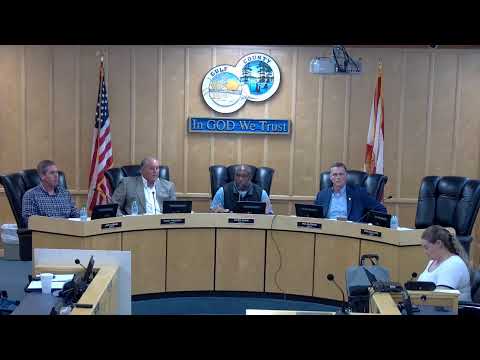
GULF COUNTY, Fla. — Gulf County commissioners held a conflict‑assessment meeting Sept. 10 with Port St. Joe officials to attempt to resolve the county's opposition to two city ordinances that annexed and changed the land use of a 2.5‑acre parcel in the city’s industrial park.
The county opposes City of Port St. Joe Ordinance 618 (annexation) and Ordinance 619 (land‑use change) and has filed court challenges; county legal staff told commissioners the conflict assessment is a required statutory step before mediation or further litigation. County Attorney said, “The conflict assessment is a step required by statute,” and described legal filings that are pending in the Fourteenth Judicial Circuit.
The dispute centers on Parcel ID 4571 (2.5 acres), owned by HK Gulf Coast Holdings LLC, inside the city’s industrial area. Gulf County officials contend the city’s notice for the public hearings was defective, that the land‑use change amounts to illegal spot zoning, and that the change conflicts with Port St. Joe’s comprehensive plan and Florida law. The county has cited Florida Statute 171 (annexation procedures) and Florida Statute 163 (comprehensive planning) in its written challenge and adopted Resolutions 2025‑43 and 2025‑44 opposing the ordinances on Aug. 26.
County legal staff told the commission the county filed a complaint for declaratory judgment and an injunction challenging Ordinance 619 and a writ of certiorari challenging the annexation in Ordinance 618; both pleadings were described as substantial filings (the county attorney described the complaint as about 70 pages and the writ as roughly 450 pages) and are currently in the court system but not yet served on the city.
City officials told the meeting they would consider working with the county to avoid protracted litigation. The Port St. Joe mayor asked local officials, “What do you think we should do?” and later expressed willingness to discuss solutions that support both workforce housing and industrial development.
The meeting record shows several areas of disagreement. County commissioners and staff stressed that the parcel and surrounding area have been designated industrial under the county comprehensive plan (adopted retroactive to 1990 and finalized in 1992) and warned that allowing a residential land‑use designation on the parcel could undermine the larger industrial zoning of the area. As one county commissioner put it, “Smart growth is when you have comp plans and you follow your comp plans.”
City officials and some commissioners raised the county and city need for workforce housing and described an active city project elsewhere — a donated 65‑acre tract the city says could yield roughly 25–30 usable acres and a potential 172 units (a mix of single‑family and multifamily). City staff said they have engineering and a road plan for that project but need about $1.7–$2.3 million for access.
The city’s presentation to the county reported that the city had processed the parcel under its residential category “3” (maximum 15 units per acre), which for roughly 2.3 acres would yield about 30 units; the parcel was said in the city record to have been platted historically as 12 lots.
Rather than conclude the conflict assessment, Gulf County commissioners agreed to recess the meeting and give the county, the city and the parcel owner (referred to in the record as Miss Haddock) at least one week to negotiate a proposal. County legal staff recommended abating the mediation requirement while the parties attempt to reach agreement; if no agreement is reached, the statutory process (mediation followed by litigation if necessary) will proceed.
The commission’s next steps are to receive any written proposal from the parties, reconvene the conflict‑assessment meeting within the week following that submission, and—if necessary—enter the formal mediation required by Florida law.
Ending: The conflict assessment ended with an explicit plan to recess and reconvene after staff from both jurisdictions and the parcel owner draft a proposal. If the parties cannot reach a negotiated settlement, the county attorney said the county will continue with mediation and pursue its court filings in the Fourteenth Judicial Circuit.