
City staff outline public‑safety sales‑tax option and three‑year grant opportunity to help fund defenders and officers
Get AI-powered insights, summaries, and transcripts
Subscribe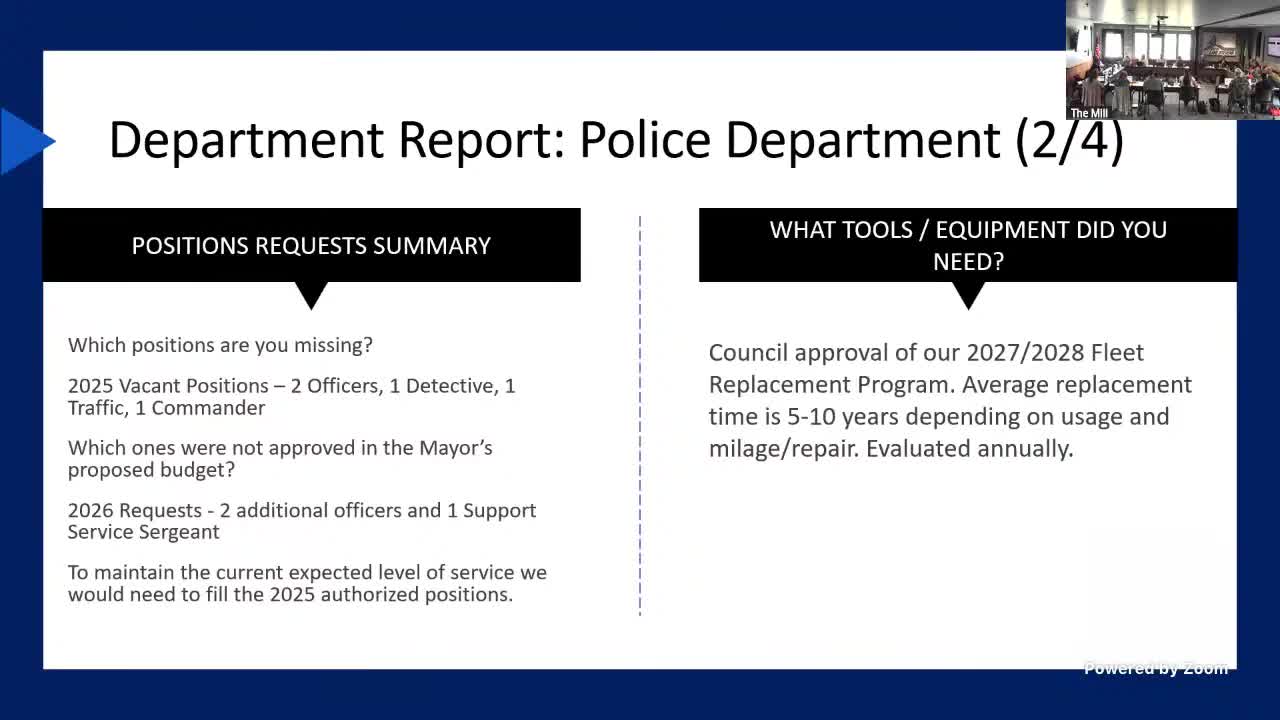
Summary
Staff briefed council on a councilmanic 0.1% public‑safety sales tax that could raise roughly $800,000 annually, and on a competitive three‑year CJTC grant that partially funds new public‑safety positions; staff outlined eligibility, timing and caveats.
At the retreat, staff explained two linked mechanisms available to Lake Stevens to increase public‑safety funding: (1) a councilmanic 0.1% public‑safety sales tax the city can adopt and (2) a three‑year grant administered by the Criminal Justice Training Commission that requires a local match and program eligibility.
The 0.1% sales tax (if adopted locally) would yield in the order of roughly $800,000 per year for the city under current sales‑tax projections, according to staff estimates provided at the retreat. The sales‑tax statute allows cities to fund a broad range of public‑safety and criminal‑justice related expenditures — for example, support for public defenders, domestic‑violence services, diversion programs, behavioral‑health crisis response and other public‑safety needs — though staff noted the statute’s authorization is intentionally broad and local councils choose how to prioritize uses.
A related grant program administered by the Criminal Justice Training Commission offers multi‑year funding (75% of salary up to specified thresholds) for newly created public‑safety positions; staff stressed that the grant typically requires a 25% local match and that the grant expects new positions rather than lateral hires. The two programs are linked because meeting the grant’s eligibility often requires an existing local revenue commitment (for example, the local sales tax).
Staff noted practical constraints: the grant is competitive and subject to program requirements — such as training benchmarks and policies for use‑of‑force reporting — that the city must meet. The sales tax option would need council action to notify Department of Revenue if the city wants the tax effective on January 1 (staff cited an October notice deadline), or otherwise the city could place the tax on a ballot. Staff emphasized the tax is perpetual unless repealed, while the grant runs for fixed multi‑year periods and would not cover long‑term operating costs indefinitely.
Police leaders said additional recurring funding would help with both hiring and with support functions (training, fleet and wellness) but noted hiring remains constrained by the regional labor market and downstream costs such as academy and field training.
Ending: Staff recommended bringing a public‑safety sales‑tax proposal for council consideration at an upcoming meeting and promised to return with an implementation timetable and recommended prioritization of eligible spending tied to community needs.