Get Full Government Meeting Transcripts, Videos, & Alerts Forever!
Votes at a glance: council approves study of floodgates, childcare food grant, lawn bowling license and pavement contract
Summary
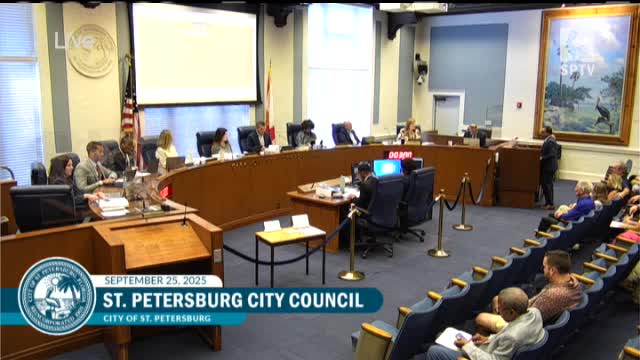
On Sept. 25 the St. Petersburg City Council approved a river of routine and high‑impact items: a regional floodgate feasibility study for Shore Acres and nearby neighborhoods, a $262,000 childcare snack grant, a license renewal for the St. Pete Lawn Bowling Club with follow‑up conditions, and an accelerated pavement contract amendment.
St. Petersburg City Council approved four notable items during its Sept. 25 meeting after short presentations and targeted discussion: a study and initial funding for tidal gates and wet‑weather storage in the city’s northeast quadrant; continuation of a state child‑nutrition grant for after‑school snacks; a license renewal with conditions for the historic St. Pete Lawn Bowling Club; and an amendment to an accelerated pavement contract.
Quick summaries and results
1) Floodgates and Northwest plant equalization feasibility (Agenda item F2) - What passed: Council approved staff’s recommendation to move forward with a feasibility and design planning process focused on installing tidal gates and EQ/wet‑weather storage in the area that discharges to Tampa Bay (the Shore Acres vicinity and connected stormwater basins). The item was pulled for discussion and then approved unanimously. - Why it matters: Public Works staff and consultants told council that some portions of the stormwater/wastewater system are tidally impacted. The Wade Trim study evaluated nine candidate sites, ranked them for storage volume and construction complexity, and highlighted site tradeoffs. Staff emphasized that detailed hydraulic modeling and federal/state permitting (including Army Corps, Florida Fish & Wildlife and NEPA processes) are required before construction can proceed. - Key technical note from staff: consultants used a planning goal of at least 5 million gallons of EQ storage and noted that an additional 6 inches of a downstream water body could equate to tens of millions of gallons of storage…
Already have an account? Log in
Subscribe to keep reading
Unlock the rest of this article — and every article on Citizen Portal.
- Unlimited articles
- AI-powered breakdowns of topics, speakers, decisions, and budgets
- Instant alerts when your location has a new meeting
- Follow topics and more locations
- 1,000 AI Insights / month, plus AI Chat