
North Dakota Supreme Court hears challenge to terrorizing charge after knife encounter
Get AI-powered insights, summaries, and transcripts
Subscribe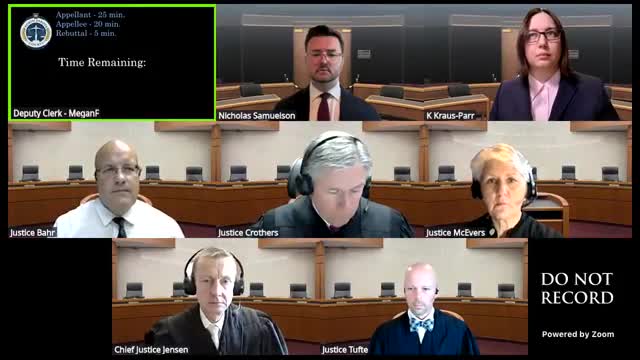
Summary
The North Dakota Supreme Court heard oral argument in an appeal by Daniel "Mr. King" challenging a terrorizing conviction that stemmed from a brief, five‑second encounter in which he drew a knife near a woman at a gas station.
The North Dakota Supreme Court heard oral argument on whether a terrorizing conviction based on a brief encounter in a gas station parking lot violated the appellant’s constitutional rights.
Appellant counsel Miss Crosspar argued that the terrorizing statute, as applied to Mr. King, is unconstitutionally vague and overbroad. Crosspar told the court that the encounter lasted about five seconds, that surveillance video shows Mr. King removing a knife from a belt sheath and walking toward a vehicle, and that “we can't have the basis of a terrorizing charge be her subjective fear.” Crosspar said the jury acquitted Mr. King of the concealed‑carry charge but convicted him of terrorizing and argued the conviction effectively prevents him from exercising constitutionally protected rights to carry weapons openly in public.
The state, through Mister Samuelson, urged the court to affirm. Samuelson told the justices the terrorizing statute requires a mens rea element—intent to cause fear or reckless disregard—and a threat of violence, and that the facts here (a dimly lit parking lot, a witness’s testimony that Mr. King “threw his bike down, drew his knife, and came at the victim” with an angry look) permitted a reasonable jury to find the elements. “This court should affirm the criminal judgment because Mister King has failed to establish obvious error,” Samuelson said.
Why the appeal matters
The case tests how broadly the state may apply a terrorizing statute when a private person reports fear after seeing another person openly carry a weapon. Crosspar argued an as‑applied overbreadth claim: applying terrorizing to Mr. King’s conduct, she said, would criminalize ordinary open carriage of weapons whenever a bystander felt fear. The state countered that the statute contains scienter and threat elements that exclude mere possession or display of a weapon.
Arguments and courtroom exchanges
Crosspar emphasized objective limits on criminal liability and said the prosecution relied on the witness’s subjective fear and on the state’s contention that Mr. King displayed a reckless disregard for that fear. She told the court the video does not show threats or pointing and that the witness’s memory may have been influenced by fear: she “felt terror” and later reported nightmares and changes in travel to work. Crosspar also cited Keller v. Keller and U.S. Supreme Court precedents on the right to bear arms in arguing that open carriage cannot be converted into terrorizing liability solely by a witness’s subjective reaction.
Several justices questioned whether a jury could infer intent from the video. At one point, Justice Douglas Barr asked, “Why can't they infer intent from watching the video?” Crosspar answered that allowing that inference in every open‑carry situation would permit prosecutors to bring terrorizing charges based on any bystander’s subjective fear.
Samuelson disputed Crosspar’s characterization and urged adherence to the obvious‑error standard that limits appellate review of constitutional claims not raised below. He told the court he found no controlling precedent holding the terrorizing statute unconstitutionally vague or that overbreadth extends outside First Amendment doctrine; he cited Salerno and other cases to argue overbreadth is principally a First Amendment tool and that a novel extension would fail the second prong of obvious‑error review.
Courtroom context and facts in the record
According to arguments, the encounter occurred early in the morning (Crosspar indicated about 4 a.m.; Samuelson described it as “still dark” and with no one else around). Counsel said the interaction lasted about five seconds and that surveillance video was shown to the jury. The victim testified she felt threatened, had nightmares afterward, and altered travel arrangements; Crosspar said the victim also testified she did not know Mr. King’s intent and left to call police rather than remain to find out. Counsel reported that jurors acquitted Mr. King of carrying a concealed weapon but convicted him of terrorizing.
No decision at argument
No decision was read from the bench during the argument. The justices asked questions about procedural posture—specifically, whether the appellant’s arguments implicate obvious‑error review because the constitutional claims were not raised below—and about how existing precedent (including Keller and U.S. Supreme Court Second Amendment cases) should guide the court’s analysis.
Next steps
After oral argument the court will take the matter under advisement and issue an opinion explaining whether the conviction must be reversed on constitutional grounds or whether the judgment should be affirmed. The record shows competing factual accounts (the surveillance video and the victim’s testimony) and a legal dispute over the proper scope of the terrorizing statute when it intersects with the right to bear arms.