
Binghamton mayor unveils roughly $111 million 2026 budget with modest tax cuts and heavy public‑safety, housing and infrastructure spending
Get AI-powered insights, summaries, and transcripts
Subscribe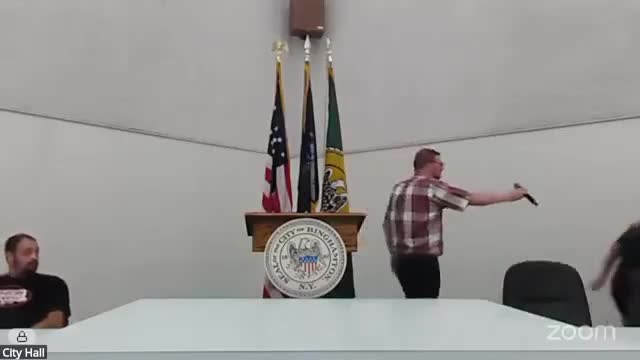
Summary
At a Committee of the Whole meeting, the mayor presented the city’s proposed 2026 budget — about $111 million — that lowers property tax rates slightly, keeps water/sewer/refuse fees steady, and boosts spending on police staffing, fire apparatus and housing rehabilitation while allocating funds for demolition and downtown revitalization.
The mayor of Binghamton presented the city’s proposed 2026 budget at a Committee of the Whole meeting, proposing a budget of roughly $111,000,000, slight reductions in property tax rates, and targeted investments in public safety, housing and infrastructure.
The proposal would reduce the homestead tax rate by 0.1% and the nonhomestead rate by 1.7%; it would not increase water, sewer or refuse fees. The mayor said the budget “includes $78,800,000 federal fund that supports the day to day operations of the city” and that the city has increased its fund balance to $14,000,000.
Why it matters: the budget shapes staffing and service levels for police and fire, funds ongoing housing rehabilitation and downtown revitalization projects, and underpins multiple infrastructure projects citywide.
The spending plan allocates major amounts to public safety. The Binghamton Police Department’s proposed 2026 budget is $16,100,000, intended to support personnel and community‑oriented policing. The mayor said the city increased officer pay, adopted a citywide paid parental‑leave policy, expanded recruitment and modernized rules to retain officers; he noted a recent civil‑service test had more than 120 applicants, “more than triple the number” who took it five years earlier. The mayor said violent crime is down 30% since he took office and that index crime is “at its lowest levels on record,” citing FBI statistics.
On behavioral‑health response, Broome County Mental Health has an RFP under way and the county is “doubling the funding” for the mobile crisis program, the mayor said; the city proposes a $100,000 allocation in 2026 to support vehicles, gear, training and start‑up costs as Broome County and local law enforcement redesign 911‑linked crisis response.
The mayor announced a new city attorney position dedicated to public‑safety work, including coordinating with the fire marshal on vacant and condemned properties and supporting prosecutions against problematic property owners. The Binghamton Fire Department’s 2026 budget is proposed at $12,300,000. Planned capital investments include replacing an aging fire truck used by Station 2 ($1,900,000), purchasing new hazmat and utility trucks, and creating a $100,000 capital fund for turnout gear. Architects and public‑safety analysts are studying siting and design for a new North Side fire station to replace a 65‑year‑old facility; the mayor said he is working with Congressman Josh Riley to pursue federal grant funds for design and construction.
Housing and blight: the mayor highlighted record residential construction last year ($56,700,000 in permitted housing construction) and listed ongoing projects (111 units on Court Street; 257 units at Town and Country Apartments; 100 units rehabilitated at Saratoga Heights; 12 new units on Munsell Street, half reserved for seniors; 120 workforce units proposed at 187 Clinton Street; 19 units by First Ward Action Council; and a 64‑unit “stadium lofts” workforce project cited at $27,000,000). The city reported allocating federal funds in recent years to support these projects and continues partnerships with the Broome County Land Bank; the mayor said the city provided a $2,000,000 grant to the land bank’s affordable homes program.
To address persistent blight, the mayor proposed $300,000 in the 2026 budget for demolition and expanded cleanup, including demolition of tax‑foreclosed properties. The mayor said some properties have been in legal limbo awaiting county foreclosure.
Downtown and infrastructure: the city secured $10,000,000 in New York State Downtown Revitalization Initiative funding for Clinton Street; the mayor said 55 project proposals totaling nearly $119,000,000 responded to the call for projects and that the city will spend $6,100,000 on a Clinton Street streetscape. The budget proposes $10,000,000 for the neighborhood street program (paving, sidewalk and water/sewer replacement), a $5,000,000 Shenango Street reconstruction, and continuing a redesign of the Memorial Bridge (the mayor said the bridge carries about 15,000 vehicles per day). The mayor said Binghamton worked with the Binghamton Metropolitan Transportation Study (BMTS) to secure more than $5,000,000 in grant funding that would cover about 80% of certain bridge and streetscape project costs.
Parking and water: the State Street parking garage is slated to be demolished; the mayor said the site is nearly 1.5 acres and will be replaced short‑term with a surface lot while long‑term redevelopment is planned. At the city’s water filtration plant, the mayor proposed a $3,000,000 investment in a whole‑plant generator system to protect water service during power outages and described the city’s expanding role supplying water to nearby municipalities.
Federal‑and state‑funded programs: the mayor said the city will again use HUD funding in 2026, including Community Development Block Grant dollars, to support housing repairs, homelessness services and youth programs; he cited figures for specific allocations in his remarks. He also highlighted state programs that can fund new single‑family construction on city‑owned vacant lots and other state funding sources supporting housing and downtown projects.
Quotes and context: the mayor quoted President Lyndon B. Johnson’s Housing and Urban Development Act signing: “We must make sure that every family in America lives in a home of dignity and a neighborhood of pride, a community of opportunity, and a city of promise and hope,” and said the city’s budget “speaks to those goals.” He added, “We want to be a city under construction, a city transforming, a city of promise and hope.”
Process and next steps: Robert Kavanaugh, finance chair of city council, opened the meeting and said the council will hold budget hearings over the coming weeks. No final vote on the 2026 budget was recorded during the address; the mayor presented the administration’s proposal and council review and hearings were described as forthcoming.
Ending: the mayor framed the proposal as the fiscal foundation for continuing public‑safety improvements, housing rehabilitation, downtown investment and infrastructure upgrades in 2026, and urged the council and community to “get to work.”