Get Full Government Meeting Transcripts, Videos, & Alerts Forever!
Get email alerts on the Seasons At Cary Pud topic
No spam. Unsubscribe anytime.
Zoning board backs Seasons at Cary with one-way New Haven link after traffic fight
Summary
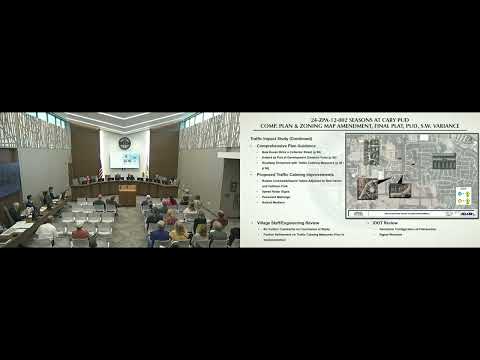
The Village of Cary Board of Zoning and Planning Appeals voted 5‑0 on Sept. 11 to recommend approval of the Seasons at Cary planned development (case 24ZPA12002) while imposing a condition that the New Haven Drive connection be built as a one‑way outbound link from the Cambria cul‑de‑sac, with emergency access allowed.
The Village of Cary Board of Zoning and Planning Appeals on Sept. 11 voted 5-0 to recommend the Seasons at Cary planned development to the Village Board, and required that the proposed New Haven Drive connection be built as a one-way outbound (westbound) link from the existing Cambria cul‑de‑sac into the new development, with an emergency‑vehicle exception.
The recommendation covers five approvals the developer sought for the project known on the agenda as case 24ZPA12002: a comprehensive plan land‑use map amendment, rezoning from B‑2 Shopping Center District to a combination of B‑2 and R‑3 Multifamily District, final plat of subdivision, approval of a planned development covering the multifamily component, and a variance from the McHenry County stormwater ordinance. The matter will go next to the Village Board for final action; staff said the earliest Village Board meeting for the item is Oct. 7.
Why it matters: the proposal would convert the former Damish Farm site along Illinois Route 31 into a mixed commercial/multifamily development that the petitioner says would include roughly 360 multifamily apartments and seven lots. Residents who live on New Haven Drive and in the adjacent Cambria subdivision strongly opposed allowing a two‑way through‑connection, saying it would increase cut‑through traffic, create safety risks for pedestrians and schoolchildren, and could depress nearby home prices. After presentations from the developer and consultants, the petitioner offered a compromise — a one‑way outbound connector — and the ZPA adopted that as a condition of its favorable recommendation.
The application and departures: the petitioner asked to reconfigure the site so commercial uses front Route 31 and multifamily sits behind them, create seven lots of record, and approve a planned development for about 360 apartments with several departures from standard zoning: reduced front and interior setbacks (examples cited in staff materials included a reduction from 30 feet to 15 feet along the new extension of New Haven Drive and from 30 feet to 24 feet along an interior access drive), a reduction in required off‑street parking (staff packet figures were presented by the petitioner), an increase in maximum density from 9 units per acre to 13 units per acre, and more monument signage for the multifamily portion (from 1 monument sign to 3). The developer also sought a variance from the county stormwater ordinance to increase basin drawdown time from 72 hours to 96 hours.
Traffic and signal analysis: the petitioner submitted an updated traffic impact study dated Sept. 2 that expanded the study area and incorporated comments from village staff, the village engineering consultant and IDOT. The traffic consultant, Louay Abuna of KLOA, told the ZPA the study tested multiple origin zones and travel‑time scenarios and concluded most redistributed traffic would come from the neighborhood immediately west of the site (the consultant labeled it Zone 1). Abuna said the study estimates daily traffic on the New Haven section at the east property line would be roughly 1,700 vehicles per day with a full connection and about 900 vehicles per day if the connection were made outbound only.
Abuna said the study shows the location meets volume criteria used in signal‑warrant analyses: “we're anticipating 174 vehicles coming out of the driveway in the morning, [and] 113 in the PM,” numbers the consultant said exceed a 100‑vehicles‑per‑hour threshold used by the Manual on Uniform Traffic Control Devices that IDOT applies. The village’s traffic reviewer, HR Green, told the board it had reviewed the revised study and found the methodology and assumptions consistent with standard traffic engineering practice.
IDOT told the petitioner that a signal at the intersection with Route 31 is a likely, but not immediate, outcome: preliminary comments said a signal would be warranted once traffic volumes reach the applicable thresholds and that IDOT would not install signal equipment until that warrant is met. Village staff and the petitioner said they would continue to coordinate with IDOT on any future signal installation.
Market and other technical studies: the petitioner presented a market impact analysis by Marus and Company that compared nearby sales to similar developments and concluded it found “no market data indicating the project will have a negative impact on residential property values in the nearby area,” as appraiser Steven Viscara summarized to the ZPA. Village staff said they reviewed the report and accepted the methodology and findings.
Public comments: more than two dozen residents spoke during public comment, nearly all urging the ZPA to preserve New Haven Drive as a cul‑de‑sac and to deny a full two‑way connection. Common themes included fears of increased cut‑through traffic to Route 31 and to retail (Walmart and other businesses), worries about traffic safety near parks and schools, concerns about parking changes on New Haven, and unease about potential impacts on home values and school enrollment. One resident said New Haven was “a beautiful street” and that opening it “would destroy the safety, the serenity, and the sanctity of our neighborhood.”
Developer’s offer and board action: the petitioner, Tony DeRosa of Fiduciary Real Estate Development, told the board he and his team were able to study alternatives and said they were “open to a one‑way access as an alternate solution,” language the board cited when it added the unidirectional condition. The ZPA then voted 5‑0 to recommend the package of approvals to the Village Board, with conditions in the staff report plus the new condition that the New Haven connection be operated as one‑way outbound from the existing Cambria cul‑de‑sac to the new development, with provisions for emergency‑vehicle access and further village review of final traffic‑calming designs.
Votes at a glance: - Case 24ZPA12002 — Seasons at Cary planned development (recommendation to Village Board) - Approvals recommended: comprehensive plan land‑use map amendment; rezoning B‑2 to B‑2/R‑3; final plat of subdivision; planned development approval for multifamily; variance to McHenry County stormwater ordinance (drawdown 96 hours requested) - Motion outcome (ZPA recommendation): approved 5‑0 (Williams, Graziano, O’Laughlin, Trendell, Corey — yes) - Key condition added by the ZPA: New Haven Drive connection to be made one‑way outbound (westbound) from Cambria into the new development, with emergency‑vehicle exception; petitioner to refine traffic‑calming measures with village staff and village engineer prior to final engineering and building permits.
What’s next: the ZPA’s recommendation will be transmitted to the Village Board, which will consider final action; staff said the earliest Village Board meeting for this item is Oct. 7. If the Village Board approves the project, additional engineering approvals, IDOT permitting for access on Route 31, and final plat recordation would be required before site construction.
Quotes: - Village planning staff: Brian Simmons, director of community development, said staff reviewed the market report and “concurred with [the] methodology” and accepted its findings. - Appraiser Steven Viscara, Marus and Company: “there is no market data indicating the project will have a negative impact on residential property values in the nearby area.” - Traffic consultant Louay Abuna, KLOA: the study showed most redistributed traffic would come from the neighborhood immediately west of the site and estimated “about 1,700 cars a day” at the east property line with a full connection. - Petitioner Tony DeRosa, Fiduciary Real Estate Development: the petitioner said the team was willing to consider alternatives and “are open to a one‑way access as an alternate solution.”
Context and limits: the ZPA action this evening is only a recommendation; final authority rests with the Village Board. IDOT retains jurisdiction over access permitting on Illinois Route 31 and will decide if and when a traffic signal is installed; both IDOT’s warrant process and post‑development traffic counts influence that timing. The stormwater variance and other engineering approvals will require further technical review before issuance of building permits.