Get Full Government Meeting Transcripts, Videos, & Alerts Forever!
Get email alerts on the Solar Ordinance Amendment topic
No spam. Unsubscribe anytime.
Davenport planners review proposed Title 17 changes to define residential, commercial and utility solar use; staff to revise draft
Summary
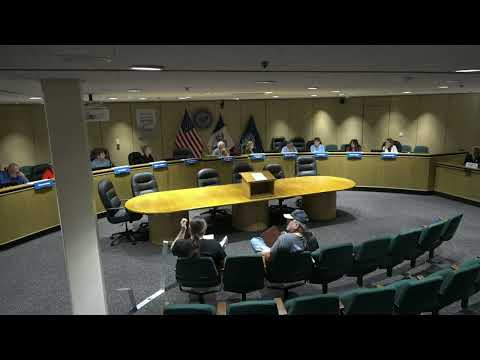
The Davenport Plan and Zone Commission spent the Sept. 16 meeting reviewing a proposed amendment to Title 17 that would define accessory and principal solar uses, set size and setback limits, require decommissioning plans for larger arrays and set battery siting rules; no formal vote was taken and staff was directed to return with revisions.
On Sept. 16, the Davenport Plan and Zone Commission discussed a proposed amendment to Title 17 of the Davenport Municipal Code that would clarify when solar installations are accessory uses versus principal uses and impose new standards for commercial, community and utility-scale solar.
The proposal, presented by planning staff member Matt, would treat freestanding accessory solar differently from building-mounted panels, limit residential freestanding solar to rear yards and cap accessory freestanding arrays at 50% of the principal building footprint. Staff did not seek a final vote; commissioners provided direction and asked staff to revise the draft and return with edits.
Commissioners and staff said the changes aim to give clearer rules after a recent moratorium and public discussion. "My intention here is to build your understanding of the ordinance, to kind of get an idea of why we're doing this," Matt said during the presentation, asking the commission for feedback on where the city should draw lines between accessory and principal solar.
Key provisions discussed
- Residential accessory freestanding solar: The draft would restrict freestanding accessory systems in residential districts to rear yards and to a maximum of 50% of the home's footprint (the proposer described 50% as a commonly used metric to keep an accessory use subordinate to the principal use). Commissioners asked staff to consider exceptions for through lots and lots where the functional rear yard faces a street.
- Building-mounted panels: The draft does not propose changes to building-mounted solar (roof- or structure-mounted systems), which staff said remain an alternative to freestanding arrays.
- Commercial and industrial: The draft ties accessory solar on commercial properties to 50% of the commercial building and limits industrial accessory freestanding solar to 50% of the developed area of a site. Staff used an example of a 106,000-square-foot light-industrial site where half of the developed area would allow roughly 52,000 square feet of solar (about 500 kW), and commissioners debated whether larger arrays should be encouraged when mounted over parking.
- Community-scale and setbacks: Staff proposed that community-scale solar undergo a special-use review in some districts, set a suggested maximum panel height (discussion centered on 10 feet), and consider a standardized setback where district standards are inconsistent.
- Agrivoltaics: The draft would permit agrivoltaics (collocated agricultural production and solar) in agricultural districts and allow it by special use in open-space and institutional districts, though commissioners asked staff to return with more detail about how that interacts with nearby residential uses.
- Utility-scale solar: For larger utility-scale farms, staff proposed anti-glare requirements, a third-party glare/viewshed study, stormwater and site-maintenance plans, and a decommissioning plan. Staff described options for financial assurance for decommissioning — escrow, surety bond, parent-company guarantee or letter of credit — and cited Woodbury County’s approach, which requires an estimated decommissioning cost in current dollars and 125% of that cost provided before ground disturbance.
- Batteries and safety: The draft recommends siting batteries at least 500 feet from an occupied structure and 200 feet from a property line or stream; commissioners noted that such distances could be difficult to meet on smaller or constrained sites.
Community concerns and enforcement
Commissioners and members of the commission raised recurring concerns about aesthetics, neighborhood impacts, maintenance and long-term abandonment. Commissioner Hefner said he was concerned by the prospect of many freestanding units in front and side yards: "I don't like that. That makes me a little nervous," he said, arguing that freestanding systems are more visible than rooftop installations.
Staff noted maintenance and code enforcement are already part of accessory-use requirements: inoperable or damaged systems must be repaired within 12 months or be subject to municipal enforcement. Commissioners asked staff to research inspection and upkeep requirements and scenarios in which an installer or owner abandons an array.
Direction to staff (no formal vote)
Commissioners did not take a formal vote on the proposed amendment. Staff said there was adequate direction to revise the draft. Laura, a staff member who coordinates the item, said she would return with edits reflecting the commission’s direction: treat low-intensity commercial separately from other commercial districts; add exceptions for through lots and condo/common-area situations; consider targeted allowances for over-parking carports; refine decommissioning financial-assurance and maintenance provisions; and examine battery siting language.
What happens next
Staff will prepare a revised draft and return to the commission for further review; no formal motion or ordinance vote was recorded at the Sept. 16 meeting. Any future ordinance changes would follow the city’s public-review process, which may include additional public comment and a recommendation to city council.
Votes and formal actions: none recorded on the solar ordinance amendment; staff directed to revise and return.