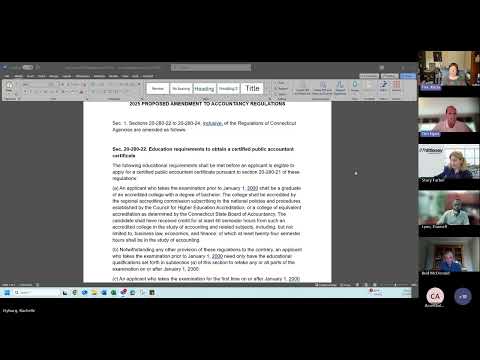
Consumer Protection Department board adopts draft CPA regulation revisions defining "accounting concentration" and issues interim guidance
Loading...
Summary
The board voted to adopt draft revisions to CPA licensing regulations that define an "accounting concentration," clarify education and experience pathways, and tighten supervising-CPA verification language; staff may use the draft as interim guidance until formal promulgation.
The Consumer Protection Department board voted to adopt draft revisions to its certified public accountant licensing regulations that define an "accounting concentration," clarify education and experience pathways, and revise rules for verifying qualifying experience. The board also approved DCP staff using the draft as interim guidance while the regulations proceed through formal promulgation.
The changes establish an education definition the committee described as a 27-semester-hour accounting concentration (which may include the introductory accounting course) together with 24 semester hours in economics and business administration or equivalent coursework as determined by the board. The draft adds language allowing the board to recognize equivalent coursework for license mobility from other states.
Board members said the committee considered a nationwide survey of state requirements and the recent statutory changes that removed the Uniform Accountancy Actprovision on substantial equivalency. The regulation draft sets experience thresholds linked to education: applicants who possess the defined accounting concentration must document two years of qualifying experience; applicants without the concentration but with an additional 30 semester hours or a post-baccalaureate degree would qualify with one year of experience. The draft also revises verification forms and updates the definition of a qualified supervising CPA to require a current valid CPA license or recognized practice privilege and to have been licensed continuously for no less than three years throughout the verified period.
Board members discussed how the revisions could affect academic programs. Several members said some universities moved many credits into graduate programs after the 150-hour shift, which complicates returning to earlier curricula. The board noted that colleges that preserved undergraduate core accounting courses (the board cited one example as UConn) would more readily meet the new concentration definition, while institutions that shifted more requirements into master's-level electives might need curricular review and campus approvals.
The board also debated whether the phrase "acceptable to the board" should modify the degree or the institution. Members agreed to substitute language used elsewhere in the draft tying acceptability to accreditation by a regional accrediting commission (or equivalent as determined by the board), rather than leaving an open "acceptable to the board" phrase that could be read broadly. That change was incorporated into the draft before the votes.
Two formal motions passed during the meeting: first, to adopt the draft regulation revisions to be promulgated through the department's regulatory process; second, to authorize DCP staff to use the draft as guidance in licensing reviews pending final promulgation. Board members acknowledged the drafts are not yet law and said the national AICPA/NASBA/Uniform Accountancy Act committee may produce additional guidance within months that could prompt further revision.
The board chair closed the meeting after the two votes and thanked the regulations committee and staff for their work.