Get Full Government Meeting Transcripts, Videos, & Alerts Forever!
Get email alerts on the Law Enforcement Budget topic
No spam. Unsubscribe anytime.
Weber County officials review law-enforcement budget split between countywide services and contract cities
Summary
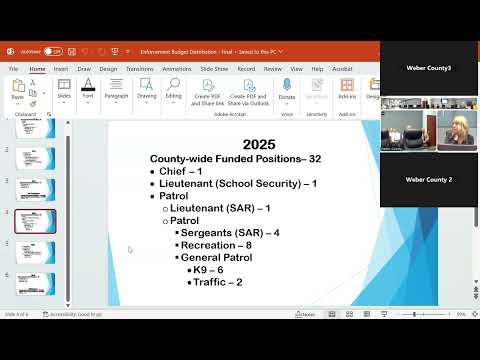
County commissioners, the sheriff and city leaders met to reexamine a longstanding allocation of sheriff's enforcement positions — a core countywide staffing level of 31 (now 32) full-time equivalents and roughly 46 FTEs billed to contract cities — and asked staff to return with detailed data for budget decisions.
Weber County commissioners, the sheriff and city officials met to reexamine how law-enforcement personnel and costs are split between countywide services paid from the general fund and deputies billed to cities that contract with the sheriff’s office. The discussion centered on whether the county’s baseline staffing — previously identified as 31 general-fund full-time equivalents (FTEs) and now 32 after a state-mandated school-security position — still reflects the county’s core needs and whether contract-city charges remain fair as populations and call patterns shift.
The review matters because commissioners plan to treat enforcement budgeting like an enterprise-style, zero-based exercise inside the general fund and want to minimize potential tax impacts. “We’re gonna go forward from here on out with the enforcement budget working and operating like an enterprise settlement,” a commissioner said, explaining the intent to revisit how countywide services are funded and billed to contract cities.
County staff and the sheriff reviewed the 2017 baseline that set 31 general-fund enforcement FTEs, which covered a mix of patrol leadership, detectives and specialized roles; that number rose to 32 when state law required a school security officer. The sheriff described how some countywide positions fill multiple roles and are deployed where need is greatest: “There’s an increase in demand for ICAC. A lot of police agencies provide assistance with ICAC. We have a full time, but the case load for countywide is so much that we need additional positions,” he said. Officials said the remaining enforcement positions (about 46 FTEs in recent years) are supported through contracts with cities and are allocated using a formula.
Officials described the contract-city billing formula as a mix of population and call volume to weight fairness among cities: “I believe it's 40% of the bill is based on population, and 60% is call volume,” a county staff presenter said, adding that call volume is averaged over an 18-month period to smooth short-term fluctuations. Contract cities share a single pool of deputies rather than purchasing dedicated officers for guaranteed hours; staff described that model as treating the contract cities as one aggregated service area.
Participants raised several recurring concerns: cities that already operate their own police departments questioned whether they are effectively “double paying” for services they provide locally while also covering countywide positions; small contract cities said their per-resident cost can be high; and several mayors asked whether contributions to special teams (for example, a metro crash team, CSI and task forces) are included in the contracts or billed separately. Staff said they will verify which specialized units and overhead costs are being allocated to contracts and which are borne from the county general fund.
Officials also discussed how certain school-related costs are shared. County staff explained that for school-resource/recreation deputies the school district pays 70% of deputy pay for the 182 days those deputies are in school, with the remaining days and share falling to cities and the county: “In this current year, 70% of the officer or the deputy salary for the hundred and 82 days that they're in school,” a presenter said.
Legal and operational limits were raised. County counsel described the sheriff’s general statutory duty to “preserve the peace” and noted that statute authorizes contracting with municipalities for law-enforcement services (statute cited in the meeting as 17-22-2). Counsel said the statute does not itemize every specialized capability (such as drones), leaving some discretion about what is required countywide and what is provided by contract. Commissioners asked staff to identify which of the baseline positions are statutorily required and which are discretionary.
The meeting produced follow-up directions rather than immediate policy changes. Commissioners asked staff and the sheriff’s office to return with data showing how much contract cities contribute to special teams and investigative units, clarifying overhead allocation, and to confirm whether certain services are billed through the contract rate. The commissioner summarized the next step: gather the questions and inputs, have staff and sheriff’s leadership meet to revisit the “32” baseline, and report back before final budget decisions.
The session ended without policy votes on staffing or billing. The only formal action recorded was the meeting adjournment. A commissioner asked attendees to continue local conversations and to email additional comments to county staff so the commissioners and sheriff can refine recommendations before budget hearings.
Ending: County leaders emphasized that the meeting was intended to validate or adjust the baseline staffing and billing approach ahead of upcoming budget work. Staff will supply the underlying call-volume data, contract billing spreadsheets and a breakdown of which specialized teams are charged to contracts; commissioners asked cities with their own departments to detail local services (for example, warrant activity, ICAC involvement and special-team participation) so the county can identify duplications or gaps and consider reallocating resources.