Get Full Government Meeting Transcripts, Videos, & Alerts Forever!
Get email alerts on the Public Safety topic
No spam. Unsubscribe anytime.
Committee advances bill giving fire chief authority to set emergency perimeters, restrict unauthorized access
Summary
The Baltimore City Council Public Safety Committee voted to advance Bill 25-0018, which would let the fire chief establish an emergency scene with barricades and authorize who may enter; the measure includes penalties mirroring disorderly-conduct limits and will go to second reader after a 5-2 committee vote.
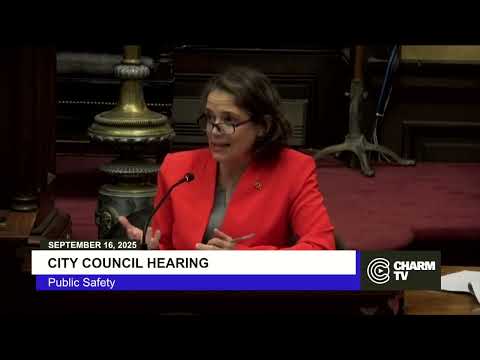
The Baltimore City Council Public Safety Committee voted 5-2 to advance Bill 25-0018, a measure sponsored by Councilwoman Odette Ramos that would authorize the Baltimore City Fire Department to establish an emergency scene with barricades and prohibit unauthorized people from entering while the scene remains active.
Ramos, the bill sponsor and member representing the Fourteenth District, told the committee the ordinance "requires that the fire chief create a fire or emergency scene around an emergency with whatever barricade tape whatever is necessary. And that only certain people are allowed in that scene." She said the measure aims to keep firefighters, emergency medical personnel and residents safe and to give incident commanders clearer authority to control scenes.
The bill's amended language replaces the narrower term "caution tape" with the broader term "barricade" and defines an emergency scene's boundaries. The reprint circulated to committee members lists examples of authorized persons — including Baltimore City Fire Department personnel (firefighters and EMS), Baltimore Police Department personnel, the victim or family of a victim, elected city officials with city identification, and "community or volunteer-based nonprofit organizations that support and assist victims and survivors of disasters" — but the text uses "may include" language so the on-scene commander retains discretion to admit others.
Assistant Chief John, operations for the Baltimore City Fire Department, described how commanders manage access: "...we pretty much try to exclude everyone right away until we can get our hands wrapped around it and mitigate what's going on. And as it deescalates, more and more people, regardless of that badge... that's when the time is to start allowing people to slowly integrate into the scene." He told the committee the department calls utilities such as BGE as needed and does not automatically allow contractors into the "hot zone."
The committee also discussed penalties. The sponsor and the city Law Department agreed to mirror the penalties commonly applied when someone crosses a police crime-scene tape: a misdemeanor carrying up to 60 days in jail, a $500 fine, or both (the original draft had proposed 90 days). Ramos said the amendment lowered the jail term to 60 days to match the penalty framework used for disorderly conduct and related offenses.
Tyler Shnella, deputy director of government relations for the Mayor's Office, said the administration supports the amended package and emphasized the bill is intended to give the fire chief flexibility to control scenes across different kinds of emergencies: "We worked, very closely with the sponsor on the bill, on these amendments. Right? We've worked with the fire department. So the package in front of you is what the administration supports. We do not support mandating specific people to be on the scene. We support the flexibility of our fire chief and our subsequent incident commanders to be able to make the determination based on the scene."
Some committee members pressed for clearer, less ambiguous language. Councilman Yitzi Schleifer said the "may include" phrasing leaves too much uncertainty about who is automatically permitted onto a scene and suggested the ordinance should more clearly list who is authorized so that critical responders — for example utility crews — can act without delay. "I really don't see what the purpose of the bill is when it's may include this and may include that. It seems to me that it just creates more confusion," Schleifer said.
Committee discussion also covered practical logistics: how an elected official or contractor would seek permission to enter a scene, the role of police in executing arrests or citations after an incident commander reports a violation, and whether the city should issue badges to restoration companies (the fire department said it would not support a universal badging system for safety and operational reasons).
A motion to recommend the amendments favorably was moved by Councilman Zach Blanchard and seconded by Councilman Tony Glover and was approved by voice vote. A subsequent motion to move Bill 25-0018 favorably as amended to second reader was moved by Blanchard, seconded by Councilmember Paris Gray, and passed on a roll-call vote of 5 in favor and 2 opposed (Conway — chair — voted yes; Blanchard yes; Danielle McCray yes; Gray yes; Felicia Porter yes; Yitzi Schleifer no; Tony Glover no).
The bill text as amended clarifies that barricades may remain while a public safety hazard exists, lists example categories of persons who "may" be authorized to enter, and specifies penalties. Ramos said she will work with colleagues ahead of second reader to refine language addressing committee members' concerns about clarity and implementation.
The committee record shows the amendments were the result of negotiations among the sponsor, the Mayor's Office and the Law Department; the administration sought immediate effectiveness rather than a 30-day delayed effective date. The measure will appear on the council's next agenda for second reader action.