Get Full Government Meeting Transcripts, Videos, & Alerts Forever!
Get email alerts on the Naloxone Colocation topic
No spam. Unsubscribe anytime.
Baltimore City committee reviews readiness to colocate naloxone with AEDs in public buildings
Summary
City committee heard state-led rollout details for a 2024 Maryland law that would colocate naloxone with automated external defibrillators (AEDs) in certain public spaces; agencies described current city stock and training and asked the state for regulations and prioritization guidance.
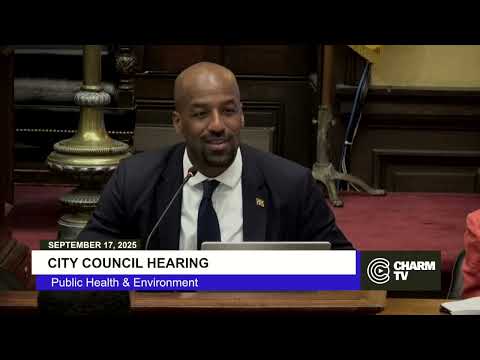
The Baltimore City Council’s Public Health and Environment Committee held an informational hearing on council resolution 25-005R about making naloxone available in public buildings and heard agency updates on the city’s readiness to comply with a 2024 Maryland law that requires naloxone colocated with automated external defibrillators in certain public sites.
Councilman Mark Conway, sponsor of the resolution, said the measure is a life‑saving step in Baltimore’s opioid response. “Naloxone is one of the most effective tools that we have at the ready, and it has the ability to turn tragedy to triumph and a second chance,” Conway said, urging the city to lead in training, signage and stock maintenance.
Tyler Schnella, a representative from the mayor’s office who briefed the committee on state implementation, said the state — not local governments — is responsible for rolling out the program under the statute. “Both the city’s law department and the Maryland Association of Counties have reviewed the law and concluded that responsibility for implementation rests with the state of Maryland, specifically the EMS Board in partnership with the Maryland Department of Health,” Schnella said. He told the committee the program will be funded from state opioid restitution funds and that the state has ordered naloxone supply and is preparing to begin implementation.
Nut graf: The session focused on practical steps Baltimore must take to match the state program once Maryland issues regulations. Committee members and agency staff discussed which city buildings already have naloxone and AEDs, how to prioritize sites for state colocations, how to train staff and the logistics of restocking kits after use.
Most important facts
- The state law cited by witnesses is Chapter 764 of the Acts of the Maryland General Assembly of 2024 (often discussed in the hearing as Senate Bill 1099), which expands public access to AEDs and requires placement of up to two doses of naloxone alongside AEDs at certain public sites. Schnella said the state has until Oct. 1, 2027, to complete implementation. The state estimates roughly $25 per site for storage/packaging and $45 for a two‑dose naloxone kit, with replacement required every three years or sooner if a dose is used.
- Multiple city agencies filed favorable reports to the committee. Dr. Michelle Taylor, commissioner of the Baltimore City Health Department, said the department “stands by our favorable agency report.” Benjamin Brosh of the Department of Finance and Tyler Schnella (mayor’s office) also reported favorably.
- City officials described current local coverage and training: all 22 pools operated by Recreation and Parks are equipped with AEDs and naloxone and trained pool staff; all 44 fire department buildings have both AEDs and naloxone; every police officer in the city is personally equipped with naloxone. Committee staff reported there are approximately 7 AEDs at police headquarters and 3 in an annex that are not yet colocated with naloxone.
- The Department of General Services (DGS) reported roughly 30–33 DGS‑managed buildings currently in compliance with colocated AEDs and naloxone. Committee members noted the city owns “about 200+” buildings overall and asked DGS to provide a list of compliant sites and locations for the committee’s review.
Discussion and committee direction
Committee members pressed agencies on priorities and logistics. Councilwoman Odette Ramos asked whether the initial state rollout will prioritize publicly accessible buildings; Tyler Schnella said the committee should expect prioritization to focus on publicly accessible sites but that the city will pose specific prioritization suggestions to the state. Councilman Conway and others urged the city to recommend additional sites and to consider larger facilities (for example, large markets) that may need more than two doses at a single location.
Committee members also asked about training and replenishment. Julia Roche, legislative affairs director at the Baltimore City Health Department, told the committee that a Workday naloxone training rolled out in 2023 has trained 1,246 city employees. Schnella said the state’s forthcoming regulations will address inspection, maintenance and prioritization, and the committee asked the administration to follow up with the Maryland Office of Overdose Response and the EMS Board on how sites will be inspected, how the state will be notified when a dose is used, and whether the city will have any role in restocking.
What remains unresolved
- The state regulations that will govern inspections, maintenance, site prioritization and funding timing have not been finalized; Schnella told the committee Maryland officials were preparing regulations and ordered naloxone stock, but added that jurisdictions statewide are awaiting formal regulations before they have obligations under the statute.
- Whether the city or the state will be responsible for immediate restocking after a kit is used was not resolved; Schnella said the committee’s questions will be posed to the state for clarification.
Procedure and next steps
Committee members asked the administration to provide a list of the roughly 30–33 DGS‑managed buildings already in compliance and to work with the city administrator and agencies to recommend priority sites to the state. Councilman Conway asked the committee to consider recommending that some high‑use sites receive more than two doses. The committee recessed the hearing and will reconvene Oct. 29 for continued discussion.
Ending: The hearing did not include a formal committee vote on the resolution; agencies filed favorable reports and the committee requested follow‑up information and state clarifications before taking further action.