
Vallejo Housing Authority reports improved Section 8 performance, petitions HUD to adjust score
Get AI-powered insights, summaries, and transcripts
Sign Up Free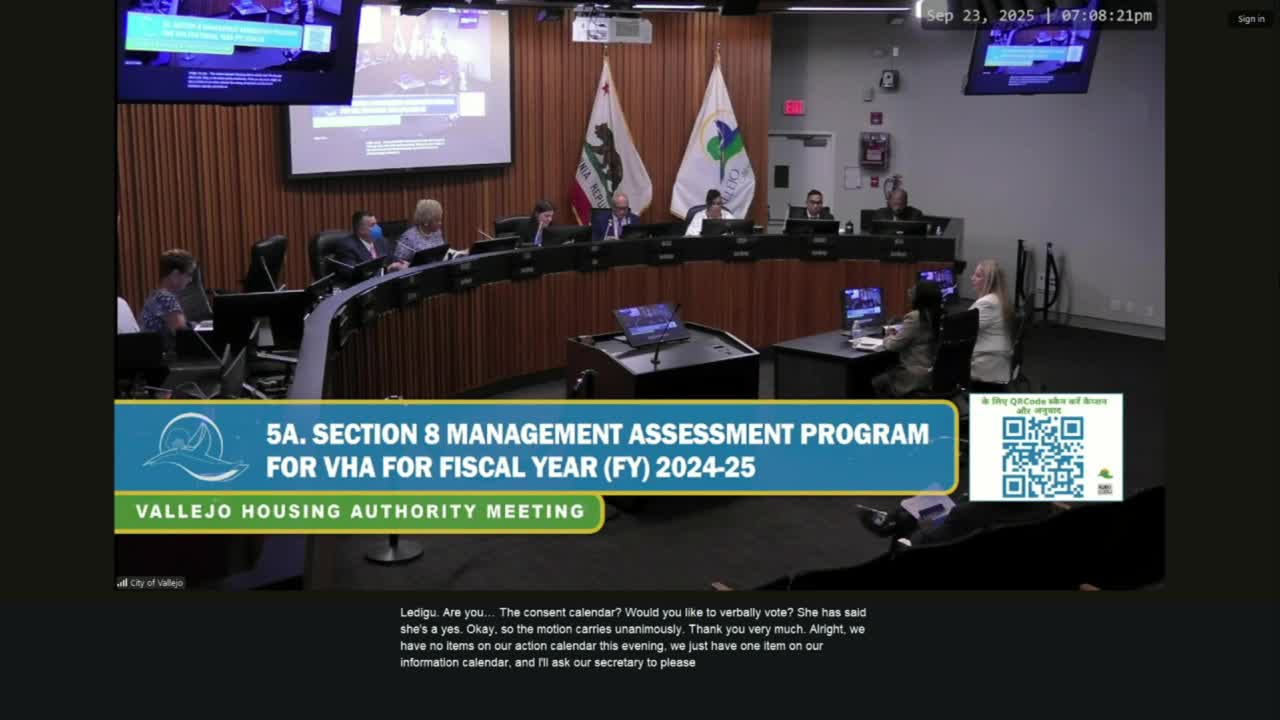
Summary
Vallejo Housing Director Alicia Jones reported to the Vallejo Housing Authority that the agency's performance under the federal Section 8 Management Assessment Program (SEMAP) rose after internal record cleanup and staff work; the authority has petitioned HUD to record an 89% score, Jones said.
Vallejo Housing Director Alicia Jones reported to the Vallejo Housing Authority that the agency's performance under the federal Section 8 Management Assessment Program (SEMAP) has improved significantly after internal cleanup of program records, and staff have petitioned the U.S. Department of Housing and Urban Development (HUD) to adjust the agency's official score.
Jones, who leads the city's Housing and Community Development Department, said the authority's internal review raised its rating from roughly 63% in 2023—24 to 81% this year. She said staff have asked HUD to recognize further corrections that would raise that figure to 89%, placing Vallejo one percentage point shy of the federal "high performer" threshold. Jones said the agency completed record cleanups going back to 2019 and that the improvements reflect concerted work by the voucher team.
SEMAP is HUD's scoring system for housing authorities that evaluates performance across a set of indicators used to manage the Housing Choice Voucher (Section 8) program. Jones told the board the program has a total of 145 available points and that agencies are categorized by HUD as "high performer," "standard performer" or "troubled performer" based on the percentage of points earned. She described indicators the authority scores on, including: selection from the waiting list; rent reasonableness (comparability to local market units); adjusted income verification; an annual review of the utility allowance schedule; quality-control inspections of housing-quality-standard (HQS) inspections; and HQS enforcement (abatement of payments for life-threatening deficiencies not corrected within 24 hours or non-life-threatening deficiencies not corrected within 30 days). Jones also noted HUD's PIC inventory system provides data for several SEMAP indicators.
Board members asked for more granular reporting. Board Member Ladazew requested that future presentations show the points earned in each SEMAP category (for example, whether the authority received the full points available for a category or a partial amount). Jones agreed to share the metrics and a breakdown of scores and said she would email the board the slide materials used in the presentation.
Members also discussed the Family Self-Sufficiency (FSS) program. Jones said FSS is voluntary under HUD rules and therefore does not earn SEMAP points. She told the board the authority currently has 34 families enrolled in FSS; 20 of those families have escrow accounts and documented progress toward program goals, a statistic Jones cited as an "83%" participation-with-progress figure for enrolled families. Jones said the FSS coordinator position is funded by an annual grant and is currently vacant; the authority is recruiting for a housing specialist to support FSS outreach and case management.
On payment standards and market alignment, Jones said Vallejo's voucher payment standards are set at 120% of the 2024 HUD fair market rents (FMRs) for Solano County. She said HUD allows authorities to set payment standards between 90% and 110% of FMRs and that agencies may request a waiver to raise the standard up to 120% in some cases. Jones said the agency is reviewing updated FMRs for 2026 and is evaluating whether to adjust payment standards accordingly. She also said a countywide rent-comparability study would cost about $60,000; Vallejo's Housing Choice Voucher program staff presently do not have funds allocated for such a study.
A member of the public, Div Sahani, told the authority about ongoing problems with an individual tenant's voucher after a change in banking information. Sahani said, "It took till October 1 for them to actually do it," referring to the authority's update of a bank account, and added, "The payments have now stopped again, and no one's responding." Jones acknowledged the comment and staff requested Sahani's contact information so the housing authority could follow up directly.
Board Member Gordon raised a separate operational concern about families who select a new unit and later are told they do not qualify after final inspections or affordability tests. Jones explained that affordability and rent-reasonableness tests determine whether the authority can pay the rent requested by an owner under the voucher program, and that some units are not affordable under the authority's payment standards without owner-concession or rent negotiation.
The authority also described inspection practices: initial HQS inspections are required before a housing assistance payment contract is executed for a new unit, annual recertifications are conducted at least once every 12 months, and the agency currently uses a biannual (every two years) schedule for some inspections. Jones said the agency uses a contractor for most inspections and that a supervisor or qualified designee performs quality-control reviews of a sample of inspections.
The item was presented as informational and did not require a board vote. Earlier in the meeting the authority unanimously approved the consent calendar, which included minutes and the agenda. The housing director closed by thanking the voucher team for the work that produced the improved scoring.
Ending: Staff said they will provide a point-by-point SEMAP breakdown and the presentation slides to the board by email, continue recruitment for the FSS coordinator role, and follow up with the public commenter to resolve the individual voucher account issues.