East Side Union High trustees post revised trustee-area map, allow public edits before Oct. 3 vote
September 26, 2025 | East Side Union High, School Districts, California
This article was created by AI summarizing key points discussed. AI makes mistakes, so for full details and context, please refer to the video of the full meeting. Please report any errors so we can fix them. Report an error »
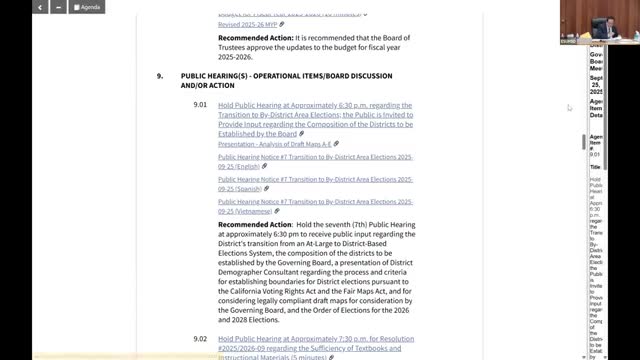
The revised map and the specialist27s analysis were presented during a public hearing on the district27s transition from at-large to trustee-area elections. Dr. Justin Levitt, the district27s redistricting consultant, reviewed five draft maps and described how the revised plan attempts to follow the statutory priorities in California27s Fair Maps Act while protecting communities of interest.
Levitt told the board, "First and foremost districts must be equal in terms of total population," and walked trustees through the Fair Maps Act criteria (population equality, Section 2 of the federal Voting Rights Act, contiguity, communities of interest, minimized division of cities/CDPs, identifiable boundaries and compactness). He said the district27s adjusted population is just under 550,000 and summarized the district27s overall demographics: about 35% Latino, 48% Asian American/Pacific Islander, roughly 13% non-Hispanic white and about 3% Black.
The revised plan preserves two Asian-majority trustee areas and one Latino-majority trustee area, Levitt said, and attempts to avoid splitting the Alum Rock and East Foothills census-designated places. He described the revised map as having a 7.3% population deviation (within the 10% legal threshold) and said it unites substantial Vietnamese-surname concentrations that sit on both sides of Highway 101 into a single trustee area.
Community members and civic leaders addressed the board during public comment. Eddie Garcia, representing the Committee for Fair and Equal Eastside Representation, read a submitted letter that urged the board to adopt options D or E from earlier community proposals to protect Latino representation. Several speakers from the Vietnamese American community urged that the Little Saigon neighborhood and adjacent residential Vietnamese communities be kept whole; Harrison Pham told trustees that "Map B not only complies with the legal requirements but also reflects the demographic realities of our district," and other speakers said they needed more time to study the revised map.
Legal counsel warned the board that some previously proposed maps (identified as maps D and E in letters to the district) were legally vulnerable to challenge. Counsel said, "I do not believe D and E are viable choices," and explained that those maps could be subject to litigation as racial gerrymanders because of how they allocate population and draw lines around high-concentration blocks.
After discussion, Trustee Lorraine Chavez moved and Trustee Cortese seconded a motion to post the revised map immediately, allow members of the public to submit modifications to that revised map by 1 p.m. the next day for posting, and bring the map forward for final action at the board27s Oct. 3 meeting. The motion passed unanimously on a roll call vote (President Do, Vice President Lay, Clerk Chavez, Member Herrera, Member Cortese: all "aye").
Next steps: the district said it will post a zoomable version of the revised map and the demographic spreadsheets, accept map variations filed through the district site by the 1 p.m. deadline, and publish all submissions in time to meet the statutory 7-day notice requirement for the Oct. 3 final hearing. The board indicated it expects to hold the Oct. 3 meeting at 6 p.m.
Board members and staff emphasized that the map adopted Oct. 3 will be accompanied by a written justification showing how it meets the Fair Maps Act criteria.
The hearing combined technical legal analysis, community testimony about neighborhoods such as Little Saigon and Alum Rock, and a working timeline imposed by state law and incoming legal threats.
The board27s action was procedural (posting and accepting modifications) and did not adopt a final trustee-area map on Sept. 25.
View the Full Meeting & All Its Details
This article offers just a summary. Unlock complete video, transcripts, and insights as a Founder Member.
30-day money-back guarantee
Sponsors
Proudly supported by sponsors who keep California articles free in 2026

