Get Full Government Meeting Transcripts, Videos, & Alerts Forever!
Get email alerts on the Flooding Drainage Canal topic
No spam. Unsubscribe anytime.
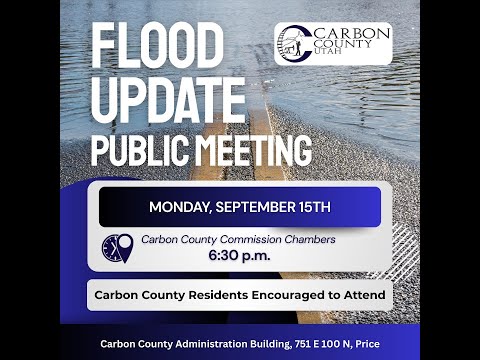
Carbon County officials outline mitigation steps after Carbonville-Price area flooding
Summary
County staff, a state hydrologist and residents discussed causes and possible mitigation measures after heavy rains caused canal overtopping and neighborhood flooding. Officials urged residents to submit damage reports, said NRCS will assess sites and described funding limits from FEMA and state relief programs.
County officials and water experts on the Carbon County Commission panel on the recent flood described how heavy, localized storms and canal overtopping combined to flood low-lying properties in Carbonville, Price and nearby neighborhoods and what steps local and state authorities plan to pursue.
Justin Needles, Carbon County emergency manager, told residents the county is collecting damage reports to support requests for outside funding and to document local need. "When FEMA looks at a disaster, they look at dollars, and they don't look at dollars damage to houses. They look at dollars damage to public infrastructure," Needles said, and he explained current per-capita thresholds the county and state must meet to trigger different disaster programs.
The discussion focused on three near-term lines of work: (1) gathering and submitting resident damage reports and photos; (2) securing technical assessments from the U.S. Department of Agriculture's Natural Resources Conservation Service (NRCS) including possible Emergency Watershed Protection (EWP) funding; and (3) engineering and maintenance efforts above and below the Price–Wellington Canal to reduce future overtopping and channeling of runoff.
Why it matters: Officials said the flooding resulted from an unusually intense, localized storm that produced runoff much greater than the canal and roadside ditches were designed to carry. That combination produced overtopping at several canal locations and high flows down mapped washes and road corridors, damaging garages, basements and one county motor-pool building.
What county staff and experts said
- Needles said 98 residents had submitted the county's online damage form at the time of the meeting and that the estimated private damages reported were roughly $600,000 for households in the unincorporated county and about $275,000 in Price City. He emphasized the damage forms are intended to document impacts for government funding requests rather than immediate homeowner payouts.
- Needles described federal and state thresholds: he said Carbon County's local FEMA threshold equates to about $100,000 in public-infrastructure damage (about $4.72 per person in the county) and that the statewide FEMA threshold is far higher — he cited roughly $1.89 per person statewide and an aggregate number north of $6 million — meaning FEMA assistance for public infrastructure requires very large totals.
- Lincoln Irvine, Carbon County engineer, provided site observations and photographs of culverts, ditches and a breached detention pond that contributed to local impacts. He noted several roadside and subdivision culverts were undersized for the storm and that maintenance and design standards in the county's 2008 drainage ordinance are sized to a 25-year, one-hour storm event, not necessarily the larger storms residents experienced.
- David Horsley, who said he works at the Utah Division of Water/Office of the State Engineer and volunteered to present hydrology data, explained basin sizes and flow concepts. Horsley described the canal's typical irrigation flow as about "40 to 60 CFS" and noted some washes and drainages above the canal represent hundreds to thousands of acres of contributing area. He said individual basins he reviewed ranged from about 31 acres (Meads Wash) to several hundred or more (for example, Penn's Wash at about 760 acres and Warehouse Wash at about 1,800 acres), and that those acreages multiply the runoff produced by intense storms.
Residents' concerns and county responses
Residents repeatedly pressed county staff and elected officials on maintenance, the timing of road- and ditch-clearing, and perceived changes to drainage patterns after development and construction of roads and oil- and gas-related pads. Several attendees described sediment-laden garage flooding, washed-out driveways, and a motel property that took repeated damage.
County officials acknowledged the scale of the problem and said crews had been working on culverts and ditches and that the county planned to have road crews assess and clean priority locations. Commissioner-level remarks emphasized the need to "work together" with Price City, the canal company and NRCS to pursue mitigation funding and engineering studies rather than attributing sole responsibility to one party.
Planned and suggested next steps
- The county is gathering resident-submitted damage reports (form/QR code) and asked residents to sign a contact sheet so staff can follow up.
- Needles said the NRCS has been contacted; NRCS engineers are expected to visit affected areas to evaluate potential EWP or other assistance and to recommend projects. Needles noted an EWP project requires substantial paperwork and is not quick — EWP guidance aims for a ~240-day construction period after funding but local experience typically shows one to two years from funding to project completion.
- County staff and private landowners discussed structural mitigations including detention/retention basins, cascaded rock berms (already used in one location in 2019), removal or enlargement of chokes such as undersized culverts and debris-prone bridges, and improving forecasting and warning (including potential new radar coverage) to increase lead time for emergency alerts.
Quotations from officials and experts are limited to those who spoke during the meeting and are attributed accordingly.
Ending: Officials said no formal funding award or construction contract was authorized at the meeting; rather, the meeting produced a plan to document damages, request NRCS assessment, pursue state and federal funding opportunities and continue coordination with Price City and the canal company. County staff asked residents to complete the damage-report form and sign the contact sheet so staff can follow up on site assessments and funding applications.