Get Full Government Meeting Transcripts, Videos, & Alerts Forever!
Get email alerts on the School Budget topic
No spam. Unsubscribe anytime.
New Berlin electors approve $45.12 million levy, allocate $6 million to capital fund
Summary
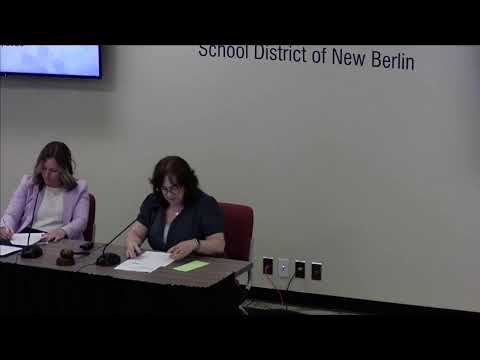
Electors at the New Berlin School District annual meeting on Sept. 19 approved a $45,118,375.75 tax levy for the 2025–26 school year, including a $6 million one‑time transfer to the capital improvement fund (Fund 41).
Electors at the New Berlin School District annual meeting on Sept. 19 approved a $45,118,375.75 tax levy for the 2025–26 school year, including a $6 million one‑time transfer to the capital improvement fund (Fund 41).
District Chief Financial and Operations Officer Patrick Miller, presenting the proposed budget, said the levy reflects a roughly 3.5% increase from the prior year and a projected mill rate of $6.02 per $1,000 of equalized property value — up from $5.89 last year. Miller said that estimate could change when October enrollment counts and state certifications are finalized. “We are very financially stable, very strong,” Miller said during the budget presentation.
The levy passed by show of hands during the annual meeting. The motion to levy $45,118,375.75 was made by Ron Seidel and seconded by Mitchell Helmer; electors approved the motion by a voice/hand vote (count not specified).
Why it matters: District officials said the one‑time $6 million transfer into Fund 41 will allow the district to fund the capital project plan for roughly five years without annual levies of about $1.2 million. Administrators described the move as a way to avoid repeated state‑aid reductions that would occur if the district used fund balance annually to support capital maintenance. Miller told electors the district has funded nearly $8 million in capital improvements over the past four years.
Key budget details
- State aid and revenue: Miller said state aid has grown since he joined the district — from about $2.5 million years ago to an anticipated roughly $14.5 million for the coming year. The administration is projecting a 6.6% increase in state aid based on the July 1 estimate. Local property tax remains the largest revenue source, with state aid at about 36% of total revenue in the district’s presentation.
- Enrollment and 4K: The district reported positive enrollment growth of about 2%, driven in part by new 4K seats. Administrators said 170 children are enrolled in 4K, which the district estimates equals 62 full‑time equivalent students (each 4K student counts as 0.6 FTE in district calculations). That increase produced an estimated $430,000 in additional revenue limit authority and about $525,000 in 4K startup grant funding, plus roughly $25,000 in per‑pupil categorical aid, according to the presentation.
- Capital and fund balance: The administration plans the $6 million levy into Fund 41 as a one‑time investment and intends to use fund balance to offset the $6 million in the near term. Officials said that approach will produce a projected $6 million fund balance deficit in fiscal 2026 but return to balanced budgets in fiscal 2027 and 2028 under current assumptions. The district’s capital plan has been funded in recent years to maintain buildings and safety systems, including recent upgrades to elementary security and building alert systems.
- Operating costs and transfers: Salaries and employee benefits account for about 61.3% of proposed general‑fund expenses; purchase services and transfers are the other large components. The district noted it contracts for certain services (for example, cleaning and substitutes) that some districts count as payroll. Miller said transfers to the special education fund are projected to decline by about $600,000 because the state increased special education funding.
Tax impact and timeline
Miller and Superintendent Joe Garza emphasized that the final mill rate and tax impact depend on two remaining steps: the city’s Oct. 1 equalized value certification and the Wisconsin Department of Public Instruction’s Oct. 15 state‑aid certification. Miller estimated the presented numbers are conservative and near final; the current projection represents about a $13 increase for every $100,000 in property value and an estimated $45.50 annual tax on a $350,000 home under the district’s assumptions.
Debt and credit
Miller presented a multi‑year debt slide showing operating‑budget debt declining over the next several years; he described total outstanding debt of roughly $18 million and said that represents about 2.5% of the state constitutional debt limit applicable to school districts. When asked by an elector, Miller said the district’s credit rating from Moody’s is Aa1.
Public questions and other notes
Electors asked whether the district employs grant writers. Administrators said the district manages grants in Patrick Miller’s office and that the Education Foundation of New Berlin assists the district and has a staff member who pursues grant opportunities on the district’s behalf. Officials said the district’s demographics limit eligibility for some federal and state grants, but the foundation and district pursue appropriate opportunities.
Votes at a glance (annual meeting actions)
- Motion to approve the rules of order and agenda: moved by Mitchell Helmer; second not specified on record; approved by show of hands. - Motion to dispense with reading and approve the treasurer’s report: moved by Allison Spindler; seconded by Richard Sipe; approved by show of hands. - Motion to levy $45,118,375.75 (including $6,000,000 for capital projects): moved by Ron Seidel; seconded by Mitchell Helmer; approved by show of hands. - Motion authorizing the school board to set the 2026 annual meeting date (window May 15–Oct. 31, 2026): moved by Amy Crosby; seconded by Renee Connick; approved by show of hands. - Motion to set annual school board salaries (members $3,500; president $5,000; vice president $4,500): moved by Amy Crosby; seconded by Mitchell Helmer; approved by show of hands. - Motion to adjourn: moved by Renee Connick; seconded by Amy Crosby; approved by show of hands.
What the district said next
Superintendent Joe Garza and CFO/COO Patrick Miller said printed budget materials are available in the foyer and online and encouraged residents to contact the district offices with follow‑up questions. Garza said the district mailed an annual report to all New Berlin households summarizing accomplishments, and he highlighted academic and extracurricular achievements at district schools.