
Judge Boyd sentences multiple defendants, grants deferred adjudication and orders restitution in Bexar County docket
Get AI-powered insights, summaries, and transcripts
Subscribe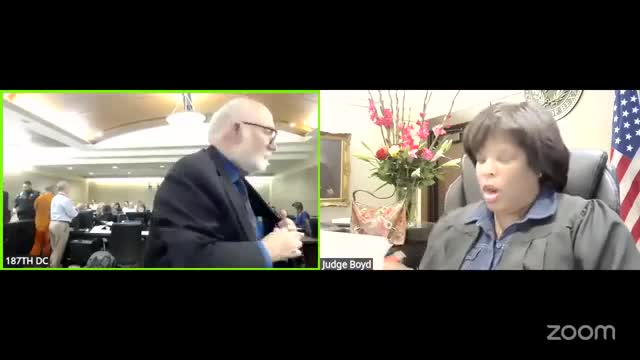
Summary
At a session of the 187th District Court, Judge Stephanie Boyd sentenced several defendants after revocation hearings, granted deferred adjudication in at least two theft/domestic-related cases and set restitution and follow-up dates, including a $3,746.99 restitution order to Target.
Judge Stephanie Boyd handled a docket of criminal matters in the 187th District Court on Sept. 22, 2025, issuing prison terms after revocation findings in three cases, granting deferred adjudication in two theft-related cases and setting multiple restitution and review dates.
The most immediate actions included sentencing after revocation findings. The court sentenced Paul Anthony Ramirez to three years in prison after finding a violation of his community-supervision conditions true and accepting a state recommendation to revoke supervision. Judge Boyd told Ramirez she would follow the parties’ agreement and ordered a therapeutic-community placement request and standard felony restrictions, including a weapons prohibition. "I'm going to follow the agreement that you worked out based upon what your attorney is saying and what the state is saying," Judge Boyd said before imposing the sentence.
In separate revocation hearings the court revoked Alicia Rubio’s community supervision, finding violation of condition 39 true, and sentenced her to three years in prison with a $1,500 fine and an affirmative finding of family violence. The court ordered no contact with the named victim (Ofelia Ribeiro) and requested placement in a therapeutic community after release. Rubio’s attorney and probation reported some completed services (TAP evaluation, DNA testing and community service) but the court found that she had missed reporting since January and revoked supervision.
Also after a hearing on a motion to revoke, the court found violation of community-supervision conditions true for Jacob Anthony Davila and sentenced him to four years in prison with an affirmative finding of family violence. The state’s motion alleged failure to comply with program rules and with required drug testing; the court cited incomplete submission of required meeting documentation and failure to timely file required materials as factors in the decision.
The court granted deferred adjudication in several matters rather than imposing immediate convictions. Andre Xavier Crawford applied for deferred adjudication in case 2025CR003791 on a charge the court characterized as a state-jail felony for theft of property ($2,500–$30,000). The state recommended deferred adjudication with restitution to Target in the amount of $3,746.99 and other recommended conditions (TAP evaluation, mental-health evaluation, community service, anti-theft and healthy-relationships courses). Judge Boyd accepted the stipulations and deferred finding of guilt. The court directed Crawford to bring $500 (cashier’s check or money order) toward the restitution by his next setting and recalled him for October 21, 2025, for sentencing review and payment accounting.
Desmond DeBryan Gomez also received deferred adjudication under a plea agreement recommending concurrent deferred adjudication on multiple counts. Probation and the TAP evaluation recommended outpatient or residential treatment options; the court ordered intensive outpatient treatment with aftercare, regular reporting by Zoom or in person, random urine analyses and other conditions including parenting classes, community service and trade-school or GED alternatives to satisfy part of the community-service requirement.
Not all matters resulted in final rulings. The court recessed or continued restitution and discovery issues in multiple cases, including a restitution hearing for Samuel Bock, which the court continued to Oct. 16, 2025, to allow the defense and state to exchange documentation (including a possible USAA insurance payment) and for both sides to compile case law and receipts to support or challenge requested amounts.
Several docket items were reset for further discovery or plea-deadline dates; the court repeatedly scheduled 30-, 45- or 60-day follow-ups and set multiple plea-deadline and discovery deadlines for late-October and mid-October dates across the docket.
Why it matters: The court's decisions send multiple people to prison, impose restitution obligations on others, and set conditions intended to address substance use and mental-health issues through TAP evaluations and therapeutic-community referrals. Deferred adjudication orders keep some cases out of immediate conviction while tying defendants to reporting and treatment requirements, and restitution orders require monetary payments to victims or businesses.
Next steps and follow-ups: The docket contains several near-term dates: Andre Crawford was recalled for Oct. 21, 2025, with an immediate $500 payment requirement; multiple plea-deadline and discovery-check dates were set for Oct. 16 and Oct. 30, 2025; and restitution hearings and discovery continuances were scheduled across October dates.