
Bellevue Planning Commission sets public hearing on critical areas ordinance after hours of public comment
Get AI-powered insights, summaries, and transcripts
Subscribe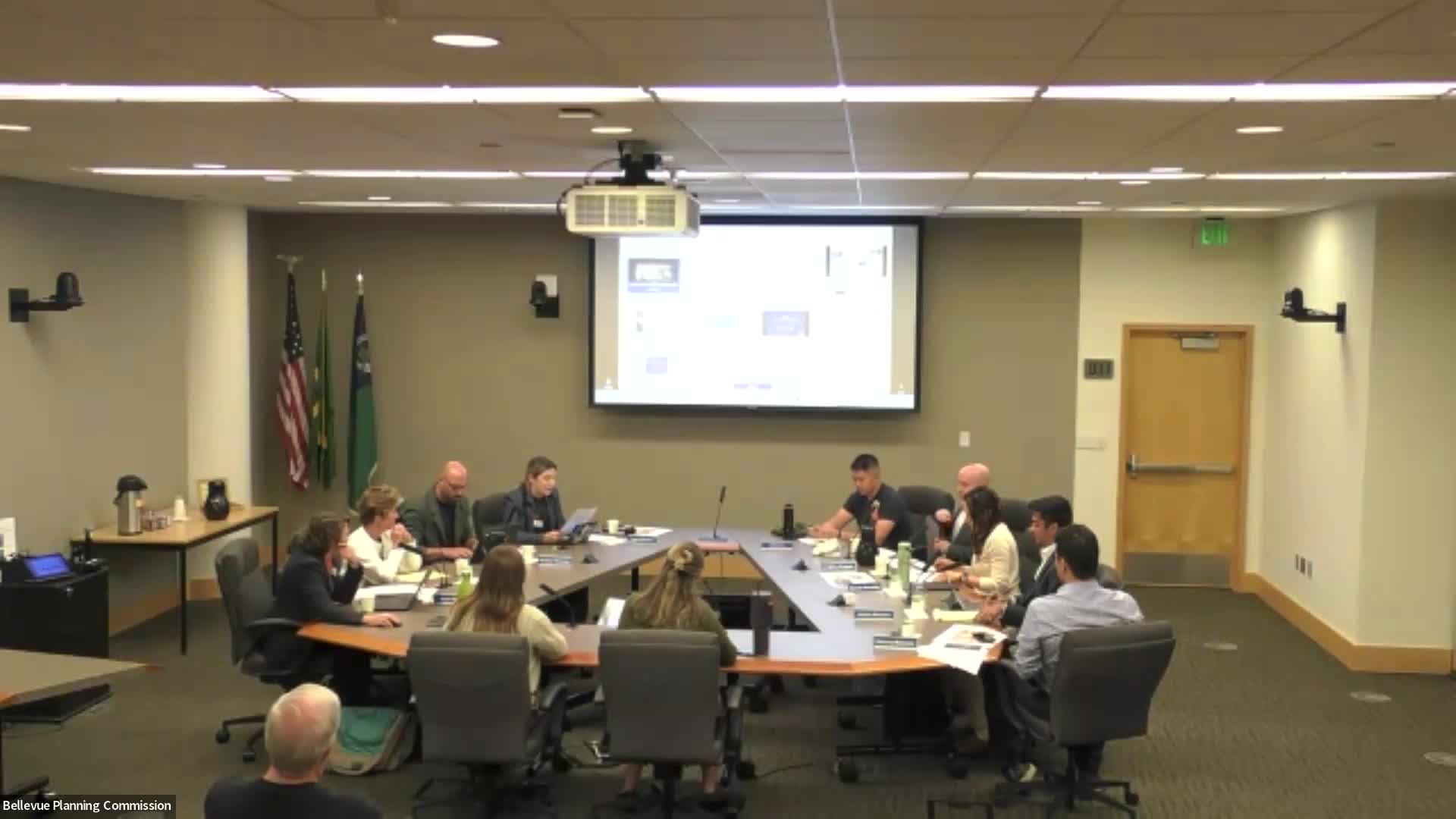
Summary
The Planning Commission voted to send a revised critical areas ordinance (land use code amendment) to public hearing after public commenters — including developers and environmental scientists — pressed competing views on larger stream buffers, daylighting and flexibility for redevelopment in degraded urban areas such as BelRed.
The Bellevue Planning Commission voted Wednesday to direct staff to prepare the proposed critical areas ordinance (a land use code amendment) for a public hearing, with the panel tentatively scheduling the hearing for Oct. 22 as staff work toward a year‑end compliance deadline.
The vote followed roughly 90 minutes of public comment and staff presentations on a draft that would expand some stream buffers, add new pathways for ‘‘innovative’’ compensatory mitigation and clarify reasonable‑use exceptions for heavily constrained parcels. The draft, staff said, aims to ‘‘strengthen project protections where they are necessary to preserve intact natural resources and to provide flexibility for development, particularly in areas with degraded conditions,’’ according to senior planner Kirsten Mint.
The issue matters to both developers and environmental advocates because buffer widths and mitigation rules determine what property owners can build next to streams and wetlands. Developers who want to re‑use or redevelop large, previously paved sites in mixed‑use/transit areas such as BelRed urged the commission to preserve options for redevelopment, while conservation interests and state agencies emphasized stronger protections to prevent ‘‘net loss’’ of ecological function.
Developers and consultants pressed the commission for clearer paths to redevelop degraded sites. ‘‘We’re looking for a common sense approach to managing previously disturbed and nonconforming spaces within the critical area buffers,’’ said Katie Kendall of GAW Capital Partners, which owns Bellfield Office Park. Rebecca Bloom of Columbia Pacific Advisors showed a redevelopment plan and warned that enlarging buffers could make ‘‘daylighting the creek render a very large portion of the site undevelopable.’’ Mark Hoyt, a housing developer, said the parking‑lot ditches on his East Main site were mapped as Class 3 wetlands but are ‘‘heavily degraded and have been disconnected for over 40 years,’’ and asked the city to align with Department of Ecology guidance so restoration plus housing could proceed.
Several speakers urged use of flexible, site‑specific tools. Kramer Canup, a senior environmental scientist with Soundview Consultants, asked the commission to ‘‘further study our recommendations to include wetland buffer interruptions for paved commercial parking lots and also an allowance for direct impacts to category 3 and 4 wetlands specifically within the East Main TOD zone’’ and to bring those concepts into the next draft. Charlie Baumann, a Bellevue resident and prospective developer in BelRed, said the area is ‘‘a true blank slate, hundreds of acres of asphalt’’ and urged incentives that make daylighting and restoration financially feasible for private projects.
State and local agency input was cited repeatedly. At least one commenter urged commissioners to keep the Growth Management Act requirement to ensure critical area regulations result in ‘‘no net loss of environmental function and value’’; a representative of the Department of Fish and Wildlife’s written comments was cited by a speaker who asked the commission to retain a development‑intensity section the agency recommended keeping. Staff noted the draft was developed with consultant input and agency review and that it includes several alternative approaches — for example, smaller standardized buffers for channelized or ‘‘armored’’ streams, an option to reduce buffers to 50 feet where daylighting or other on‑site improvements will demonstrably increase ecological function, and expanded language on innovative or compensatory mitigation (including on‑ and off‑site options and mitigation banking).
Commissioners pressed staff on whether the reduced buffers would make daylighting more or less likely. Staff and the consultant told the commission that smaller buffers can make redevelopment feasible on some sites but cautioned that too small a buffer can undermine long‑term stream functions; the draft attempts to balance those tradeoffs with multiple pathways for compliance. Staff also said they removed an older, complicated ‘‘density intensity’’ calculation from many sections of code and recommended removing some lot‑coverage restrictions to create other avenues for development where critical area constraints are present.
The Planning Commission approved the motion to send the draft to public hearing by voice vote; commissioners did not record a roll‑call tally in the meeting minutes. Staff said they will prepare a public comment matrix and return additional materials for the hearing. The commission and staff noted the city’s calendar: a council review is expected in November and staff are working toward adoption before the state compliance deadline later this year.
Public comment at the hearing will be limited by the City’s existing public comment rules and by the relevant code sections; written comments submitted before the deadline will be summarized in the record. Staff said they will present a public‑hearing draft that incorporates technical edits and any new material requested by the commission before the hearing.
The decision to schedule a hearing does not adopt the ordinance; it starts the formal legislative process that includes environmental review under SEPA and later council action. Commissioners said they expect to return to the topic in subsequent meetings and can amend the draft after the public hearing if needed.
Ending: The commission’s action sets an explicit timetable for public review and for staff to produce a public‑hearing package, including the full comment matrix and revised code language. Commissioners and staff repeatedly said additional study sessions or refinements are possible before council adoption.