
Providers, agencies urge Legislature to eliminate pay gap for community human‑service workers
Get AI-powered insights, summaries, and transcripts
Subscribe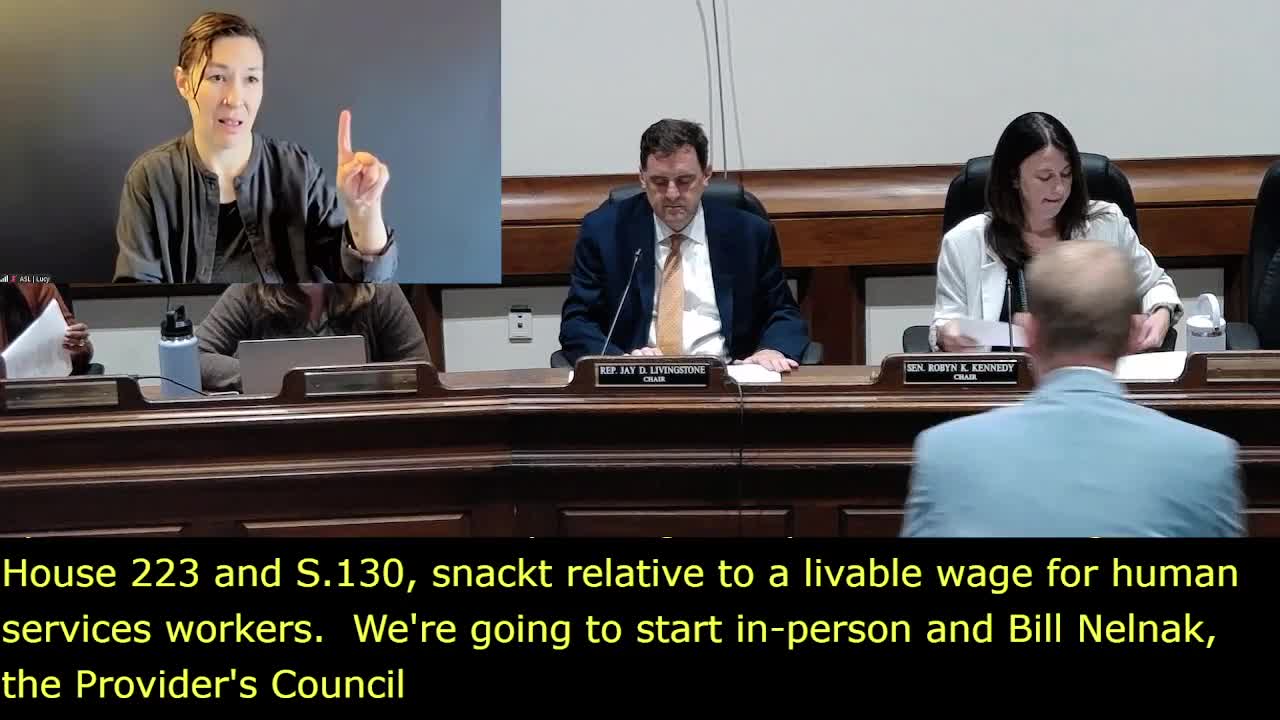
Summary
Providers and human‑service agency leaders told the Joint Committee on Children, Families, and Persons with Disabilities on Tuesday that legislation (H.223 / S.130) to equalize wages for community‑based human‑service workers would address a persistent pay gap that is destabilizing care across the Commonwealth.
Providers and human‑service agency leaders told the Joint Committee on Children, Families, and Persons with Disabilities on Tuesday that legislation (H.223 / S.130) to equalize wages for community‑based human‑service workers would address a persistent pay gap that is destabilizing care across the Commonwealth.
The bill, supporters said, would eliminate differences between rate‑setting benchmarks used for private community providers and pay for similar state‑employed roles through a phased approach ending on July 1, 2029.
The Sponsors’ bill matters because the Commonwealth is the largest purchaser of community human services and supporters said current rate benchmarks leave many nonprofit workers earning materially less than state counterparts for the same work. Bill Jelenack, president and CEO of the Providers Council, said the disparity creates a two‑tiered system of care. “Direct care workers, nurses, clinicians, and others in this sector often receive a salary that is significantly lower than those working at state operated human services programs,” Jelenack said.
Advocates gave concrete pay comparisons. Testimony said the rate‑setting benchmark for a Direct Care 1 position in community programs is $20.79 an hour while a comparable state developmental services worker averages $23.51 an hour (about 13 percent higher). A Direct Care 3 position was reported at just over $27 an hour in the community sector versus $31.25 for the state (about a 15 percent difference). Speakers also cited larger gaps for licensed therapists and clinicians, including occupational, physical, and speech therapists and psychologists.
Providers linked the wage gap to workplace turnover and service instability. Craig Gordon, president and CEO of Communities for People, described routine staff churn at his agency in Metro Boston and said vacancies leave clients unsure who will be on duty: “Our staff are not interchangeable commodities. When we hire someone, when we retain someone, we're making a promise that that person is gonna show up and be there for that youth,” Gordon said. He said his agency serves about 175 youth daily with a roster of roughly 115 staff when fully staffed and reported persistent vacancy rates around 30 percent.
Tammy Mello, president and CEO of The Key Program, said her agency of about 400 employees hired 146 workers in fiscal 2025 and lost roughly the same number, with exits largely explained by workplace stress and higher pay in state or for‑profit jobs that offer better benefits. “The love of the work cannot be the only thing that sustains them. Fair, competitive wages are essential,” Mello said.
Peter Eves, president and CEO of BAMSI, emphasized scale: “This bill will affect around about 160,000 jobs statewide,” he said, and argued that stabilizing wages is both fiscally responsible and morally necessary to maintain continuity of care.
Speakers noted the legislation builds on the 2008 rate‑setting framework commonly cited as Chapter 257 and a fiscal‑year 2025 budget provision directing a state report on pay disparities. Supporters asked the committee to fund the changes and to move the bill out of committee.
No committee vote was taken during the hearing; members asked clarifying questions of witnesses and accepted written testimony for the record.
Committee chairs asked staff and testifiers to supply additional documentation and the sponsors will await committee scheduling for any formal action.