Get Full Government Meeting Transcripts, Videos, & Alerts Forever!
Get email alerts on the School Tax Resolution topic
No spam. Unsubscribe anytime.
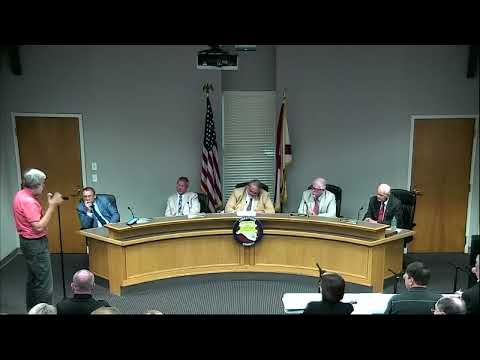
Limestone County commissioners debate whether to enact constitutionally required 10-mill school tax before Oct. 1
Summary
County attorneys told the Limestone County Commission that Amendment 7 78 of the Alabama Constitution requires a minimum 10-mill ad valorem school tax in affected school districts; commissioners and public speakers urged more public input and asked whether alternative funding could meet the mandate.
Limestone County commissioners spent nearly half an hour on a resolution to impose a constitutionally required education ad valorem tax that county attorneys say must bring affected school districts to a 10-mill minimum rate beginning Oct. 1.
The matter drew public commenters and extended legal explanation because parts of the county had previously voted down a countywide renewal and local residents said they learned of the current action only within the past week. The commission’s legal counsel said failing to adopt the resolution would expose the county to litigation.
Why this matters: The outcome affects property tax bills across parts of Limestone County and will change which taxpayers see increases or decreases depending on whether they live inside municipal boundaries (Athens, Madison, Huntsville) or in unincorporated areas. The deadline of Oct. 1 was repeatedly cited by attorneys as the date when new rates would take effect if the county does not act.
Commission discussion and public comments focused on three central points: whether the commission could delay the vote to allow more public hearings, whether alternative county funds could be used instead of changing the ad valorem tax, and the legal obligation created by a statewide constitutional amendment.
Deborah King, a resident, urged the commission to “table this for today,” saying she had learned of the issue within a week and asked the chairman to “explain to me how much we are paying property taxes as of today” and what would change if the resolution were signed.
A second public commenter, identified in the record as Mr. Wall, asked many of the same questions and provided figures he said he had researched: “We’re currently paying 23 and a half mills,” he said, and he described the 8.5 mills at issue and the history of earlier votes. Wall urged the commission not to rush and to allow public discussion.
Drew, county legal counsel, told the commission that his “reading of amendment 7 7 8 is that it sets a minimum 10-mill floor for education ad valorem taxes” and that the amendment creates “what I read as a ministerial act for you all to pass such a tax” where the listed taxes fall below that floor.
Shane Black, attorney for the school board, explained the amendment’s history and how it applies in Limestone County: he said the statewide Amendment 7 78, approved in February 2006, “authorizes and there shall be levied ... a special ad valorem tax at a rate equal to 10 mills minus the ad valorem property taxes that you’ve got.” Black said the amendment was a statewide vote that imposed a constitutional minimum and that, in areas where some countywide taxes were voted down, the amendment could require a local levying of the difference to reach 10 mills.
Legal counsel and commissioners discussed the practical effects: in some parts of the county (Madison and Huntsville portions) taxpayers would see a decrease because countywide taxes that were previously collecting more would be reduced; in other unincorporated areas the amendment would raise the effective education millage. Counsel advised the commission that if it did not pass the resolution, the county could face litigation.
No final vote on the resolution is recorded in the public portion of the work session. Commissioners asked whether to table the item or act now; the chair said the body could table it and also noted a special meeting would be required to act before Oct. 1 if they delayed. Several commissioners expressed that they felt bound by their oath to uphold the Alabama Constitution and the legal advice provided.
What’s next: The commission had the item on the agenda for the regular meeting and discussed options including tabling the resolution, calling a special meeting before Oct. 1, or moving forward at their next scheduled meeting. The transcript ends without a formal decision recorded in this work session.