Butte County outlines new limits on county service areas, rescinds earlier wastewater requirement
Loading...
Summary
Public Works staff briefed the Planning Commission on a Board‑adopted policy that narrows future county service area (CSA) and permanent road division (PRD) formations to core public‑works services, rescinding a 2013 resolution that had required CSAs to manage community wastewater systems.
Kim Hunter, Deputy Director of Land Development in Butte County Public Works, briefed the Planning Commission on a county policy the Board of Supervisors adopted June 10, 2025, that changes how the county will form and manage County Service Areas (CSAs) and Permanent Road Divisions (PRDs).
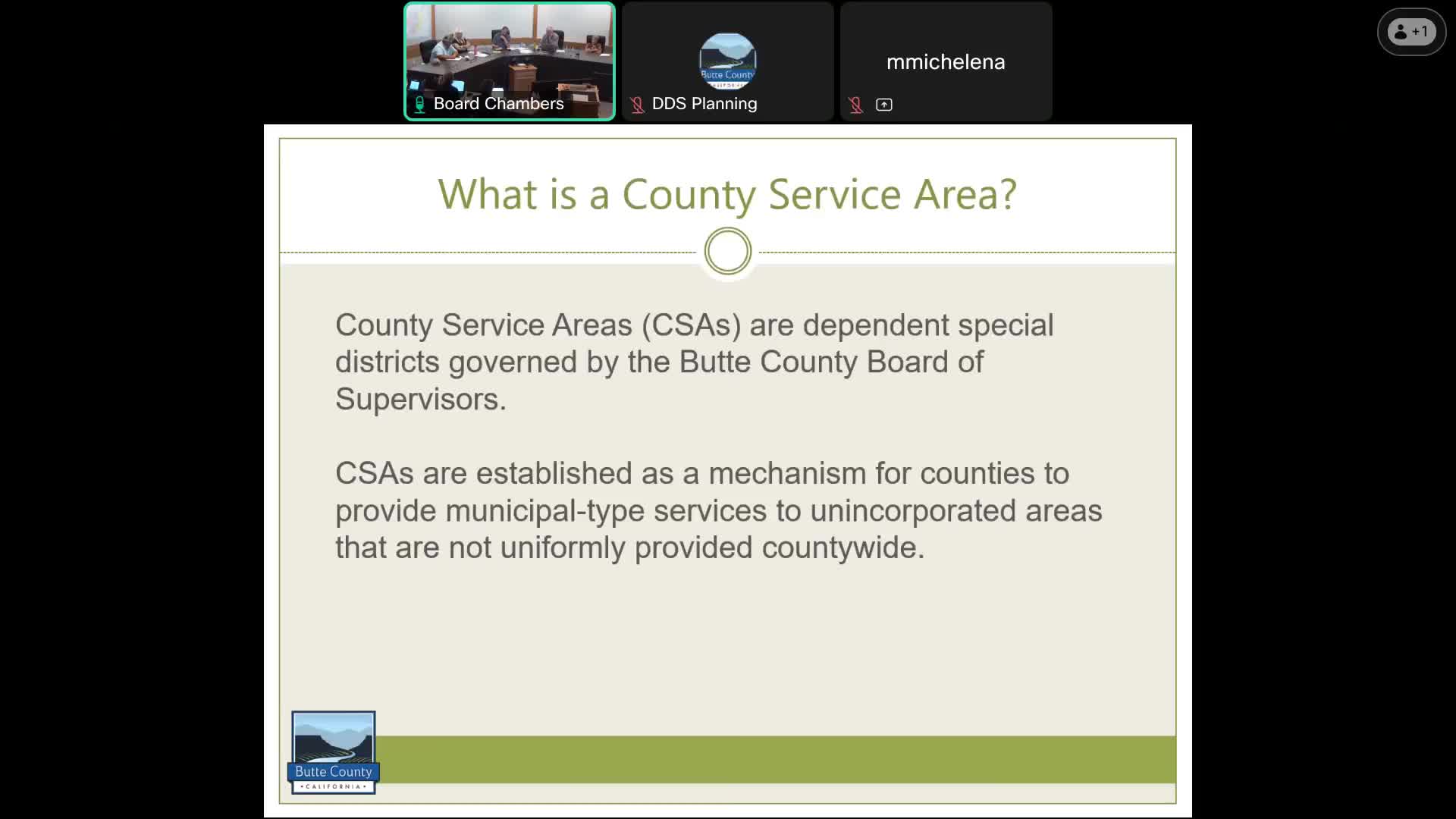
Hunter said the policy was developed after a multi‑year review of CSA finances, statutory changes (including Proposition 13 and Proposition 218) and operating experience. She told the commission the county currently manages 79 unique CSAs and PRDs, and that the patchwork of independently organized CSAs in some areas had created funding, maintenance and equity concerns. "CSAs are dependent special districts governed by the Butte County Board of Supervisors," Hunter said, and she described the differences between CSAs — which are subject to LAFCO review and may fund many services — and PRDs, which are created under the Streets and Highways Code and are specific to roads and related services.
Hunter said the Board directed staff to limit formation of new CSAs and PRDs to core public‑works services — primarily road maintenance, stormwater and drainage — and to require that non‑core services such as wastewater, community water, fire protection and landscaping be handled by other entities (for example, homeowners associations, mutual water companies, or privately managed entities) except in extraordinary circumstances. The policy rescinded a 2013 resolution that had required CSAs to manage community wastewater systems and set a five‑year policy review period.
Public Works and other county departments will address existing CSAs and PRDs on a case‑by‑case basis, Hunter said, prioritizing fiscal problems and health‑and‑safety concerns. She noted the county will look at consolidation options for some small districts — for example, consolidating multiple small lighting districts into a larger lighting district — to achieve economies of scale. Hunter also discussed the constraints Prop. 218 places on increasing assessment rates and explained the county may provide limited short‑term funding for elections or transition efforts but that general fund subsidies for ongoing CSA operations are not the county's standard approach.
Commissioners asked clarifying questions about which existing approved projects the policy would affect and how residents would be informed; staff said the policy applies to projects that have not yet formed CSAs and that detailed financial records for CSAs are public information. Staff also said LAFCO can be used to dissolve or reorganize districts that are inactive or lack funding. The presentation did not require commission action but provided context for several agenda items, including the map extension considered earlier in the meeting.