Get Full Government Meeting Transcripts, Videos, & Alerts Forever!
Get email alerts on the Retiree Earnings Policy topic
No spam. Unsubscribe anytime.
Retiree earnings limits and civil‑service exemptions draw broad support and multiple bills
Summary
Union officials, retired public safety workers and retirement system representatives told the Joint Committee on Public Service that Massachusetts' post‑retirement earnings and hours limits are confusing and constrain municipalities, and urged passage of several bills to modernize the rules.
Representatives of public safety unions, municipal retirement systems and retired municipal employees told the Joint Committee on Public Service multiple bills are needed to modernize post‑retirement earnings and hours limits.
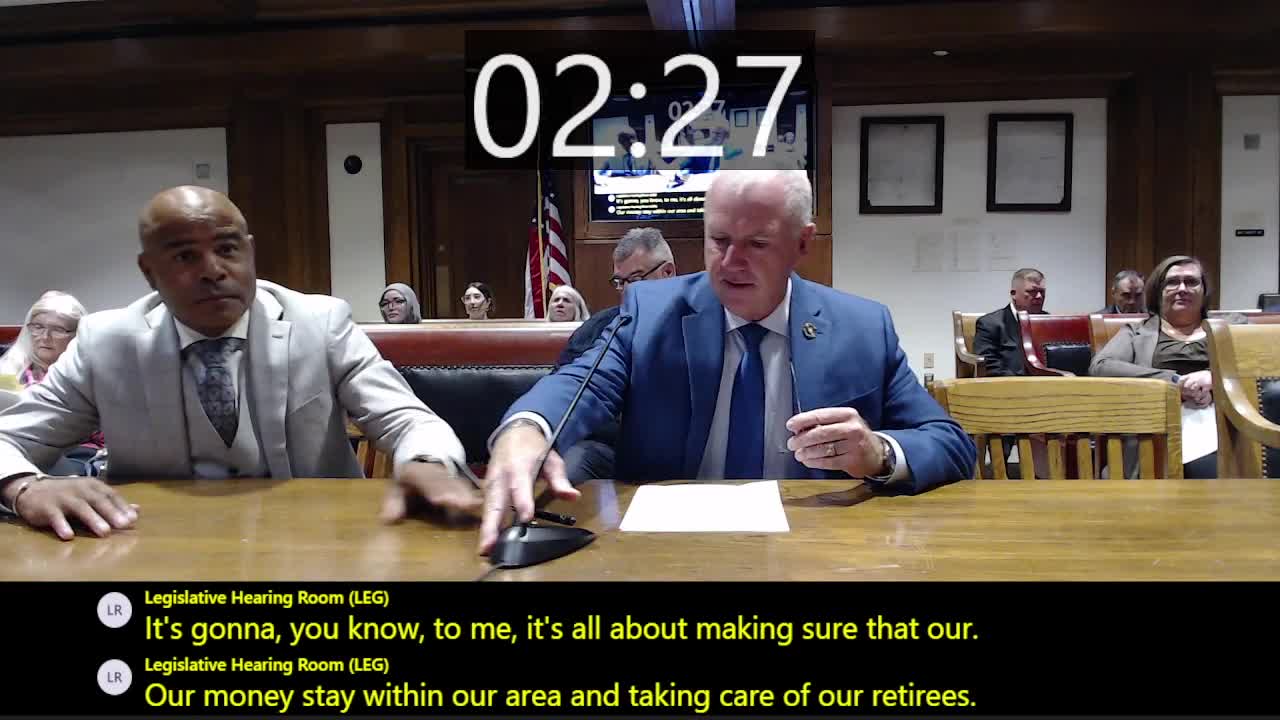
Frank Frederickson, director of governmental affairs for the Massachusetts Fraternal Order of Police, told the committee he supports several bills (HB 2966, HB 4079, SB 1839, SB 1826 and HB 2903) that take different approaches to the same problem: retirees facing legal limits on earnings and hours that keep experienced workers from returning to needed municipal jobs.
Retired officers Edward McDonald and Tim O'Leary of Foxborough described personal reasons for seeking relief from earnings caps and asked the committee to support HB 2903, which McDonald said ‘‘would be extremely beneficial’’ and allow retirees to work without penalty. Michael O'Reilly of the Massachusetts Association of Contributory Retirement Systems (MACRS) said his organization supports HB 2755 to exempt certain professional services (actuarial, auditing, accounting, legal) from hours and earnings limits under Chapter 32, Section 91.
Legislative agents for the Professional Firefighters of Massachusetts and the Massachusetts Police Association and other union representatives submitted written testimony and voiced support for bills including HB 2791, HB 2925, HB 2959, SB 1793, HB 2755 and HB 2791. Jim Machado (Massachusetts Police Association) described the current system as ‘‘complicated, convoluted, and difficult to understand’’ and argued for a ‘‘common sense middle ground’’ that would simplify limits for both retirees and regulators.
The committee heard no recorded votes; witnesses urged the committee to advance proposals that would allow municipalities to hire experienced retirees for time‑limited and specialized needs while clarifying enforcement and reporting.