
Council amends Chapter 20 to change timing and offsets for sewer benefit areas
Get AI-powered insights, summaries, and transcripts
Subscribe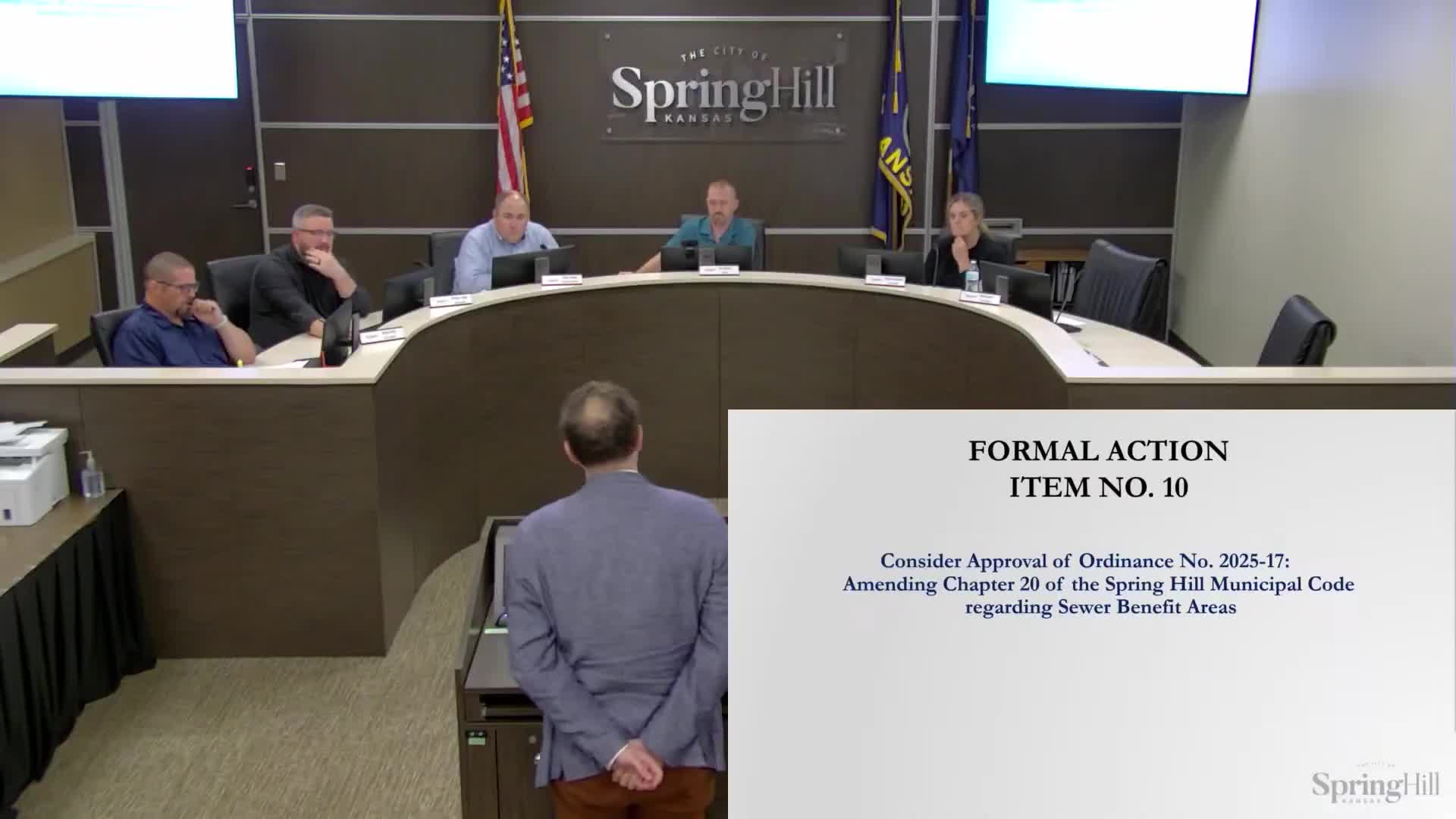
Summary
The council adopted Ordinance 2025-17 to amend Chapter 20 of the Spring Hill Municipal Code, making developer payments due at time of platting and allowing the city to offset acquisition costs for city‑owned infrastructure against hook-up fees in some cases.
Spring Hill City Council on Thursday adopted Ordinance 2025-17, amending chapter 20 of the Spring Hill Municipal Code to change how sewer benefit-area charges are assessed and to allow limited offsets against those charges for certain city real‑estate acquisitions.
Spencer Lau, a staff member who presented the ordinance, said the changes respond to issues found while applying the new sewer benefit-area process earlier this year. The ordinance makes two primary changes: it requires payment when a plat is recorded (payment “due at the time of platting”) rather than up front at district creation, and it allows the city, where appropriate, to offset a landowner’s hook-up obligation by the value of land or easements the city acquired and will own as infrastructure sites.
Mr. Lau said payment on platting spreads the cost across development phases for large, multi‑phase residential projects; the offset provision is intended to avoid the “shell game” where the city pays landowners for easements and then those owners later repay the same dollars when they hook up. As an example, Mr. Lau said, “if they owe us a million dollars and the value of the land is 50,000, well they'll just owe us $950,000 at the time of hookup.”
Council discussion noted the change gives staff additional flexibility when negotiating with developers and avoids penalizing developers who may already have paid for infrastructure. The ordinance passed 5-0.