Get Full Government Meeting Transcripts, Videos, & Alerts Forever!
Get email alerts on the Land Use Permitting topic
No spam. Unsubscribe anytime.
Monroe moves to align permit timelines with state’s SB 5290; first reading approved
Summary
Council approved first reading of an ordinance updating Monroe municipal code to implement timelines and fee rules in Second Substitute Senate Bill 5290 (2023), including revised review clocks of 65/100/170 days, refund requirements if timelines are missed, and housekeeping changes.
The Monroe City Council on Sept. 23 approved first reading of an ordinance to update the city’s project‑permit process to conform with Second Substitute Senate Bill 5290, the 2023 state law that revises permit review timelines. The motion to accept first reading of Ordinance No. 0202025 passed 7-0.
City planner Kate Turla told the council the packet included the planning commission recommendation, findings of fact, a draft ordinance with proposed Monroe Municipal Code amendments, a copy of the state bill and the city’s notice to the Washington Department of Commerce and Commerce’s acceptance for expedited review. Turla said the city has been operating under the new timelines and reported two permits exceeded the required timeframe but were negotiated with applicants.
Turla summarized the revised review clocks the bill establishes: administrative reviews without public input must be completed within 65 days; reviews that require mailed notice (the city’s 500‑foot notice) must be completed within 100 days; and matters requiring a public hearing have 170 days for review. The prior generic 120‑day clock remains in the background for certain cases; statutory stop‑the‑clock provisions for incomplete applications remain unchanged.
The ordinance also updates permit fees to reflect refund obligations when the city fails to meet timelines. Turla said staff submitted permit‑timing data to the Department of Commerce in March and that if the city is found to be out of compliance in 2026, additional actions may be required of jurisdictions.
Councilmember Walker sought clarification about decision authority for certain application types and whether responsibility shifted from the council to the hearing examiner for some items; staff explained the ordinance refines review categories (types 1–6) and that certain type 5 items still come to council while some quasi‑judicial items are examined by other decision makers. Turla also noted staff used the code update as an opportunity for housekeeping across multiple chapters (the agenda bill lists the chapters changed on page 6 of 222) and to address items not updated since the 2019 Unified Development Regulations.
Councilmember Fisher moved and Councilmember Fulcher seconded first reading of the ordinance; the motion passed 7-0.
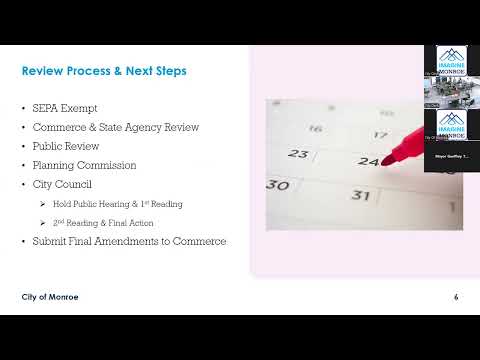
The ordinance now proceeds toward additional readings and adoption steps; staff will provide the required public notice and any follow‑up reports to the Department of Commerce.