Get Full Government Meeting Transcripts, Videos, & Alerts Forever!
Get email alerts on the Donations And Naming topic
No spam. Unsubscribe anytime.
Council reviews proposed donations, sponsorship and naming-rights ordinance; thresholds and public input draw questions
Summary
Deputy City Attorney Doug Ruth presented an ordinance (No. 2938) to update Sumner’s donation rules (code 3.54), add sponsorship and naming-rights sections and raise administrative approval thresholds; councilmembers raised concerns about dollar thresholds and public input on naming decisions.
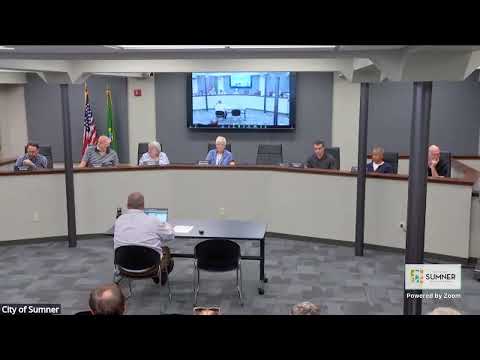
Deputy City Attorney Doug Ruth presented an ordinance update (Ord. No. 2938) at the Sept. 22 study session to revise Sumner’s donation code (chapter 3.54), clarify approvals for monetary and nonmonetary donations, add sponsorship and naming-rights provisions and direct the mayor to adopt implementing policies.
Ruth said the draft increases approval thresholds to account for inflation: the city administrator would approve monetary donations below $5,000, the finance committee would consider donations from $5,000 to $50,000, and donations of $50,000 or more would go to the city council. The ordinance would also require condition donations to be accompanied by a written agreement, confirm donated items become city property, and allow the city to reject donations at its discretion.
On naming rights, Ruth said the city council must approve the naming of city parks and facilities and any naming-rights agreements valued above $50,000; the mayor could approve naming of portions of facilities (for example a room or playground) valued at $50,000 or less. Ruth also said naming-rights agreements would be written, include time limits and warranties, and that only the city council could rescind an assigned name (the ordinance explicitly preserves council authority to rescind names).
Council members raised several concerns. Council member Elpers asked whether finance-committee approvals would bypass council visibility; staff said the finance committee would review and vote at its meetings and only certain items would be referred to council. Council member Andy (Alpers) questioned the sizable jump in thresholds from $5,000 to $50,000 and suggested a smaller middle tier (for example up to $25,000) so the council would see more approvals. He also urged more public input for naming decisions and noted other cities place greater emphasis on heritage and public process instead of commercial naming. Ruth and staff said the draft ordinance allows the mayor or staff to refer donations to council when appropriate and that the city will adopt policy procedures to operationalize public commissions’ review where relevant (parks commission, arts commission, etc.).
Ruth noted the ordinance will not apply to street names and that staff will bring the draft ordinance to the Oct. 6 regular meeting; he invited council members to propose edits in advance. No vote was taken at the study session.