Get email alerts on the Development Code Update topic
No spam. Unsubscribe anytime.
Buckeye planning commission recommends approval of Phase 2 development-code overhaul
Summary
The Buckeye Planning and Zoning Commission on a voice vote recommended approval of PLZM-24-0064, a Phase 2 rewrite and modernization of the city's development code, forwarding the package to the mayor and city council after a public hearing.
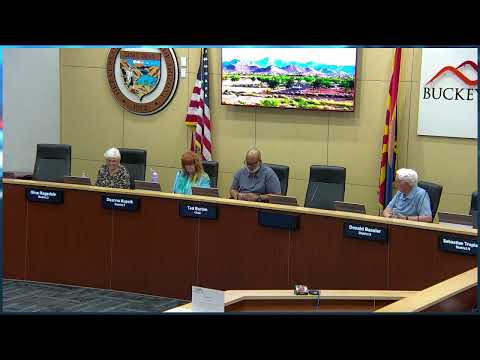
The Buckeye Planning and Zoning Commission on a voice vote recommended approval of PLZM-24-0064, the Phase 2 update to the city's development code, sending the package to the mayor and city council after a public hearing and a staff presentation.
The update, presented by Mandy Woods, principal planner with Development Services, rewrites and reorganizes Chapter 7 (Articles 1'10) and Appendices A'C of the Buckeye Code of Ordinances to modernize use tables and definitions, streamline procedures and add new standards for subjects such as accessory dwelling units, backyard fowl, battery energy storage systems and signage.
Woods said the project builds on a 2024'25 multi-phase effort and on Phase 1 changes adopted earlier, and that staff and consultant Logan Simpson focused Phase 2 on uses, signage, development and design standards, land subdivision and process streamlining. "The recommendation is to conduct a public hearing and then recommend approval of PLZM-24-0064 to mayor and city council," Woods told the commission.
Key changes highlighted by staff include:
- Pre-application protection: Applicants who complete a pre-application meeting would be able to lock in the applicable code for up to nine months, to reduce hardship when the code changes during project preparation.
- Zoning district consolidation: The single-family flex district was removed as redundant and the city consolidated the community master plan district and planned area development (PAD) tools into a single PAD term for efficiency; existing CMP entitlements and overlays remain unchanged and are not automatically converted.
- Uses and use-specific standards: Table 3.1-1 (use table) was reorganized and many use-specific standards were added or revised. New or updated provisions explicitly referenced include compliance additions tied to recent state bills (Woods referenced HB 2721 and HB 2720) and standards for battery energy storage systems (BESS), wireless facilities and marijuana uses.
- Marijuana policy: The rewritten marijuana section preserves the city's long-standing policy to allow medical marijuana dispensaries only; Commissioner Kupczyk asked for clarification and staff said the code "preserves the current policy of the city," limiting retail to medical dispensaries and not allowing recreational retail.
- ADUs and backyard fowl: Accessory dwelling unit (ADU) standards that staff had been implementing by policy will be codified. A new state-mandated backyard-fowl provision allows up to six hens and no roosters at single-family detached residences, subject to enclosure and health-and-safety standards; Commissioner Sebastian asked whether homeowner associations could still restrict these uses and staff confirmed HOAs can impose additional limits.
- Signage: The entire signage article was rewritten to improve clarity and to address content-neutrality concerns raised by the U.S. Supreme Court's Reed v. Gilbert decision. The update adds a district-by-district sign table, graphics for sign-type measurement, an expanded comprehensive sign plan (CSP) process to allow custom sign proposals, and potential future allowances tied to state right-of-way alignments (staff noted SR 30, I-10 and E Route 85 as corridor considerations).
- Subdivision and infrastructure: The subdivision article clarifies block-length standards and allows open-space connections to break block length limits in some cases, adds protections for lots adjacent to T-intersections (landscape tracts or lot orientation), and alters the financial-assurance timing so assurances are tied to civil-permit release rather than final-plat recordation.
- Procedural changes: Design review was codified as a distinct process for residential and commercial projects. Appeals language was rewritten for completeness. A previously drafted hearing-officer section was removed and the authority to hear variance requests was proposed to be delegated to the Planning and Zoning Commission.
- Development and design standards: Article 5 was updated with clarified design standards aimed especially at multifamily and nonresidential projects; the revision adjusts "garage dominance" measures and adds standards for large-format retail. Landscape and lighting standards were expanded.
During the public hearing, Kurt Jones of Tiffany & Bosco, representing the Howard Hughes Corporation and participating as a community advisory committee member, told commissioners his team worked with staff and supported the amendment. "We think the updates are a very comprehensive update. City should be happy with it, and we were happy to be a part of this team," Jones said.
Commissioners asked for clarifications on several items. Commissioner Sebastian asked whether HOAs could restrict backyard fowl or ADUs; Woods confirmed they could. Commissioner Basler praised staff for the effort. Commissioner Kupczyk asked about marijuana provisions and staff responded the rewritten section aligns with state statute and preserves the city's policy limiting retail to medical dispensaries.
The commission closed the public hearing, moved to recommend approval of PLZM-24-0064 to the mayor and city council, and the motion passed by voice vote. The record in the meeting transcript does not include a roll-call tally of individual votes.
Next steps: The recommendation will be forwarded to the mayor and city council for their consideration. Woods said staff expects to continue annual code evaluations and smaller, targeted development-code amendments as needed.
Sources: Staff presentation by Mandy Woods, public comment by Kurt Jones (representing Howard Hughes Corporation), and commission discussion and motion recorded in the Planning and Zoning Commission meeting transcript.
AI generated
The text on this page is AI generated. Summaries, highlights, analysis, and video transcripts are all produced from the original source material.
AI can make mistakes, so if you spot one, and we will fix it for everyone.
Note: the source content is unaltered by us. Any content source we link to, be it a video, an audio recording, or a document, is presented exactly as its publisher released it. That publisher is usually a government body, sometimes an individual official or another organisation.