
TAG debates parking rules for multiplexes, focusing on EV charging and accessibility thresholds
Get AI-powered insights, summaries, and transcripts
Subscribe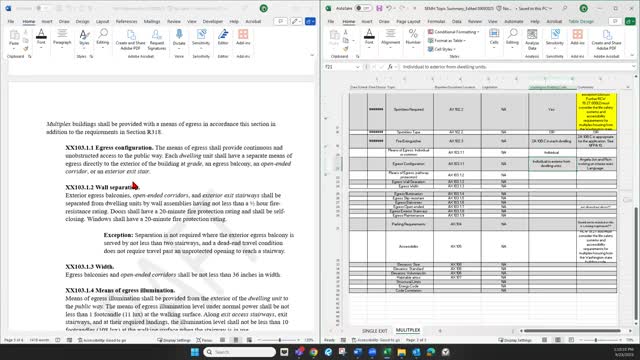
Summary
The Building Code Council technical advisory group discussed whether parking rules for proposed multiplex housing should live in the IRC appendix or remain in the building code, and how EV‑charging and accessible parking rules apply when buildings are treated as R‑2 versus R‑3 occupancies.
Members of the Building Code Council’s multiplex housing technical advisory group debated how parking requirements should apply to the new multiplex appendix and whether electric‑vehicle (EV) charging and accessible parking rules should follow the International Residential Code or point to the International Building Code.
The issue matters because the group is trying to keep multiplexes affordable while ensuring life‑safety and accessibility standards are not reduced. The advisory group considered whether on‑site parking rules belong in local land‑use codes, in the IRC appendix for multiplexes, or by cross‑reference to IBC provisions already covering EV readiness and accessible stalls.
Dustin (staff presenter) opened the discussion and asked whether the group wanted to include parking requirements in the appendix or leave them to local land‑use codes. "My first inclination is 100% leave it to the local land use code and not have it in the appendix," said Derek Hubel, a TAG member.
Others urged a middle path. Jeremy Moore said the appendix could be a pointer: when parking is provided, it should comply with applicable IBC/IRC electrical and accessibility requirements so jurisdictions and builders get consistent guidance. Spencer Gardner warned that pointing to the IBC could import IBC rules that the residential (IRC) industry does not expect.
The group discussed a practical conflict: IBC‑level requirements for accessible parking and EV infrastructure can apply by parking stall count even where an IRC building would not have accessible dwelling units. Marcus (TAG member) summarized the concern: requiring an accessible parking stall for a three‑unit multiplex that lacks any accessible dwelling units could create a mismatch. Several members noted that IBC Chapter 11 (accessibility) ties accessible parking requirements to whether accessible dwelling units (Type A/Type B) are required on a site; that threshold can change depending on whether the project is treated as R‑2 (apartment‑style) or R‑3 (residential single‑family/townhouse style).
Patrick Hanks with the Building Industry Association of Washington and Ardel Jala, building official for Seattle Department of Construction and Inspections, urged caution before lowering statewide EV expectations. Jala told the TAG that the original direction to the State Building Code Council to add EV provisions came from separate legislation (RCW 19.27.540), and that changing scoping here could conflict with that legislative intent.
The group did not adopt a final code text. Members generally agreed to keep accessibility scoping clear—many favored scoping accessible parking so it does not require a stall for three‑unit multiplexes unless accessible dwelling units are required—but to flag the EV charging language for follow‑up so current and pending changes to the IBC/IRC EV rules can be reconciled before a final decision.
Next steps: staff were asked to leave the EV charging language highlighted for further review, to circulate relevant code sections (IBC Table 429.2, IRC R3xx references) and applicable RCW citations, and to return with suggested language clarifying when accessible parking and EV infrastructure requirements apply.