
Vulnerable-adult committee adopts recommendations to improve reporting, training and workforce; schedules public hearing on electronic monitoring
Get AI-powered insights, summaries, and transcripts
Subscribe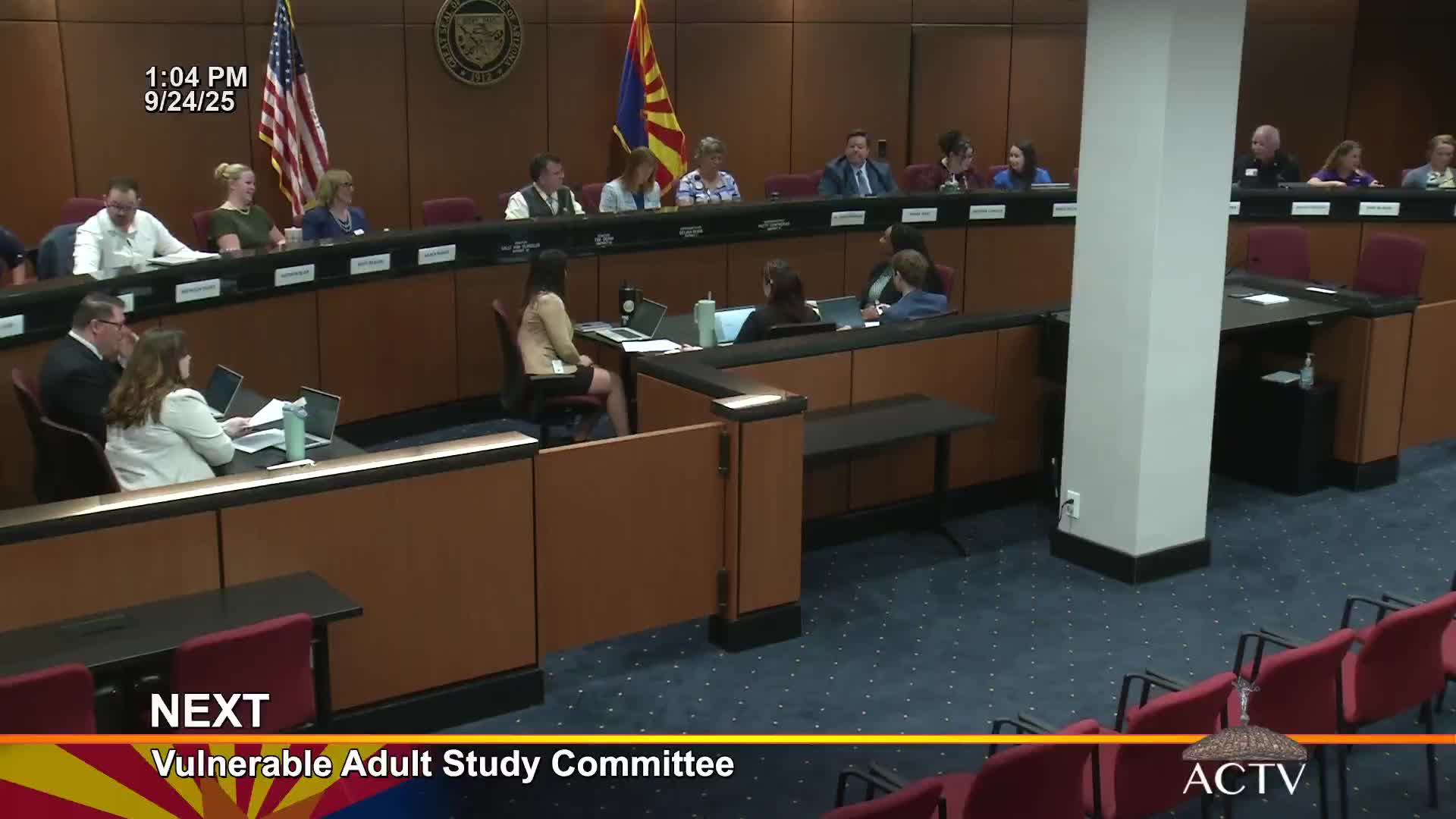
Summary
Arizona—s Vulnerable Adult System Study Committee approved seven recommendations aimed at improving interagency reporting, data systems, workforce training and guardianship processes and voted to hold a separate public hearing on electronic monitoring in assisted-living facilities.
At a public meeting, the Arizona Legislature—s Vulnerable Adult System Study Committee approved a set of seven recommendations intended to better coordinate reporting and investigations of abuse, neglect and exploitation, expand training and workforce pathways for caregivers, and collect statewide data on involuntary discharges and evictions from health care institutions. The committee also agreed to hold a separate public hearing to gather testimony on electronic monitoring in assisted-living facilities and to add findings to its October report.
The recommendations, presented to the committee by Ajane Graham, a House research analyst, direct the Legislature and state agencies to remove barriers to interagency collaboration, invest in data and reporting technology, create a statewide standard operating procedure for cross-reporting, expand training and prevention resources, develop workforce pathways and an expanded registry for paid care providers, and collect and analyze data on involuntary discharges. "The legislature should remove barriers to interagency collaboration between law enforcement, state agencies, boards, and other regulatory bodies involved in investigating abuse, neglect, and exploitation," Graham told members as she read the committee—s final proposals.
Why it matters: Committee members and agency staff said the changes aim to shorten delays and reduce duplication when multiple agencies investigate the same vulnerable-adult incident, make it easier for members of the public and providers to report concerns, and address long-standing workforce shortages in direct care. Several agency representatives warned parts of the package will require new funding and staffing to implement effectively.
Most important actions and details - The committee voted, by voice, to adopt the seven recommendations as distributed; members had multiple opportunities to discuss and amend language before each voice vote and the chair called each motion carried after the ayes. The votes were taken by voice and no roll-call tallies were recorded in the transcript. - The committee directed staff and stakeholders to centralize reporting by creating a user-friendly online form that would automate cross-reporting to law enforcement, Adult Protective Services (APS), licensure boards and other regulators. - The committee recommended creation of a single online database to store and cross-reference reports of abuse, neglect and exploitation so relevant agencies can follow up and see related events. - On workforce and training, the committee recommended establishing apprenticeship-like pathways and stakeholder groups to align training, licensure and certification for direct care workers (DCWs), certified nursing assistants and paid caregivers. Several providers and advocates urged the group to ensure training recognizes caregivers who excel in hands-on care but struggle with standardized tests. As John Scott Williams, a provider representing senior living communities, put it, "My best caregivers—...their gift is mercy, not test taking." - ADHS (Arizona Department of Health Services) staff told the committee a substantial staffing and budget increase would likely be required to expand work in this area: the ADHS representative said the agency—s current estimate to enhance access work is roughly 70 new FTEs and "over a $5,000,000 increase to the access budget," and that an independent consultant to revise assessment tools would likely cost in the "$400,000 to $500,000" range. - On involuntary discharges and evictions, the committee asked state agencies to work together to collect and analyze data on discharges from health care institutions so policymakers can determine whether a systemic problem exists and where. Lisa Pollock of the Long Term Care Ombudsman Program told the committee that among the thousands of complaints her office receives each year, discharge and eviction issues are consistently near the top. - The committee added Recommendation 7 after subcommittees failed to reach consensus on electronic monitoring. The committee directed the Vulnerable Adult System Study Committee to hold another public meeting before Dec. 31, 2025, to receive testimony specifically on electronic monitoring in assisted-living facilities and to issue an addendum to its Oct. 1, 2025 report with recommendations on that issue.
Discussion highlights and agency concerns - Budget and IT costs: Molly McCarthy of the Arizona Department of Economic Security cautioned that "recommendations 1 through 5 have a budget component" and that implementing state data technology and centralized reporting will likely require additional funding and FTEs. An ADHS representative gave the committee the numerical estimate cited above to illustrate scale. - Data compatibility: Tony Brown, a member of the developmental-disabilities work group, warned that "one of our biggest hurdles is going to be a compatibility of computer systems," arguing that long-term benefits would outweigh the initial investment if agencies can share information reliably. - Workforce pathways and registry design: Stakeholders including providers, community-college instructors, and advocates favored an apprenticeship-style pathway and cross-walking existing credentials so caregivers can receive credit for prior learning and avoid unnecessary duplication. Committee and provider speakers emphasized starting with a voluntary, positive registry listing caregivers— qualifications and current training rather than a punitive database. - Discharges vs. evictions: Participants debated terms and legal processes. Providers described required notice and documentation practices under Arizona rules and the landlord-tenant framework; advocates and ombudsman staff argued there is value in collecting standardized data to identify any problematic patterns, especially in smaller facilities or alternative care models.
What the committee did not decide - The committee did not adopt operational specifics for the online reporting tool, the schedule for implementation, or exact funding mechanisms; members repeatedly noted those details would need to be hashed out in stakeholder groups and, ultimately, in budget requests or legislation. - The committee did not reach consensus on electronic monitoring; it chose to hold a separate public meeting with testimony and to include recommendations in an addendum to the Oct. 1 report.
Next steps and timeframe - Staff will prepare the committee—s Oct. 1, 2025 report and an addendum on electronic monitoring after the public hearing, which the committee asked to schedule before Dec. 31, 2025. - Stakeholder working groups and relevant state agencies were directed to continue discussions on data architecture, standardized training curricula, apprenticeship pathways and a voluntary registry for paid care providers; several agency representatives warned the work will require additional budget allocations and personnel.
Ending Committee leaders and members repeatedly emphasized the recommendations are an initial step toward longer-term reforms: they said the changes are intended to improve efficiency, protect vulnerable adults, and provide clearer pathways for caregivers, while acknowledging that many items will require additional legislative or budget action to implement fully.