
Public split as Shepherdsville council hears first reading of Mark 12’s Grace Village rezoning request
Get AI-powered insights, summaries, and transcripts
Subscribe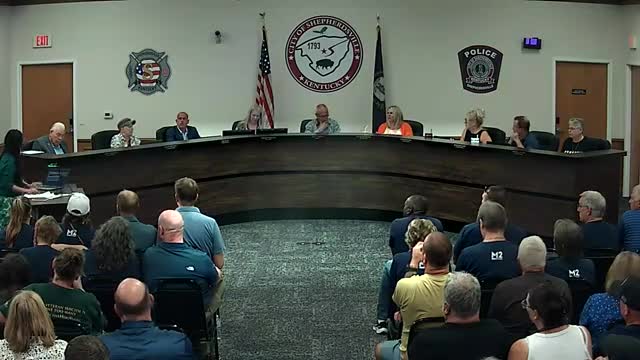
Summary
Mark 12 Ministries presented a site plan and public testimony for Grace Village, a proposed transitional housing community with six bunk houses, a community building and a thrift store; the Bullitt County Planning Commission recommended approval with conditions and the council set a second reading after an extended public hearing.
Mark 12 Ministries on Monday presented a revised site plan for “Grace Village,” a proposed transitional housing community on Old Preston Highway and Charles Hamilton Way, and the Shepherdsville City Council held a lengthy public hearing that produced dozens of speakers both in favor and opposed.
Emily Vessels, representing Mark 12 Ministries, described the proposal as a residential transitional program for people who have completed an initial recovery program and need structured, short‑ to medium‑term housing and services. The organization proposed six bunkhouses (two of the bunkhouses reserved for veterans), one community building with toilets/showers and laundry, a manager’s residence in an existing house on the site, and an expanded Outreach Thrift store. “This proposed development would allow for this community to have that type of resource,” Vessels told the council.
Why it matters: The council considered three zoning ordinance changes (dockets 2025Z‑29, 2025Z‑30 and 2025Z‑31) that would rezone approximately 0.98, 2.60 and 2.94 acres from agricultural (AG) to B‑1 highway business and B‑2 central business for the thrift store and the transitional housing components. The planning commission voted to recommend approval with two specific technical conditions: (1) provide floodplain mitigation at a minimum 1.5:1 ratio (pooled across parcels as needed) unless a higher standard is required by other authorities, and (2) reduce the predevelopment stormwater discharge by 75% (pooled across properties).
What proponents said Dozens of supporters — including clergy, veterans, thrift‑store volunteers and program graduates — told the council they have worked with Mark 12 and the Pathway Home program and urged approval. Supporters described the program as structured, outcome‑focused and supervised; named partners included Isaiah House, the Kentucky Baptist Convention and UofL Peace Hospital. Several pastors and volunteers described personal experience hosting the program’s participants at churches and noted few problems in those arrangements; executive director Perry (last name not stated) and program director Rob Sarver (a program graduate) and other staff described intake vetting, random drug testing and daily scheduling that includes work, transportation and evening check‑ins.
Rob Sarver, Pathway Home program director, said the program “provides housing. We assist with getting jobs. We do transportation, to help people get back on their feet. We are very structured programming.” Several speakers who identified as veterans or veteran‑service partners emphasized reserving two bunkhouses for veterans. Proponents also said the thrift store funds program operations and that expanded store revenue will support Grace Village.
What opponents raised Nearby residents and other opponents raised public‑safety, property‑value and floodplain concerns. Opponents said the site has a history of flooding and asked whether a detention/compensation basin would work in practice; others worried about increased traffic on Cedar Street and Hackberry Lane and the potential for unsolicited drop‑offs at the thrift store.
Speakers questioned whether the bunkhouses meet local building‑code definitions for residential units when the individual living units lack in‑suite bathrooms (the plan places showers/toilets in a shared community building). One resident asked why the use was proposed under B‑1 (highway business) and not an R‑3 residential classification; the planning director’s interpretation — explained at the hearing — is that the regulatory text does not clearly contemplate transitional housing, and staff used the closest comparable category (tourist camp / B‑1) while adding specific use restrictions to the zoning ordinance. Proponents said the design intentionally locates the bunkhouses as minimally comfortable to encourage participants to engage with program services.
Technical and process points - Planning commission conditions: council heard that the planning commission recommended a minimum 1.5:1 floodplain mitigation (can be pooled across parcels) and a 75% reduction in predevelopment stormwater discharge; both requirements were included as restrictions to the zoning recommendation. - Site plan changes: the applicant revised the plan after the planning commission to move bunkhouses away from adjacent residences, enlarge the detention basin, and add access connections to Hackberry Lane and Cedar Street (the applicant is open to discussing limiting those connections to emergency access or posted hours). - Regulation gap: the planning director said current local regulations do not specifically address transitional housing and that the “tourist camp” designation was a planning‑director interpretation because the code lacks a specific category for tiny‑home bunkhouse style transitional housing. The city and county are planning regulatory updates.
Formal action and next steps The council conducted first readings of three zoning ordinances (025035, 025036, 025037) reflecting the planning commission dockets. The items were introduced and read; the council scheduled second readings for the next regular meeting (October 13, 2025) to allow additional information and for applicants and opponents to continue dialogue. Mayor Jose Cabero urged both sides to keep discussing technical questions such as access controls, thrift‑store drop‑off hours, and detailed stormwater calculations; the administration and applicants agreed to provide additional documentation to the council before the second reading.
Clarifying details from the presentation - Proposed capacity: six bunkhouses with two reserved for veterans, total capacity 12 participants (two per bunkhouse as shown in plan). If veterans do not occupy their reserved bunkhouses they remain vacant rather than repurposed, per the applicant’s statement. - Community building: a single community building will contain showers, toilets and laundry (three sets of facilities were described: one each for veterans, men and women); proponents said this design is intentional to keep housing modest and encourage community engagement. - Stormwater/flood mitigation: planning conditions call for at least 1.5:1 floodplain compensation and a 75% reduction in predevelopment peak discharge; applicant said detailed hydraulic calculations and permitting with the Kentucky Division of Water, FEMA mapping agencies and the city engineer will be required during site‑plan review.
Ending The council left the rezoning matters open for a second reading on Oct. 13 and asked the applicant to provide requested technical and operational details. The hearing demonstrated split community opinion: many religious and social‑service partners urged approval as a measured response to homelessness and post‑treatment housing needs; many nearby residents urged caution over flood resilience, traffic and neighborhood impacts.