
Ad hoc Right-of-Way Committee asks attorneys to draft broader ordinance on sidewalk obstruction, storage and sitting
Get AI-powered insights, summaries, and transcripts
Subscribe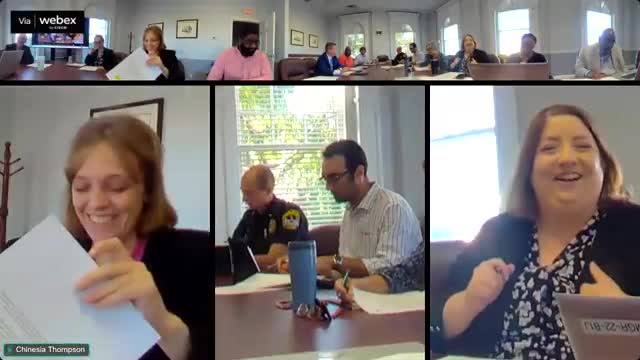
Summary
The committee met Oct. 3 to consider expanding the county''s obstruction ordinance to cover storage of personal property, sitting/lying on public rights-of-way and other public-area encroachments; staff will return draft language and follow-up data to the committee at its next meeting Oct. 10.
The Right-of-Way Use Committee, an ad hoc committee of the Banner Commission, met Oct. 3 to consider revising local rules that govern use of public rights of way, including when sitting or leaving property in a sidewalk, greenway or other public area should be treated as an unlawful obstruction.
Committee members directed the attorney''s office to prepare draft ordinance language that would expand the current obstruction rule, asked police and municipal court to confirm citation locations, and asked staff to return options for handling abandoned property at the next meeting, scheduled for Oct. 10.
The committee is considering a narrower enforcement standard and clearer definitions because the existing county obstruction ordinance (listed in staff materials as county ordinance 3-5-23) has produced few citations and is difficult to apply in practice.
"The core of our mission here today. And that really is the public rights of way and allowable uses," Mayor Kelly Gertz told the group as the discussion began. The mayor and staff framed the work as two related questions: when a person''s presence or posture in a public right of way creates a public-safety hazard, and when material left in a right of way should be treated as storage or abandoned property rather than a temporarily accompanied item.
Data presented by the police department highlighted the enforcement gap staff described. Deputy Chief Harrison Daniel said municipal-court records show 12 citations issued under county ordinance 3-5-23 between Jan. 1, 2024, and Sept. 30 (date range presented in the meeting materials); those cases included eight arrests that were associated with other criminal offenses. Daniel''s office also ran a wider review of calls for service and identified about 69 incidents during the same period that analysts judged likely to relate to sidewalk obstructions, though those calls did not necessarily result in citations.
"We had issued 12 citations specifically under county ordinance 3 5 23, which is obstructing sidewalk," Deputy Chief Harrison Daniel said. He and other police representatives warned committee members that the department''s record systems do not directly tag every call as an "obstruction" in a way that easily separates sidewalk-only incidents from complaints about business ingress/egress.
Staff attorneys suggested taking model language from other cities that address "improper use of public areas" or "urban camping" to expand the definition of where and how an encroachment can occur. Senior attorney Courtney Davis said the committee''s existing tool is the March 5, 2023, ordinance (3-5-23) but that other jurisdictions''ordinances include language on storage of personal property, medians and other public areas not limited to sidewalks.
"I think there's a good opportunity to look to these other communities," Courtney Davis said, naming Rome, Gainesville, Atlanta and Asheville as examples staff reviewed. Davis warned that the city''s code references the phrase "right of way" many times, and adopting a broad, universal definition would require careful cross-checking to avoid unintended conflicts with other code sections.
Parks and solid-waste staff described the operational procedures they already use. Alex, a parks staffer, said parks enforcement generally follows a 72-hour sticker-and-notice practice for abandoned personal property in park facilities and that contracted crews typically remove items rather than city staff storing them.
"We actually do sticker," Alex said, describing the parks team''s process of posting a 72-hour notice and attempting outreach before removing items. Parks staff said they do not typically store removed items because of liability and safety concerns; solid-waste staff noted an ordinance reference showing a 96-hour limit for abandoned property on streets and sidewalks in some code sections.
Transit and public-safety staff urged caution about policies that require storing collected items. Hassain, a representative of the transit authority, said transit facilities generally avoid storing unknown property because of the safety risk posed if a package contains hazardous materials. Multiple staff members noted workers' safety and potential exposure to needles, fentanyl or damaged batteries in removed property.
Committee members discussed timeframes for treating property as abandoned and whether precise hour-based rules (for example, 1 hour, 72 hours or 96 hours) are the right approach. Several members and staff favored leaving more procedural discretion to officers and staff, with a reasonableness standard and written operational guidance to reduce inconsistent application.
Members also raised free-speech concerns. Staff said attorneys would need to craft language that avoids unduly restricting constitutionally protected expressive activity such as peaceful demonstrations or petitioning, while still allowing enforcement when an occupation of space materially interferes with movement or safety.
Courtney Davis said she would prepare draft ordinance language that errs on the side of inclusiveness of terms ("public area," "right of way," storage of personal property) and return it for committee review. Staff also committed to recheck municipal-court records to confirm the locations of the citations that were included in the report and to bring options for abandoned-property handling, including operational and liability tradeoffs, to the Oct. 10 meeting.
Votes at a glance: - Motion to approve the Oct. 3 agenda with an amendment to add an item to approve the September minutes: motion and second not clearly attributed in the record; committee voice vote recorded as in favor; outcome: approved. (Recorded in meeting audio and agenda.) - Motion to approve the September minutes: motion by Commissioner Myers; second by Commissioner Fisher; voice vote recorded as in favor; outcome: approved.
Next steps and timeline Courtney Davis, senior attorney, will circulate a draft ordinance that expands definitions of public area, encroachment and storage and will include exemption language for protected expressive activity. Police and municipal-court staff will confirm the addresses associated with the 12 cited cases and the roughly 69 call-for-service incidents and report back. Staff will also return options for abandoned-property operations, including whether and how the city would store items, contract with a third party, or use partner organizations.
The committee scheduled its next meeting for Oct. 10 to review the draft language and operational options.
Ending Committee members and staff emphasized they want a workable, constitutional ordinance that gives field officers and operational staff clearer authority and procedures while minimizing unintended consequences for everyday uses such as temporarily parked bicycles or lawful expressive activity.