Get Full Government Meeting Transcripts, Videos, & Alerts Forever!
Get email alerts on the Parks And Culture topic
No spam. Unsubscribe anytime.
Seattle Center seeks funding for campus repairs, waterfront operations and safety ahead of major events
Summary
Seattle Center briefed the Select Budget Committee on a proposed 2026 budget that shifts maintenance costs onto earned revenue funds, funds pedestrian safety barriers and fire‑system repairs, and continues waterfront operations and a tribal heritage/operations center at the Pike Street site.
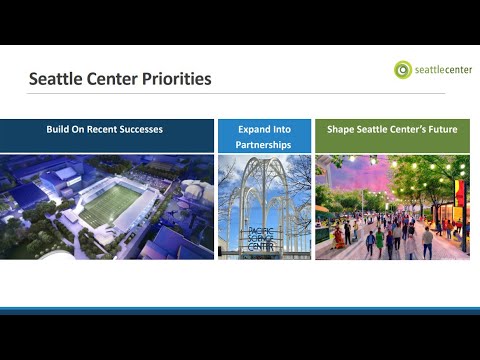
Seattle Center Director Marshall Foster told the Select Budget Committee the department’s 2026 proposed budget prioritizes safety, partnership expansion and reinvestment in the campus and waterfront, citing a return to pre‑pandemic attendance and the need to maintain aging systems. “Our mission is to create exceptional events, experiences, and environments that inspire the human spirit and build strong communities,” Foster said during the briefing.
The department said it is largely self‑funded: about 70% of its operating expenses are covered by earned revenue from parking, facility and event fees, long‑term leases, concessions and monorail concession payments. Dematrice Winston, deputy director and director of finance and administration for Seattle Center, told the committee the department expects roughly $17.5 million in general fund support in 2026 and about $41 million in other funds, the majority earned on campus.
Seattle Center asked for one‑time investments to maintain public safety and avoid operating failures. The presentation listed a pedestrian safety barrier investment to separate people and vehicles during large events and daily activity, and a replacement of fiber optics for a failing fire‑alarm system after an earlier failure increased operating costs. The department said those investments are safety‑driven rather than discretionary.
Committee members focused on the waterfront, which Seattle Center began managing in mid‑2023. The department described a partnership model in which Seattle Center provides day‑to‑day maintenance and public‑safety staffing while Friends of Waterfront Park and other non‑profits support programming. Seattle Center said the waterfront operations have completed regular inspections and hundreds of maintenance work orders and that its emergency services unit has completed tens of thousands of public‑facing interactions, most of them non‑enforcement help for visitors.
The department proposed $1.65 million in one‑time waterfront spending from 2024 carry‑forward and advanced funding for continued waterfront operations through the Metropolitan Park District allocation and a six‑year agreement with Friends of Waterfront Park. The budget package also advances funds to acquire and improve the historic Backend Building at the foot of Pike Street to create a waterfront operations and tribal heritage center in partnership with the Muckleshoot Tribe; Foster said construction would start after next year’s FIFA World Cup fan events.
Members asked about the monorail. Foster said the monorail — owned by Seattle Center and operated under concession by Seattle Monorail Services — runs without a general fund subsidy and returns a negotiated concession payment to the department; that payment is used to fund free public programming such as festivals. He said the department monitors the monorail operator’s capital maintenance program and is working with the operator to secure and fabricate replacement parts that are no longer manufactured.
Committee members also requested more detail on capital reinvestment needs across the 74‑acre campus, including Memorial Stadium redevelopment and deferred maintenance challenges that have caused intermittent power and system outages. Foster said the department is preparing a 10‑year strategic plan that will address revenue diversification, partner support and physical reinvestment in the campus. No formal votes were taken during the briefing.
Seattle Center said it will return to committee with additional detail on capital reinvestment needs and a strategic plan for the campus and waterfront; staff also said they will coordinate with SDOT, Parks, and other city departments on public safety and operations matters.