Get Full Government Meeting Transcripts, Videos, & Alerts Forever!
Get email alerts on the Municipal It topic
No spam. Unsubscribe anytime.
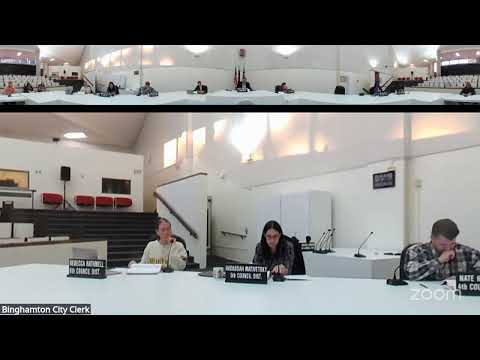
Binghamton council hears IT budget increases tied to ARPA licensing and police equipment
Summary
At a Binghamton City Council budget hearing Oct. 9, Wayne, the city’s information technology director, told council members the IT department’s personnel budget is largely stable but that increases in hardware and software maintenance are driven by ongoing licensing obligations from prior ARPA-funded projects and new public-safety equipment needs.
At a Binghamton City Council budget hearing Oct. 9, Wayne, the city’s information technology director, told council members the IT department’s personnel budget is largely stable but that increases in hardware and software maintenance are driven by ongoing licensing obligations from prior ARPA-funded projects and new public-safety equipment needs.
The overview: Wayne said personnel costs show only “year-over-year increases” with no new positions and that overtime and temporary-services costs have declined after a transitional hire ended. He attributed the main budget increase in the citywide hardware/software line to licensing commitments that began during COVID and are now recurring city expenses. “We had some ARPA funded projects ... that have ongoing licensing fees,” Wayne said.
Why it matters: Council members flagged the increases because the licensing obligations create recurring costs rather than one-time capital outlays, and because the IT budget now includes recurring expenses tied to police technology such as body-worn camera licenses and mobile data terminals (MDTs) used in patrol cars.
Major budget drivers and vendor arrangements: Wayne said wireless and IoT costs rose mainly from adding devices; the city uses Verizon for those lines. He identified a security contract with a vendor referred to as Broom Security that covers staffing for public meetings, and noted modest increases to cover ad hoc meetings and supplier rate changes. He also said the city pays a county GIS fee as a shared service.
Police hardware and MDTs: Wayne described a planned multi-year replacement schedule for in-car computers (MDTs), saying the department is buying equipment now to replace “at least 3 to 4 cars this year” and expects ongoing end-of-life replacements next year. He explained that MDT replacement requires mounts, wiring harnesses and a custom configuration for each vehicle and that costs are split between vehicle procurement (mounts/wiring handled by police) and IT (the computer units and licensing). “We are securing what we can with the capital we have and making active purchases right now to get at least 3 to 4 cars this year,” Wayne said. He acknowledged that the fleet’s readiness is below ideal while replacements proceed.
Technical services and software contracts: Wayne said technical/consulting spending fluctuates by project and that recent internal projects — backup infrastructure and migration to a new remote monitoring and management (RMM) platform — contributed to higher third‑party hours. He offered to meet privately with council members about specific elements of the hardware/software line that the department cannot discuss in public for security reasons.
Public-facing software and training: Council members asked about the city’s use of its enterprise software (referred to conversationally as Munis/Municity). Wayne said IT provides training and supports domain holders in other departments who control usage; he encouraged joint conversations with those domain holders about public-facing features. He also reported increased travel and training funds to broaden staff skill sets, including public-safety-focused conferences and a general training subscription the department plans to subscribe to.
Security at meetings: One council member raised concerns about gaps in security screening prior to 5 p.m. meeting starts and asked whether staffing or scheduling changes could reduce the window when entrances are unsupervised. Wayne acknowledged the concern, said the city could ask the security contractor to arrive earlier or build a buffer into schedules (with added cost), and noted that metal-detector screening at the council entrance is not under the police department’s purview.
Cost-saving and life‑cycle practices: Wayne said the department emphasizes repairability and extending hardware life where possible (for example, upgrading components to meet Windows 11 requirements) and has reduced reliance on outside consultants as staffing has improved. He also said the city does not permit mixed mobile-device platforms for management reasons: the mobile device management solution requires Android devices, so the department does not supply iPhones for individual requests.
Other capital priorities: Wayne listed plans to replace a main camera server, phase in a new audio system in the council chamber, and repair or replace end-of-life security cameras at city hall and the new parking garage. He said the parking‑garage camera installation is functioning as intended and stakeholders are satisfied with how feeds are recorded and transmitted.
Next steps: The council kept the IT budget pages open for further review and Wayne offered to meet with council members to discuss sensitive technical details in a closed session or separate briefing.
Ending: Council members and staff signaled further follow-up on public‑facing software features, security staffing at public meetings and the MDT replacement schedule as the department refines final capital requests.